Great Ideas: Management & Leadership Week in Review

October 14, 2011 by · 1 Comment
Filed under: Professional Growth 

Note from Art: My blogging patterns tend to change with the seasons, and now that summer has faded nicely into fall and I’m no longer migrating Up North every Friday, it’s time to bring back the Week in Review posts. Every week (ok, that’s not a promise, but an aspiration), I’ll offer a few articles/posts and an occasional book suggestion, that I believe are worth sharing and worth thinking about and even acting on in our lives. The topics will be eclectic with a slight emphasis on management and leadership. Enjoy!

-Speaking of eclectic, here’s an outstanding essay entitled: “My Years in the Wilderness” from author, Steven Pressfield, that stopped me in my tracks. Pressfield’s historical fiction is remarkable, and I truly love his content on “The War of Art,” applicable to anyone who is striving to achieve something and laboring to fend of what Pressfield describes as, “resistance.” This is another extremely personal essay on “The War of Art,” and while the emphasis is on the struggle to write, the message is broadly applicable to all of our endeavors to create and achieve.

-Jesse Lyn Stoner writing at Harvard Blogs offers us, “Diagnose and Cure Team Drift.” We’ve all been participants in teams or committees that started with a bang and ended with a whimper. Jesse offers us some tools to recognize and deal with the drift. As an aside, if you’ve not checked out Jesse’s work with Ken Blanchard, “Full Steam Ahead, 2nd edition,” you’ve missed the best book I’ve yet encountered on this often abstract topic. Jesse and Ken make it real and practical. (Also, check out my podcast with Jesse!)

-A Book Selection: Beyond Performance, by Scott Keller and Colin Price. This is a research-based book offering some fresh thinking on what it takes to create and sustain high performance over time. While this topic is the equivalent of the search for a unified theory of everything to business researchers and consultants, for the first time in a few decades, I’m optimistic that there’s a work-product here that moves us closer. The concept of Organizational Health, backed by a decade’s worth of research, offers some compelling and actionable ideas and a lot of evidence. As much as I love Jim Collins, I’ve been looking for something to fill that empty gap on my bookshelf,  left by my disposal of Good to Great.

-From Tanveer Naseer, a thoughtful and thought-provoking piece on, “What Does the World Really Need from Today’s Leaders?” Tanveer raises some important issues in a world that is seemingly begging for effective leaders and leadership. This merits consideration and discussion, and Tanveer’s mini-manifesto here is a great place to start. Visit for the essay and stay for his consistently great content.

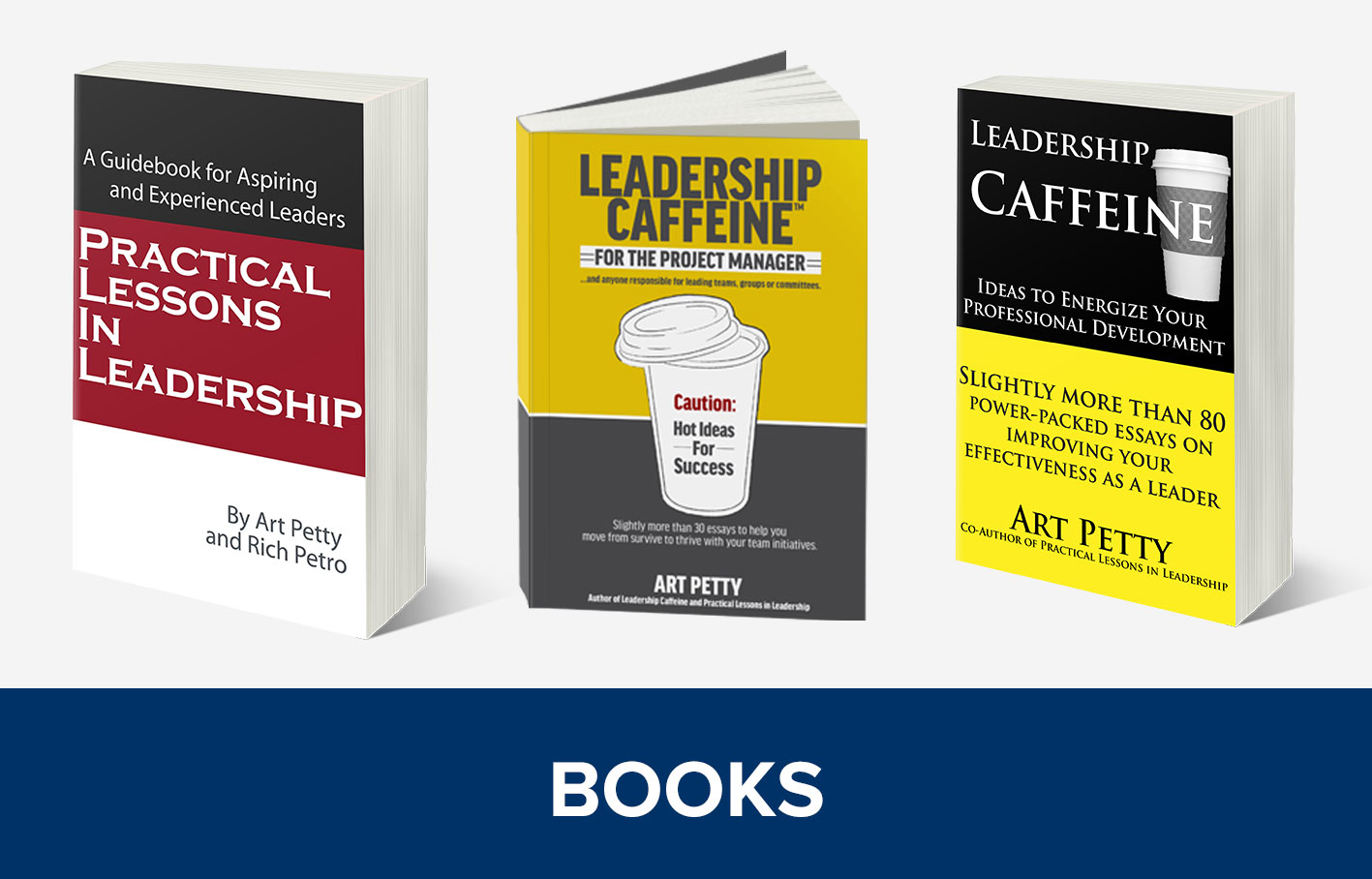
JUST RELEASED! Check Out Art’s New Book: Leadership Caffeine-Ideas to Energize Your Professional Development

More than 80 quick reads filled with ideas to lead teams, manage yourself, survive the tough days and generally improve your performance and success as a professional. This book is ideal for motivated professionals and it is particularly powerful for teams and leadership and performance discussion groups. Take advantage of my group book promotion while it lasts!

Want More: Sign up for the new, Leadership Caffeine e-Newsletter. (publishing in October)  I’ll guard your e-mail address with ferocity, while sharing ideas to energize and inspire.

About Art Petty:

Art Petty is a Leadership & Career Coach and Strategy Consultant, helping motivated professionals of all levels achieve their potential. In addition to working with highly motivated professionals, Art frequently works with project teams in pursuit of high performance. Art’s second book (an edited, annotated collection of the most popular leadership essays), Leadership Caffeine-Ideas to Energize Your Professional Development, was released at the end of September in 2011.

Contact Art via e-mail to discuss a coaching, workshop or speaking engagement.

April, 2011 Leadership Development Carnival

One of the highlights of every month for me is wandering through the great content at the latest Leadership Development Carnival. Many of my favorite leadership and management writers and thinkers are represented, and it is truly fun to find so many ideas and insights under one roof.

Thanks to Sharlyn Lauby, author of the excellent blog, HR Bartender, for hosting this month’s edition. I’m pleased to be in such great company with my recent post on building a tenacious culture, and I’m thrilled to see so much outstanding content to explore.  OK, it’s time for me to quit blathering and head over to the Carnival.

I’ve got a sudden craving for cotton candy and some great leadership reading!  See you on the Midway!

Suddenly, Deming is Relevant Again

demingIn my opinion, he’s never been irrelevant as a management philosopher, teacher and advisor, but our fast-moving, idol-for-a-minute, fad-crazed modern culture, we’re quick to write off those thinkers and doers from prior eras as yesterday’s relics…interesting perhaps, but irrelevant.

If you are a younger reader, the man that I am referencing in this post is W. Edwards Deming, the late and in my opinion, great management philosopher and consultant. Dr. Deming is certainly well known in quality circles (bad pun intended), but scour today’s current management books and if you’re lucky, you might find an occasional reference.  Fascinating treatment of a man that inspired and guided the rebuilding of a country (Japan) and that spent his last years trying to “keep American companies from committing suicide.”

Through no fault of their own, my recent informal polling of some really sharp university students (undergraduate and graduate), I found through the “show of hands” method that very few had ever heard of Deming, and those that knew the name didn’t really know much about him.

I refuse to let a group of talented emerging professionals run through any management course of mine without spending some time with Deming, and introduced them via a 15-minute interview that he conducted in 1984, entitled “Management’s Five Deadly Diseases. I encourage you to do the same.  It’s fifteen minutes of pure Deming in his affected, slow and hard to understand speaking-pattern, filled with wisdom for managers that transcends time.  I’ve added this and a few other readings to your homework list below.

Following my Tuesday night showing of this video, I caught up with one of my favorite management thinkers, Bret Simmons at his Positive Organizational Behavior blog in a great post, “Toyota’s Quality Mess: What Would Deming Say?” Bret and I exchanged some notes reinforcing the impact that Deming’s work has had on both of us in our careers.

Homework for Your Career:

If you are curious to learn more and improve your understanding of the role of a manager and perhaps improve your performance, consider this homework list:

  • Visit the Deming Institute and learn more about his “Theory of Profound Knowledge” and his “14 Points for Management.”
  • And if you’re really into it, find a copy of Out of the Crisis” and shudder at the parallels and still relevant lessons.

The Bottom Line for Now:

I’m most definitely in the camp that says that the science and art of management have not moved forward much in the past 100 years and that has to change.  I’m also critically concerned about learning from the past and understanding the wisdom of those that came before us.  We’ve not yet moved beyond the flaws and failings that Deming saw clearly in the management practices of the industrial revolution. And in fact, the only way that we will move forward is through conscious effort, or should I say, “constancy of purpose.”

You owe it to yourself, your career and your firm to understand and learn from this great man.   I’ve outlined the homework.  The test results will be visible at the end of your career.

Leader, What Are You Doing to Improve Your Value Creation?

December 26, 2008 by · 1 Comment
Filed under: Leadership, Leading Change, Management Innovation 

How much value are you creating as a leader?

How much more value can you create?

How are you supporting the ability of your customers (employees) to create value? Where should you improve to strengthen your value creation?

What are your core processes as a leader?

How much waste do you generate through your leadership activities?

Borrowing from the principles espoused in “Lean” these are just a few of the key questions that every leader should ask himself/herself as part of their own personal development initiatives. Unfortunately, in my experience, few if any of these questions are asked or answered either by individuals or their direct leaders.  This has to change.

In a world that is begging for radical reinvention of business and leadership practices, the organizations and individuals that are diligent in pursuit of the answers to these and related questions will make it through the storm.

Leadership should be one of the principal value creation components of the management system, yet  poor leadership practices often result in increased complexity, added waste and blocked attempts to streamline processes and make improvements that would otherwise benefit the organization and its customers.

One of the key reasons that leaders and leadership practices often fail to create value (or to create more value) is the lack of a common operational and actionable definition for the role of a leader.  Another cause is the lack of top management commitment to ensuring that leaders are accountable for ever-increasing contributions to the firm’s value creation mission.  I’ll focus on the former in today’s post.

During the course of my career, I’ve developed and leveraged something that I describe as The Leader’s Charter, to help develop other leaders as well as to remind me of my True North as a leader. It reads as follows:

The Leader’s Charter:
Your primary role as a leader is to create an environment that:

•facilitates high individual and team performance against company and industry standards…

•supports innovation in processes, programs and approaches…

•encourages collaboration where necessary for objective achievement…

•promotes the development of your associates in roles that leverage their talents and interests and challenge them to new and greater accomplishments.

As I sit here and think about the Charter’s application and relevance for helping leaders in context of the questions at the top of the post and in light of the world situation, I suspect that it is time for another update.  The next update must add specificity to the people development issues covered in the current version, while incorporating all of the primary “value creation” processes that a leader controls and impacts.

I don’t intend on wordsmithing the 2009 version of The Leader’s Charter here in this post, but I will take a stab at identifying a broader universe of areas that leaders must be held accountable for in their roles.  I would love your inputs, additions and constructive suggestions via comments or by e-mail.

The Value Creation Processes/Activities of a Leader

  • Developing others through coaching, feedback and by encouraging and supporting the pursuit of developmental (stretch) activities.
  • Creating a working environment that draws out the collective knowledge and skills of team members in pursuit of solving customer problems.
  • Ensuring that the standards for accountability, values, general behavior and communication are understood and adhered to by all participants.
  • Clarifying and communicating a Vision that anchors organizational goals and aspirations and gives context to team and individual activities.
  • Creating forums to gain ideas and insights into customer issues as part of strategy formulation.  Involving everyone in capturing and translating the Voice of the Customer into strategies and actions.
  • Ensuring that individuals and teams have the resources they need to carry out their tasks.
  • Ensuring that teams and individuals gain access to skills development and educational opportunities.
  • Eliminating fear from the workplace (Deming) and replacing it with a focus on customers and improvements.
  • Determining what measures contribute to improving understanding and continuous improvement and implementing the systems to monitor and act on these measures.
  • Look at the workplace as a system and support the continuous improvement of the entire system. (genesis: Deming.)

It would be easy to keep adding to this list with a series of increasingly granular tasks.  My focus is on making this granular enough to be actionable and high-level enough to not be prescriptive.

Let me know your thoughts on other ways/areas that leaders must focus on to create value in their roles and for their organizations.

Is it Time to Tune Up Your Firm’s Values?

December 4, 2008 by · 4 Comments
Filed under: Decision-Making, Leadership, Values 
Are Your Corporate Values Just Wall-Art For Your Conference Room?

Are Your Corporate Values Just Wall-Art For Your Conference Room?

While Mission is the “reason for being” of a firm, the organization’s clearly stated Values are supposed to define critical behaviors, offer context for decision-making and generally serve as bedrock for defining culture.  And like Mission descriptions, the Values are often collections of lofty thoughts that are so far removed from the minds and actions of employees as to be nearly useless.

I survey (either in writing or by show of hand) management audiences on the meaningfulness and utility of their firm’s Values.  It is rare to find groups where more than 20% are either positive or very positive that their firm’s Values are widely used to define and enforce acceptable behavior.  Even fewer individuals indicate having been trained on the meaning and use of the firm’s Values in their day-to-day activities. (Note from Art, take the anonymous 2-question Values Poll in the sidebar here at Management Excellence and see the cumulative feedback from all respondents immediately!)

Four Common Problems and Solutions:

1.  Values statements are often generic lists of well-intentioned, positive virtues.   There is nothing actionable or tangible to help guide decision-making.

Solution: make the Values as specific as possible.  For example, one firm’s “Never let a profit center conflict get in the way of doing what is right for the customer,” is actionable, while a more common variant, “We exist to serve the customer” is not.  Sharpen your Value statements until they are tangible, meaningful and actionable.

2.  Senior leaders define the Values without employee input.

Solution: defining or revising Values should include input and ideas from across the organization.  One way to make the desired cultural and behavioral norms tangible for everyone is to let employees help define them.

3.  Values, like Mission statements are viewed as something reserved for a handsome plaque hung in the lobby or a conference room.

Solution: Values should be brought to life through internal education and constant reinforcement.  Publicize the reinforcement.

4.  Values are not leveraged as a powerful management tool.

Solution: a firm’s Values are incredibly powerful in identifying and selecting new hires, deciding on promotions, resolving conflicts and deciding on proper courses of actions.  Teach managers to leverage the firm’s Values as part of their decision-making process.

The Bottom-Line for Now:

Instead of frowning at the vagueness of the concept of Corporate Values, recognize that individuals and teams perform best when they embrace their mission, understand the tools and approaches that they should take to get there and have input into defining the roadmap.  Strong, clear and tangible Value Statements are part and parcel of creating a high-performance culture.

  • Art Petty

    picture of Art Petty

  • e-Newsletter Sign-Up


  • Lead Change Member

Blog Subscriptions

Email:

RSS Feed Subscribe to Management Excellence

Connect With Me On

View Art Petty's profile on LinkedIn
Art Petty on Twitter