New Leader Tuesday-Setting Great Expectations

newleadertuesdaygraphicA manager I work with offered the following comment: “I set high expectations for the performance of my team members and I’ve almost never been disappointed.”

Setting proper and challenging expectations is absolutely a part of promoting performance on your team. However, what you wouldn’t know from the manager’s comment, is that he had invested several years in selecting and developing his team members and working hard to establish mutual trust built on a culture of accountability.

Setting lofty expectations without doing the heavy lifting of forming an effective working environment is a hollow exercise in something ranging between comedy and futility.

5 ideas to Help Bring Great Expectations to Life on Your Team:

1. Accountability must be in attendance for expectations to take root. As the team leader, you own the responsibility for establishing and ensuring a culture of accountability. Be careful to avoid setting double-standards where some members are held accountable and others have a perpetual hall-pass that lets them slide out of the way on performance and projects.

2. Remember Deming’s advice: “Strike out fear.” Fear is the single most destructive force in the workplace and too often, managers attempt to impose accountability by using fear as a lever. Accountability built at the end of a metaphorical gun-barrel is compliance. You want to move beyond compliance to a point where people are excited about pushing beyond base level expectations towards something new, innovative, improved etc.  Fear of job loss and all of its’ attendant consequences is the biggest issue for most people. Don’t be THAT manager who uses this very powerful emotion to drive performance.

3. Expectation setting is a full-contact activity. Jointly developing S.M.A.R.T. (specific, measurable, attainable, realistic and timely) goals is a fine approach to setting performance expectations. Both parties have to believe in the goals and both have a stake in constructing them.

4. Don’t contradict yourself by encouraging experimentation and then jumping on people for failure. Too many team leaders talk about encouraging experimentation and then jump people for failures. Most experiments fail…and the first time you verbally assault someone or make them feel like failure is a stigma, is the last time you’ll find them extending themselves in pursuit of a project. While repeated or chronic performance failures are an issue, a setback in pursuit of doing something new or innovative or striving for a new level of performance is just a lesson learned on the road to success.

5. Feedback is the most powerful performance enhancer in your tool-chest. Consistent performance feedback reinforces the behaviors that work in support of high expectations and helps identify the behaviors that detract from this pursuit. Give behavioral, business focused and specific positive and constructive feedback early and often.

The Bottom-Line for Now:

Early career and first-time leaders often struggle with the pursuit of high performance on their teams. You own the heavy lifting of building a working environment that promotes aggressive pursuit of challenging goals. Get this right and your team members will thank you and your manager will have ample evidence to justify your next promotion. Set your sights high and support people who strive to meet and exceed those expectations.

More Professional Development Reads from Art Petty:book cover: shows title Leadership Caffeine-Ideas to Energize Your Professional Development by Art Petty. Includes image of a coffee cup.

Don’t miss the next Leadership Caffeine-Newsletter! Register here

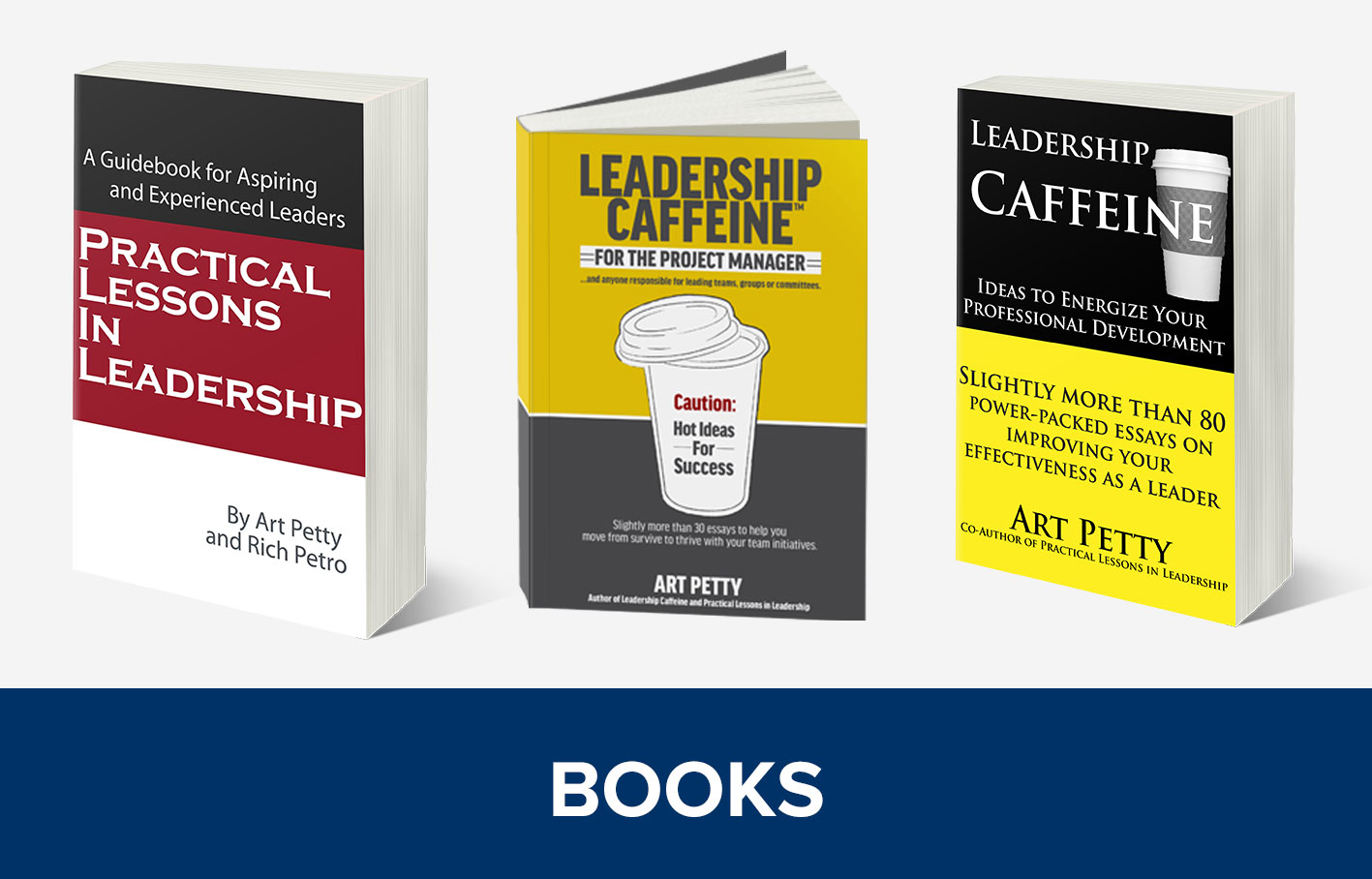
For more ideas on professional development-one sound bite at a time, check out Art’s latest book: Leadership Caffeine-Ideas to Energize Your Professional Development.

New to leading or responsible for first time leader’s on your team? Subscribe to Art’s New Leader’s e-News.

An ideal book for anyone starting out in leadership: Practical Lessons in Leadership by Art Petty and Rich Petro.

Leadership Caffeine-Of Crucibles and Leadership Character

image of a coffee cup“…the crucible experience was a trial and a test, a point of deep self-reflection that forced them to question who they were and what mattered to them. It required them to examine their values, questions their assumptions, hone their judgment.”  -Warren Bennis and Robert Thomas in Crucibles of Leadership (subscription may be required).

Two job candidates walk into a coffee shop. One has a spotless record of achievement and accomplishments and a career that runs upward like a steep staircase from early career until now. His life reads like a storybook we can all smile about and wish ourselves to be so fortunate. This is a solid professional.

The other candidate’s record is good, however, there are several points in time when things went wrong. A start-up failure is the first warning flag. A few years of seeming under-employment after the start-up raises another flag. However, even under-employed, there’s visible growth into a leadership role. And then there’s a gap in the work history of 18 months followed by more underemployment. Still, there’s a quick quick progression to a level of significant responsibility. It turns out that this time spent outside the workforce was time she spent caring for a loved one struggling with a terminal disease.

The first candidate is compelling, but the second candidate is likely my choice. And it’s not because I have a soft spot for hiring people who have encountered hardship during their lives. It’s because I want to field the absolute best talent to help our people grow and our organization survive and succeed. The individual who has fought through hardship and displayed signs of survival and success brings a level of personal and leadership depth far beyond that of our more traditional and successful candidate.

I know that at some point we’ll face a crisis we didn’t see coming…something that threatens our business and even our continued existence. This is beyond the quarterly sales shortfall or the delayed product launch date. It’s a crucible moment in the life of a business and we either rethink and change or we risk becoming corporate road kill. 

It’s at this point in time…the seemingly dark moments, that I want leaders who understand what it takes to walk into the fire and emerge out the other side changed and stronger.  It’s their leadership and resolve that will see us through the dark hours towards survival and strengthening.

The Bottom-Line for Now:

Your struggles and even your failures are important elements of who you are as a leader.  A track-record of chronic failures is different than having encountered and survived a profound setback. It’s the setbacks, the unexpected crises and your approach to surviving and persevering through these crucible moments that forge your character as a leader. Learn, live and lead. And as a hiring manager responsible for building your team’s and your organization’s leadership future, open your eyes to people who understand what it means to struggle and then win.

More Professional Development Reads from Art Petty:book cover: shows title Leadership Caffeine-Ideas to Energize Your Professional Development by Art Petty. Includes image of a coffee cup.

Don’t miss the next Leadership Caffeine-Newsletter! Register here

For more ideas on professional development-one sound bite at a time, check out Art’s latest book: Leadership Caffeine-Ideas to Energize Your Professional Development.

New to leading or responsible for first time leader’s on your team? Subscribe to Art’s New Leader’s e-News.

An ideal book for anyone starting out in leadership: Practical Lessons in Leadership by Art Petty and Rich Petro.

It’s Your Career-Seize that Invitation to Growth

It'sYourCareerSome career opportunities are wrapped in gold leaf and hand-delivered on a silver-platter. Don’t let one of these precious invitations slip through your fingers. There are no guarantees you’ll remain on the invitee list.

These invitations show up in different forms:

  • The gigantic problem that the boss has asked you to run point on solving.
  • The new opportunity in uncharted waters that she would like you to explore and define.
  • An invitation to participate in strategy work.
  • An opportunity to lead a team (for the first time).
  • An organization-impacting systems implementation.
  • Creation of an all-new role in the department.

These are career changing and sometimes career-making offers. And yes, the new adventure might seem intimidating and even frightening. The healthiest growth comes through exploration and confronting fear is just part of the journey.

Some people hesitate upon receiving the invitation to “new” and in this moment of hesitation, doubt and insecurity set up camp and occupy a disproportionate amount of space in their minds.

Know that the boss selected you because she believes in your ability to grow into the role. She sees something in you that perhaps you don’t see in yourself. She’s looking for a way for you to prove to yourself and to everyone else how good you are. The invitation is given in good faith based on her belief in your abilities.

The Bottom-Line for Now:

Beware hesitating too long. Invitations to growth come with an expiration date.

More Professional Development Reads from Art Petty:book cover: shows title Leadership Caffeine-Ideas to Energize Your Professional Development by Art Petty. Includes image of a coffee cup.

Don’t miss the next Leadership Caffeine-Newsletter! Register here

For more ideas on professional development-one sound bite at a time, check out Art’s latest book: Leadership Caffeine-Ideas to Energize Your Professional Development.

New to leading or responsible for first time leader’s on your team? Subscribe to Art’s New Leader’s e-News.

An ideal book for anyone starting out in leadership: Practical Lessons in Leadership by Art Petty and Rich Petro.

Art of Managing-6 Ideas to Help Management Groups Develop as Teams

ArtofManagingFrom long experience and ample client CEO and Board input, the typical state of a management team looks less like a team and more like a group of functional experts who occasionally gather to talk uncomfortably (and shallowly) about the hard issues confronting their organization. The behaviors and integration you might anticipate from a “team” of smart, senior people are often absent from the equation.

Many CEOs agonize over the issue of how to “gain more” from this group of senior managers, and the managers are often equally perplexed, suspecting they should be doing more of something with their functional counterparts.

Team development in any environment is challenging and requires deliberate, focused effort. While there are no silver bullets for turning groups of senior managers into a productive or high-performance team, a bit of expectation adjustment and some focused actions can help you and the group move in the right direction.

6 Ideas to Strengthen Team Development at the Senior Management Level:

1. Don’t expect team performance to be on display at the operations review. The most common forum for senior managers to gather is in the operational review. In reality, this is the one environment where teamwork and collaboration approach irrelevant. Budgets, forecasts and scorecard results dominate the dialog, and they should. However,  a good operations review will uncover issues that merit more detailed group scrutiny. Capture those items under the label of “Team Topics” and pursue them in the forum(s) described below.

2. Adjust your expectations for the senior management team’s role in key decisions. Bob Frisch in his excellent book, “Who’s in the Room-How Great Leaders Structure and Manage the Teams Around Them,” helps us understand the realities of senior level decision making, and in Bob’s ample experience, it happens between the CEO and a fluid “kitchen cabinet” of advisors, and not via a group of functional managers who suddenly check their hats at the door and agree to operate for the greater good. Use the team as an input source and adjust your expectations to reflect the reality that senior management teams are better used implementing decisions than making them.

3. Create the forums and format to harness the talents and knowledge of your senior managers. Leave the operating topics for the operations review and create a series of narrowly focused sessions around important topics such as the external world (e.g. How are market forces impacting us and how should we respond?), strategy (generating ideas on how we can create value, better serve customers and beat competitors) and talent (Who are the high potentials? How are we managing succession?)  Identify follow-on homework and group-work to further the discussion and help move topics from ideas to actions. Ensure accountability on homework activities from session to session.

4. Use frequency to reinforce working together-meet just often enough to make the teamwork in #3 real. While most groups are good about connecting on a periodic basis to review operating activities and metrics, many struggle to carve out the time for the discussions suggested in #3. The lack of regular contact outside the world of functional operating activities is a problem and fights team creation. If you’re not spending at least half a day every six weeks and a full day or two every quarter on the big issues in front of you, it’s time to build a calendar and put some rigor and regularity into the schedule with your senior managers.

5. Don’t expect retreats and non-work related activities to substitute for the “butts in seat” focused time required for team development.  You might have a fun experience paddling a canoe with one of your counterparts, but I’ve yet to find any connection between this extra-curricular work and the improvement of team dynamics.

6. Remember and build towards Hackman’s 5 conditions for effective teams. The recently late J. Richard Hackman devoted a career to studying teams and his five conditions for high performance are minimum table stakes for team development. They are: clear and compelling purpose; clear team membership; expert coaching, enabling structures and a supportive organization. In almost every case of the frustrated CEO or perplexed management team member, one or more of those conditions are absent.

The Bottom-Line for Now:

If you’re the CEO, it’s up to you to create the conditions for team development with your senior managers. Use the ideas above as thought-prompters and starting points. If you’re one of the senior managers seeking to support the CEO and cultivate more meaningful work with your peers, offer some ideas to the group. You might just find a grateful CEO and a group of peers hungry to do more for the firm.

More Professional Development Reads from Art Petty:book cover: shows title Leadership Caffeine-Ideas to Energize Your Professional Development by Art Petty. Includes image of a coffee cup.

Don’t miss the next Leadership Caffeine-Newsletter! Register here

For more ideas on professional development-one sound bite at a time, check out Art’s latest book: Leadership Caffeine-Ideas to Energize Your Professional Development.

New to leading or responsible for first time leader’s on your team? Subscribe to Art’s New Leader’s e-News.

An ideal book for anyone starting out in leadership: Practical Lessons in Leadership by Art Petty and Rich Petro.

Just One Thing: Focus

Just One ThingMuch like my topic a few weeks ago emphasizing the importance of finding time to think deeply about the big issues in front of us, it takes deliberate and sometimes herculean effort to find focus in our work lives.

Focus is a key ingredient on the critical path to success.

Focus is frightening. It is a deliberate decision to tune-out everything else and give ourselves to something that we don’t know or don’t understand. Also, if we focus, we might fail.

Few of us are truly comfortable pro-actively inviting the specter of failure to our work activities, and so we strive to do everything but focus.

We use our devices as mind-candy, we fill our calendars with transactional meetings and activities and we do everything possible but focus on the one or two issues that will make a difference.

Days turn into weeks and quarters and while we know we should be making progress on those big initiatives, they’re daunting and frightening and we don’t know where to start. And we choose not to focus on moving beyond those self-generated bogeymen.

Management teams do this all of the time with strategy. It’s damned hard to create and execute and refine strategy, so instead of focusing on narrowing down the options and making decisions on what not to do, they live in a world that is issue to issue. Often, the outcome is a collection of activities and costs and revenue plans and budgets that have no meaningful relationship to each other. The lack of focus ensures the absence of strategy.

The Bottom-Line for Now:

Focus is a very personal issue. It comes from recognition of the importance of tuning out all of the extraneous noise around us and stepping off the cliff into the unknown of new and daunting initiatives. It’s as much a battle within our own minds as it is within the external environment. Achieving focus is a battle you have to win if you expect to make meaning and move forward during your time here.

Is it time to focus?

More Professional Development Reads from Art Petty:book cover: shows title Leadership Caffeine-Ideas to Energize Your Professional Development by Art Petty. Includes image of a coffee cup.

Don’t miss the next Leadership Caffeine-Newsletter! Register here

For more ideas on professional development-one sound bite at a time, check out Art’s latest book: Leadership Caffeine-Ideas to Energize Your Professional Development.

New to leading or responsible for first time leader’s on your team? Subscribe to Art’s New Leader’s e-News.

An ideal book for anyone starting out in leadership: Practical Lessons in Leadership by Art Petty and Rich Petro.


It’s Your Career: 5 Ideas to Move from Miserable to Motivated at Work

It'sYourCareerBeing miserable in a job is not the normal state of existence. If this is your prevailing mood in the workplace, something is obviously wrong and needs your attention and action.

While it’s fun to run into people who gush about how much they love their work, my non-scientific polling indicates that a good many people seem to struggle with the state of their jobs. When pushed for clarity, many offer responses that single out difficult bosses, toxic work environments or feeling under-utilized and under-challenged.

The boss issue is a vexing one for many. You either find what I term coping-ground…an approach that creates an equilibrium with a bearable level of tension, or, you leave or she leaves. If you can’t find that coping ground and there are no signs of her imminent promotion, transfer or demise, then the cure is clear. Vote yourself off of her island through a transfer or job change.

The same goes for the toxic workplace. If you can’t find coping ground by creating an island of performance and respect with your team in a sea of toxicity, it’s time to go.

For the personal issues of feeling under-challenged and under-appreciated, here are a few ideas to help you remedy this problem.

5 Ideas to Help You Move from Miserable to Motivated in the Workplace:

1. Bored? Let the boss know you want to do more, (but finesse the discussion). Most bosses are overworked and understaffed and offers of “more” are typically appreciated. Be sensitive to not implying that the boss has under-worked you, but rather, you see an opportunity to take on a bit more to help the cause. Come armed with an idea that you know is on the boss’s hit list and your odds of success go up.

2. Not feeling challenged? Find and fix or, help with something big and interesting. There’s rarely a function in an organization that isn’t on the verge of automating, upgrading prior automation, striving to reduce costs or looking introduce a new project or program. Project Managers (PMs) are always on the lookout for high quality help, and a request from the PM might help you with the boss. Find the person responsible for a challenging new initiative and let him/her know that you would like to offer your help. If there’s no PM and you’re adept at herding cats and making something concrete out of something really ambiguous, volunteer to lead the effort.

3. Start something. From setting up book clubs/discussion groups to identifying community/give-back opportunities that help get people in your firm involved and working together on something other than the daily grind, these approaches can be personally and organizationally rejuvenating.

4. Consider position rotation. While it might seem like you’re being disloyal, job rotation strengthens you as a team member in the organization, and it benefits the entire organization. As in all of these discussions, make certain to apply a bit of finesse as you approach your boss or the boss of the group you are interested in joining. You don’t want anyone perceive you are running away from something, but rather, that you are striving to improve yourself and help the firm.

5. In case of emergency, work on your escape plan. Hey, some jobs, bosses and environments just suck. When you have to hang in there to pay the bills, the best tonic is taking deliberate action to strengthen yourself through school, additional training, and networking, and to begin working on the steps to move towards a fresh and hopefully less toxic adventure. Too many people lament their lot in life and wallow in their misery without ever taking action. Once you take the initial steps to get in motion, the subsequent steps become a whole lot easier and a great deal more tangible.

The Bottom-Line for Now:

Running in place won’t get you anywhere. You hold your own cure to workplace misery. Is it time to get going?

More Professional Development Reads from Art Petty:book cover: shows title Leadership Caffeine-Ideas to Energize Your Professional Development by Art Petty. Includes image of a coffee cup.

Don’t miss the next Leadership Caffeine-Newsletter! Register here

For more ideas on professional development-one sound bite at a time, check out Art’s latest book: Leadership Caffeine-Ideas to Energize Your Professional Development.

New to leading or responsible for first time leader’s on your team? Subscribe to Art’s New Leader’s e-News.

An ideal book for anyone starting out in leadership: Practical Lessons in Leadership by Art Petty and Rich Petro.


Art of Managing-Hedging Your Bets Might Be Harmful to Your Firm’s Health

ArtofManaging“Most people, including experienced executives, don’t like to make choices because it means giving up options. There is a clear temptation to hedge bets, to try to do everything, to attempt to keep all doors open at once by refusing to pick from among existing options or to work to create a better answer”. From Leading with Intellectual Integrity at Strategy+Business by by A.G. Lafley and Roger Martin, with Jennifer Riel

The essence of strategy is choosing what not to do, yet as Lafley, Martin and Riel describe, the notion of giving up options or closing off familiar paths is uncomfortable for us. It’s our drive to eliminate this discomfort by keeping our options open and flexible that might just be limiting our success or even setting the stage for failure.

Organizations striving to achieve what strategist and author Geoffrey Moore describes as “Escape Velocity” from the hold of their proud and successful histories, struggle with the hedging issue a great deal.  Even though the writing is on the proverbial wall, the pull of the past coupled with the dominant logic and know-how of the enterprise make decisions to move into adjacent spaces seem extraordinarily daunting and filled with risk. Executives for what they believe are good reasons, move to hedge their investments by continuing to place a disproportionate amount of available capital into the legacy business, just in case the new vector doesn’t work out as planned. This act of hedging in the name of managing risk creates the very real risk of choking off the new vector before it gains critical mass.

Moore reminds us that this problem is compounded when new or adjacent market development is evaluated with the same measures as the legacy business. The metrics naturally make the case for the importance of the old and the inherent weakness and riskiness of the new.

A slightly different twist on the hedging dilemma is suggested by Jim Collins in “How the Mighty Fall” as firms enjoying success begin to believe that the management formula that worked once might work again…and again and again, as they move from Collins’ suggested stage 1 of Hubris Born of Success to his stage 2, The Undisciplined Pursuit of More.  This creation of “more “is typically an outgrowth of politics…different executives competing for investment dollars and power, and it reflects an overall lack of strategic filtering and discipline at the highest levels.

Yet another manifestation of the hedging dilemma is a corporate version of the portfolio game played by VC and other investment firms who understand that only 1 out of X investments in different firms will hit a home run, and they’re never quite sure which one it will be. Executives playing this dangerous game are shirking their responsibilities to stakeholders and engaging in the corporate equivalent of Russian Roulette.

3 Thought-Starter Ideas to Help Navigate the Hedging Dilemma:

1. Seek an Outside Perspective. The risks of groupthink, excessive conservatism, not invented here or politics run rampant (or some combination of the above) are all very real when assessing next steps for your firm. Take the time to bring in some objective outside minds and voices to look at and challenge your assumptions about your investments, projected returns, risks, timing and other key factors. Make certain to bring in individuals competent and confident enough to stand up to you and your team.

2. Reconsider How You Evaluate the Performance of New Initiatives. Moore’s “Escape Velocity” offers some great wisdom on this issue. A $ in revenue or profit captured in a new venture is worth considerably more than the same $ in a legacy business. While the accountants might not agree, your internal view to performance for new initiatives should be activity and progress oriented until the initiative matures sufficiently to make traditional measures and comparisons meaningful. Don’t discount how difficult it is to actually get people on board with this important task.

3. Sleep is Optional and Ask Questions Until it Hurts. Translation: spend considerable time on the hard issues of succeeding at new. This is one of those phases in your career and corporate life when a good night’s sleep should be hard to find. Frankly, I want you staring at the ceiling for awhile and then challenging your team members on many issues, including these three important questions:

  • Are we investing fast enough in our new vector?
  • Are we diluting our effectiveness by investing in too many new vectors, hoping one will stick?
  • Are we hedging by giving a new vector lip-service while continuing to push the preponderance of our money and energy into the legacy business?

The Bottom-Line for Now:

This is a big topic wrapped in a small post. Use it as a thought-starter with your team to challenge the assumptions that underlie your attempts to build and grow your business. Whether the dilemma manifests itself as the undisciplined pursuit of more or the unnatural fear of achieving escape velocity, it’s a sticky strategic issue that you must navigate for the sake of your firm and your team.

More Professional Development Reads from Art Petty:book cover: shows title Leadership Caffeine-Ideas to Energize Your Professional Development by Art Petty. Includes image of a coffee cup.

Don’t miss the next Leadership Caffeine-Newsletter! Register here

For more ideas on professional development-one sound bite at a time, check out Art’s latest book: Leadership Caffeine-Ideas to Energize Your Professional Development.

New to leading or responsible for first time leader’s on your team? Subscribe to Art’s New Leader’s e-News.

An ideal book for anyone starting out in leadership: Practical Lessons in Leadership by Art Petty and Rich Petro.


New Leader Tuesday: 10 Tips to Help You Succeed at Your First Executive Briefing

newleadertuesdaygraphicAt some point it will happen. You’ll be invited to your first executive or board meeting to provide an update on your team’s initiatives and it’s important for you to be prepared to seize this golden reputation building opportunity.

While you are comfortable that your communication skills and your knowledge of your team’s activities will help you navigate any executive grilling, this opportunity is too valuable to leave to chance.  A bit of investigation and advance preparation will help ensure that you ace this interview. And yes, every time you are on-stage in front of the executives it’s an interview!

10 Tips to Help You Prepare for and Succeed in Your First Executive Briefing:

1. Learn About the Meeting Environment Ahead of Time. Talk with your boss and other colleagues who have been through similar experiences and ask about the meeting environment and flow. Are these typically formal settings with presentation visuals and handouts, or, are they more off-the-cuff. Are they one-way presentations or, can you expect a healthy question and answer component? Are the meetings serious or relaxed?

2. Confirm Expectations for Your Content. It may sound trite, but many a manager has been invited to his or her first executive briefing with vague instructions on what to cover. You owe it to yourself, your team and your boss to make certain that everyone is crystal clear on the topics you will cover at the session. Measure twice, cut once.

3. Know Your Time Allotment and Build Accordingly. While the executives may decide to hold you longer than the planned-for time, you want to ensure that your your messaging and supporting materials to fit within the allotted time. Plan, practice and prepare to hit your mark.

4. Strive to Avoid Inviting Air Strikes. The wrong or confusing images or data will invite a sudden barrage of questions and derail any plans you had to make a point. Pretest your slides and your messaging with your boss or a peer.

5. Map Your Message. The simple technique of message-mapping is one of the most powerful tools in your communications arsenal. Develop your message and supporting points, and use this tool to guide your briefing and to respond to questions. (See my post: The Career Enhancing Benefits of Message Mapping)

6. Resist the Urge to Share Everything You Know in One Meeting. While I’m exaggerating just a bit, nerves coupled with excitement about the opportunity can result in a sudden drive to share everything you know about everything as you strive to impress the executives. Rely on your message map.

7. Showcase Your Passion for Your Work. Your enthusiasm for the firm and for the work of your team serves as a powerful credibility builder. Turn on the energy when you hit the stage.

8. Don’t Dance Around the Big Issues. Not every briefing is intended to convey just good news. If there are problems, identify them, showcase actions and/or offer recommendations. Never raise a problem without a potential approach to offer in this setting (or any other).

9. Never Make Up an Answer. The pressure is intense, but taking a stab or offering a guess at a detailed question is a sure-fire credibility killer. “I don’t know, but I will find out and report back” is acceptable.

10. Know When to Go. It’s not uncommon to have your message derailed. If the CEO thanks you for the update and you’ve got 3 slides to go, you are well served to take the cue, ask if there are any other questions, review the items you committed to follow-up with, and thank everyone for their time.

The Bottom-Line for Now:

The best outcome of your first invitation at an executive briefing is your second invitation. The audience is hungry for ideas and insights on strengthening the business and anxious to hear from managers who care. Nonetheless, there’s an expectation that when you are in front of this group, you’ve done your homework, have clear points to make and can field the questions and stand your ground. In this situation, preparation is priceless.

More Professional Development Reads from Art Petty:book cover: shows title Leadership Caffeine-Ideas to Energize Your Professional Development by Art Petty. Includes image of a coffee cup.

Don’t miss the next Leadership Caffeine-Newsletter! Register here

For more ideas on professional development-one sound bite at a time, check out Art’s latest book: Leadership Caffeine-Ideas to Energize Your Professional Development.

New to leading or responsible for first time leader’s on your team? Subscribe to Art’s New Leader’s e-News.

An ideal book for anyone starting out in leadership: Practical Lessons in Leadership by Art Petty and Rich Petro.


Art of Managing: Tackle the Big Issues by Creating Time to Think Deeply

ArtofManagingSometimes, you just have to call a time-out.

While our tendency is to respond to the gravitational pull of our devices and the unceasing demands of the urgent and urgent-unimportant in our work lives, some issues simply require deep thought.

Most organizations and professionals get into a groove of recurring meetings and outlook calendar-driven days. They associate “being busy” with working.

The hardest work is finding the quiet time to allow you and your colleagues to stare at and talk through and solve the real issues in the way of progress.

You won’t solve: “design new approach to market and supporting organizational structure for new strategy” or, “outline succession plan for management team” in-between your 8:00 a.m. production meeting and the 10:00 a.m. call to London.

The big issues of talent and strategy and structure all demand more than transactional treatment. The decisions that commit us to distinct paths merit the thoughtfulness that can only occur when we hit the stop button, change the environment and allow ourselves to honestly engage on the issues, risks, opportunities and fears about the path.

When working with executives who are struggling to get something right…sales, profits, team dynamics etc., I look for signs that they understand the need to occasionally slow down and focus. I asked one sales executive when he took time to think about the big issues in front of his team and the firm, and his response said it all. “Never. I enjoy the thrill of the daily hunt, and I focus my energy there every day.”  OK, that explains the visible stress fractures and performance problems all over his team.

6 Ideas for Creating Time to Think Deeply:

1. Make this part of your job. Recognize and accept the need to create time to think and talk deeply about the core issues with one or more of your key colleagues.

2. Accept that off-line time is still work time. In fact it’s the right work, even though you’ve turned off your devices and are ignoring for the moment the 147 issues that seemingly can’t move forward without you opining or approving.

3. Don’t restrict “thinking deeply” to the annual offsite. Be spontaneous. Don’t restrict deep thinking time to one or two off-site retreats during the year. In my experience, the best progress is made on the big issues when the planning is less deliberate.

4. Recognize the signs that it’s time for some deep thinking and talking. Most of our big plans are developed in an iterative fashion. A compelling strategy on the surface still requires deep thinking about the assumptions and the practicalities of implementing the strategy. Don’t let the pretty pictures and great words keep you from digging deeper and throwing some mud at the ideas.

5. Learn to stimulate thinking through re-framing. Just recently, I talked through a strategy program with the head of sales and we shifted frames 4 or 5 times on how we might build a go-to-market. Every time we got one side of the multi-colored  cube right, we would look at another side and something didn’t line up. This told us to keep thinking and talking.

6. Keep talking until the discussion exposes the real issues and the honest assumptions, opinions, biases, excitement and fears. If you never hit the fears, you’ve not thought and talked deeply enough.

The Bottom-Line for Now:

Remember, being busy doesn’t mean you’re working hard. Call the time-out and create time for you and your colleagues to think deeply on the big issues. And then act.

More Professional Development Reads from Art Petty:book cover: shows title Leadership Caffeine-Ideas to Energize Your Professional Development by Art Petty. Includes image of a coffee cup.

Don’t miss the next Leadership Caffeine-Newsletter! Register here

For more ideas on professional development-one sound bite at a time, check out Art’s latest book: Leadership Caffeine-Ideas to Energize Your Professional Development.

New to leading or responsible for first time leader’s on your team? Subscribe to Art’s New Leader’s e-News.

An ideal book for anyone starting out in leadership: Practical Lessons in Leadership by Art Petty and Rich Petro.

New Leader Tuesday-Job One is to Strengthen Others

newleadertuesdaygraphic“Long before empowerment was written into the popular vocabulary, exemplary leaders understood how important it was that that their constituents felt strong, capable and efficacious.” Kouzes & Posner, The Leadership Challenge

Strengthen others.

It’s the advice no one gives you on day one.  Or, day 1000.

It’s more than advice. It’s your mission.

Early in our career our focus is on the individual staring back at us in the mirror. We’re preoccupied with engineering our own success.

And then at some point, some boss decides to make us responsible for the work (and career steps) of others. Everything has changed, yet all too often, we continue to smile back at the increasingly successful person in the mirror. 

It’s time to shift the view.

It’s not easy to move from a self-focused professional to someone who suddenly is measured by the success and growth of his or her team members.

Recognition is the first step. Too bad it’s a step that many team leaders and functional managers never make. The urgent and the urgent unimportant distract them from their rarely or never-discussed mission of strengthening others. People become tools to make numbers and complete tasks.

In reality, people are the instruments of creativity, innovation and sustainable success.

6 Helpful Reminders for Your Mission to Strengthen Others

1. You must break the mirror you’ve been staring into looking for signs of success. It’s not about you. It’s what you can do to support the learning and growth of those around you.

2. You need to change your measure of success. You will be successful if your team members feel “strong, capable and efficacious” as Kouzes and Posner share in the quote above.

3. “Strengthening Others” isn’t code for being soft. On the contrary, it comes through holding people accountable, pushing them beyond their perception of their capabilities and providing experiences that lead to experimentation, occasional failure and frequent learning.

4. Remember: teach, don’t tell. The leaders who get this right are teachers first and bosses second.

5. If you fail today, you can fix it tomorrow. There’s no expiration date on this mission.

 6. See number 5. You will fail many times. This is hard work.

The Bottom-Line for Now:

At different points in your life, you’ll shift your own personal definition of success. The day you gain responsibility for the work of others is one of those points.

More Professional Development Reads from Art Petty:book cover: shows title Leadership Caffeine-Ideas to Energize Your Professional Development by Art Petty. Includes image of a coffee cup.

Don’t miss the next Leadership Caffeine-Newsletter! Register here

For more ideas on professional development-one sound bite at a time, check out Art’s latest book: Leadership Caffeine-Ideas to Energize Your Professional Development.

New to leading or responsible for first time leader’s on your team? Subscribe to Art’s New Leader’s e-News.

An ideal book for anyone starting out in leadership: Practical Lessons in Leadership by Art Petty and Rich Petro.