Art of Managing: Work is Where the Brain Is

Small Ideas Add UpIn the past two weeks there’s been a buzz in the world of business generated by two firms changing longstanding flexible working arrangements. Yahoo CEO Marissa Mayer  announced an end to the firm’s liberal telecommuting policy, and Best Buy CEO Hubert Joly tossed out the firm’s long publicized Results Only Work Environment (ROWE) approach that offered location and time flexibility to non-store employees.

Not incidentally, both firms are fighting for corporate survival.

I suspect that the fundamental problems of two firms who no longer exist for completely obvious reasons, have as their root causes, something much deeper than whether butts are in seats behind the same walls every single day.

Like politics and religion, this topic is personal and controversial. I’ve yet to run into someone who doesn’t have a strong opinion one way or the other. You can intuit my position from the headline of this post.

Not All Roles Demand Physical Proximity:

Certainly, the nature of an individual’s work plays a critical factor in location choice. Some functions are highly interdependent and there’s little option for location or time flexibility. Other roles are highly independent and whether the individual commutes to a cubicle or works from a quiet room in her home and engages via video or audio conferencing is essentially meaningless.

As an experienced executive accustomed to both leading widely dispersed teams at market leading firms, and to working comfortably anywhere I can connect and engage, I struggle to understand the office-only mentality for all positions and all employees.

For firms that are dependent upon engaging and motivating the best available talent, demanding daily physical presence is just dumb. You reduce the size of the target talent pool, increase costs of acquiring, moving, housing and transporting these employees, and any gains in productivity for requiring this class of knowledge or creative workers to be in-office are subjective at best.

The stress of a flexible work-location approach is mostly borne by the remote individuals who may miss opportunities to build relationships that lead to career advancement. Nonetheless, for many groups of knowledge workers, the flexibility is worth the risk.

Sometimes, There’s No Substitute for Being in the Same Room:

I’m a huge fan of periodic (not constant) contact with team members and colleagues for creative and personal reasons. It is essential, even for globally distributed project teams. There are many circumstances where technology is just a poor substitute for sitting down with a group or breaking bread over lunch with your peers. We build relationships best in-person. However, the command for all employees to be in-place and imprisoned 8-5 feels like a carry-over from a bygone era.

The Organization as a Young Tool of Creation:

The organization as a critical tool of management and human invention is a relatively young institution. Frankly, our collective mindset on managing is young as well and hasn’t perhaps yet found the best approaches to harnessing the advances in technology and resources available around the globe and around the clock thanks to globalization.

The troubles of two firms who tried something new and are now retreating from their experimental approaches  shouldn’t dissuade other firms from searching for the balance that works best for their people, their customers and their top and bottom lines. And speaking of the bottom line:

The Bottom-Line for Now:

There’s a world of possibilities in experimenting with the organizational model and location is one of the variables. While the nature of the work should drive the decision, if physical presence isn’t absolutely essential, I’ll take the smartest and most creative people I can find, regardless of location. I’ll figure out how to adapt my management system and technology tools to support their efforts to do their best work.

And yes, one has to wonder whether Mayer and Joly may be fixing the wrong problem.

Additional Resource: from HBR Blog Network-The End of Results Only at Best Buy is Bad News (great post…even greater comments!)

More Professional Development Reads from Art Petty:

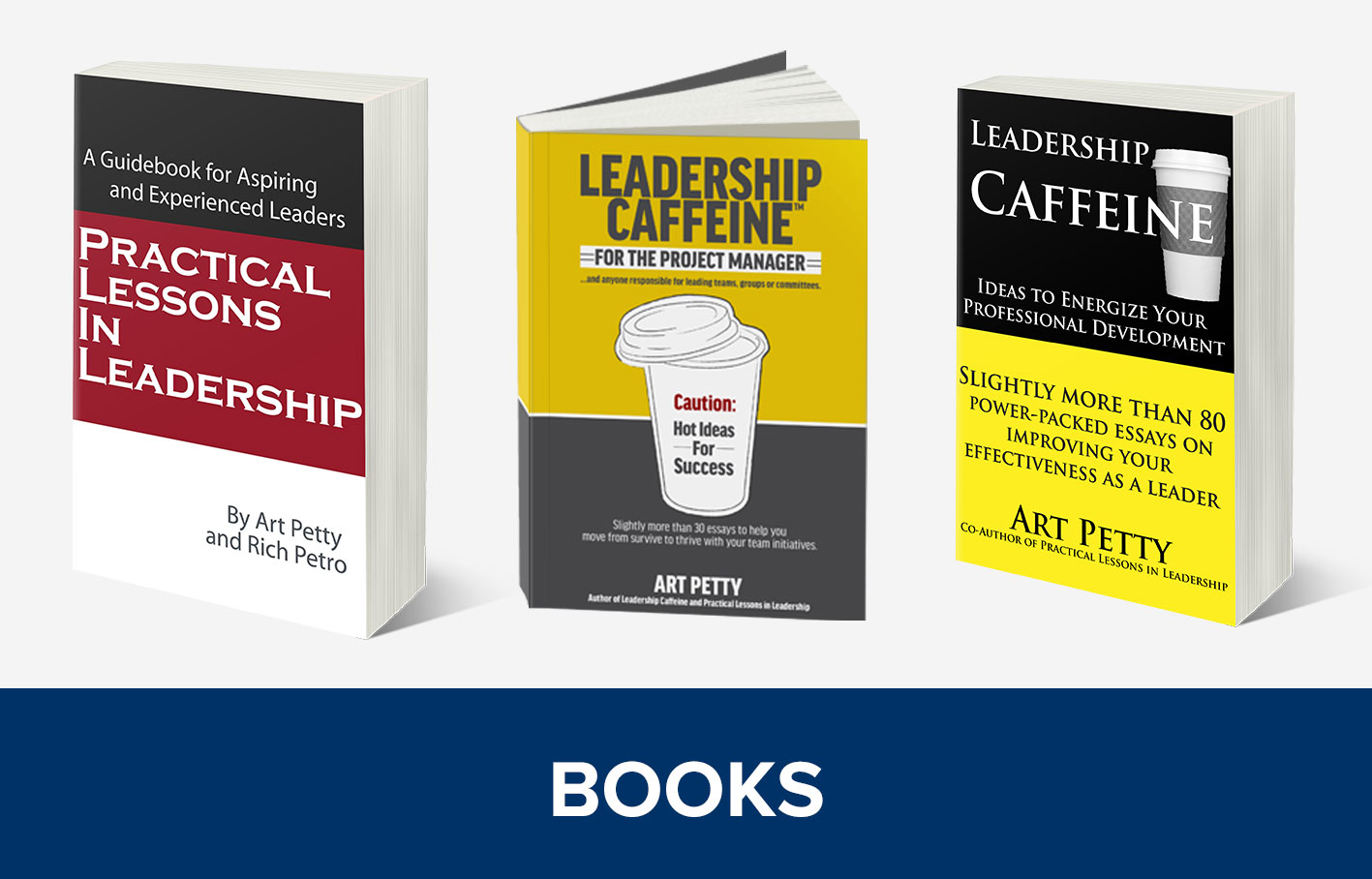
Don’t miss the next Leadership Caffeine-Newsletter! Register herebook cover: shows title Leadership Caffeine-Ideas to Energize Your Professional Development by Art Petty. Includes image of a coffee cup.

For more ideas on professional development-one sound bite at a time, check out Art’s latest book: Leadership Caffeine-Ideas to Energize Your Professional Development

Download a free excerpt of Leadership Caffeine (the book) at Art’s facebook page.

New to leading or responsible for first time leader’s on your team? Subscribe to Art’s New Leader’s e-News.

An ideal book for anyone starting out in leadership: Practical Lessons in Leadership by Art Petty and Rich Petro.

Need help with Feedback? Art’s new online program: Learning to Master Feedback

 Note: for volume orders of one or both books, drop Art a note for pricing information.

Integrator Leaders-People Who Get Stuff Done

Regular readers know my perspective on those who lead without authority. I’m a huge fan. These are the people who turn good businesses great and who power teams with the kinetic energy created by their constant motion.

Great product managers, strong project leaders and anyone else regardless of title, who takes on accountability for results without the traditional formal authority (hire, review, promote/fire authority), are worth twice their weight in platinum.

While executives meet and do what it is that executives do, Integrator Leaders view it as their inalienable right to bend the internal structure to meet their needs for initiative achievement. Instead of viewing departmental boundaries as limits, they view them as deep pools of know-how and prospective resources.

The best I’ve known manage their executives by garnering support for funding, resources and prioritization, and then delivering results. They understand the language of strategy and growth and innovation, but mostly they understand the language of motivation. Without the burden of formal authority, they are free to engage with talented colleagues and leaders in all areas of an organization, building support and coalitions, and focusing these resources on doing something new, big or both.

Oddly, much of what passes for traditional approaches to managing is seemingly at cross-purposes with supporting Integrator Leaders. The pursuit of “control” in management and misguided measurement in the form of inappropriate silo-based performance indicators often serve to fight the emergence of a culture that leverages these Integrator Leaders.

While an organization filled with Integrator Leaders all chasing their own agendas, regardless of how well they align with the big picture strategies and goals, sounds a bit like chaos, fortunately, not every person will gravitate to the role of Integrator Leader.

For managers and executives who do have one or more of these priceless professionals on their teams, you will be well-served to point the Integrator Leaders in the right direction, loosen the silo and measurement controls and focus on supporting and monitoring instead of controlling or reining in.

Oh, did I mention that Integrator Leaders are just what the management doctor ordered in a world where the need for speed and the pursuit of learning and adaptation are all table-stakes for organizational survival and success>

What are you doing to support the emergence of Integrator Leaders in your organization?

Don’t miss the next Leadership Caffeine-Newsletter! Register here.

For more ideas on professional development-one sound bite at a time, check our Art’s latest collection: Leadership Caffeine-Ideas to Energize Your Professional Development

Download a free excerpt of Leadership Caffeine (the book) at Art’s facebook page.

New to leading or responsible for first time leader’s on your team? Subscribe to Art’ New Leader’s e-News.

To talk about a workshop or speaking need, contact Art at via e-mail at art.petty@artpetty.com


Lessons in Management Innovation from Main Street

In their July, 2011 Harvard Business Review Article, Adaptability: The New Competitive Advantage (great article, worth the $ IMO), Martin Reeves and Mike Deimler make a solid case for our need to cultivate critical soft organizational skills to survive and prosper in today’s turbulent business environment.

Reeves and Deimler suggest that leaders and firms shift their focus away from the traditional approach to strategy (creating an enduring and relatively static competitive advantage through price, positioning or differentiation), and instead focus on cultivating four critical capabilities:

  1. The ability to read and act on signals of change,
  2. The ability to experiment rapidly and frequently-not only with products and services but also with business models, processes and strategies.
  3. The ability to manage complex and interconnected systems of multiple stakeholders.
  4. The ability to motivate employees and partners.

On a grand scale, these four read like the playbooks in use at Apple, Google, Amazon and other Masters of the Universe who seemingly morph their businesses and business models at a torrid pace, capturing more of our attention and more of our consumption along the way.

On a more local and relevant for the rest of us scale, these organizational capabilities are nothing more or less than the outcomes of effective leadership coupled with an entrepreneurial spirit.

Most start-ups rely on their skills in all four of those areas, almost by instinct. Their business agility is keen due to resource limitations and because they are driven to experiment with their ideas and approaches until something sticks and they move beyond survival towards success.

Local Lessons In Winning Approaches to Business Strategy:

During the past few years, I’ve marveled at the start-ups and small to mid-sized businesses in my community who didn’t need an army of consultants or MBAs to teach them the very relevant and important lessons that Reeves and Deimler share in their article.

They live in a world where agility is survival. They understand, experiment, learn and iterate. They know to seize upon what works and build it out while the building is good. And they get that they need to continuously be looking for new approaches to innovate based on failures and successes and the inevitable copycats and disruptions.

  • There’s the wildly successful local Coffee Roaster, where the founders tackled the daunting task of starting a coffee business in the era of Starbucks, and have succeeded. They continue to morph their business model and strategy…and they experiment like fiends with new approaches to serving their clientele and shifting their business through licensing and distribution.
  • And then there’s the Hair Salon that was the dream of a group of young professional women that has become the go-to place in the county. From start-up to juggernaut. Now, growth is the problem and appointments are hard to come by. I continue to get all 311 remaining hairs on my head cut at a ridiculous price premium here because the culture rocks, the senior partner is the smartest business person I know to not have a business degree, and I leave there every time feeling great and with three new ideas to write about based on their management, hiring, marketing and customer-service approaches.
  • Someone I admire tremendously runs a growing manufacturing concern focused on an offering into the display side of the retail industry. They make products you wouldn’t think twice about, yet to tour the factory is to be amazed at the thought and investment in innovation. To meet and work with the people is to know that there’s something special in the leadership and the culture.

3 Critical Common Characteristics of these Main Street Successes: 

1. Leadership that gets it. They are led by individuals who view the top and bottom lines as outcomes of doing the right things for and with their employees and customers.

2. Change is embraced. They intuitively get the guidance offered by Reeves and Deimler on building strength and they live it every day. Instead of fearing change, they find ways to leverage and promote it.

3. They are big thinkers looking to harness big ideas in small ways. They are born strategists who think beyond the here and now and take their cues not only from their customers but from observing and anticipating what some of these macro-changes in our world mean for their businesses.

The Bottom-Line for Now:

The lessons from the big firms in the news are visible and exciting. However, don’t discount the lessons in management innovation that are being taught on and around Main Street. The sharpest small business owners that I know have long understood the secrets that the rest of us in the corporate world are now discovering.


Leadership Caffeine: Change or Learn to Say, “Would You Like Fries with That?”

image of a coffee cupNote from Art: Consider this tough love intended to motivate leaders everywhere to rethink and refine their approaches.

In the prologue to my recently published collection: Leadership Caffeine-Ideas to Energize Your Professional Development, I write:

For experienced and developing leaders, the emerging environment is likely to offer a Dickensian world filled with Best of Times opportunities and Worst of Times challenges.  Now might be a good time to revise your thinking on your role as a leader and to begin cultivating the skills and experiences required for success during the exciting and perilous journey ahead.

What I Wanted to Say:

I stand behind the words…and in fact, my only regret is that I didn’t say something a little stronger, such as:

Wake up! Change now or become leadership road kill! Either start cultivating the new leadership skills or stand in front of a mirror and practice saying, “Would you like fries with that?” because this may be your money phrase in the not so distant future.

“Hey, Who Moved My…”

Much of the pablum that is passed off for guidance on leading others ignores the reality that the context in which we lead has changed from just a few years ago, and it continues to change faster than any of us can truly understand.

Now before your fingers burn a path to your keyboards to remind me of the timeless nature of and attributes of leading, I get the point in spades. Character always counts, no one ever screwed up by showing respect, your job is to develop people, you better be able to inspire people to act…paint a vision and all that great stuff. It’s good…its timeless and UNLESS it’s blended with the new skills of leading, it may prove to be USELESS.

Context is King. Meet King Context-7 Ways the World of Leading and Managing Has Changed

While it’s a bit disheartening to realize that those of us with some experience and a bit of gray are vestiges of a bygone business era, we truly are. That doesn’t mean we can’t be relevant, but first, we have to understand and accept some of the important contextual changes in our world of business:

1. Our management structures and approaches are products of late 19th century and early 20th century thinking. As Gary Hamel offers, they were designed for another goal…to get people out of the fields and into the factories and to optimize their ability to do the same thing over and over.  They weren’t designed to cope with the need for rapid innovation, constant change and frequent disruption. Gary is right…the practice of management must change to cope with a world where exponential change is the norm.

2. Oversight as a core task of those in power is no longer the point, yet it is still widely practiced. I still find managers uncomfortable with the idea that work might actually take place somewhere and sometime when employees are out of sight. Oh, and yes, imagine that it might take place at some point in time when the “normal” work day has ended. My guidance: “get over it.” Control is no longer the point. 

3. Technology tools aren’t necessary evils, they are tools essential for survival, connectivity, speed and idea sharing. Too many leaders struggle to know which end of a tablet is up (answer: neither)…much less, how to turn the power on and use it. By the way, if you’ve not purchased an e-book, grabbed your news from Flipboard, tweeted about something interesting to a group of industry peers and used Evernote to capture a few great web sites for future reference in the past few hours, please grab your hairnet and watch out, the grease is hot by those fries. You’ve got to participate in the activities of the day to understand their implications for the world of work.

4. Ambiguity is the order of the day. Get over it. By the time things become clear in most markets, the opportunity is missed.   You need to build capabilities in your organization to go from idea to execution to learning to refinement, and to do that, you need great people who are comfortable that you’ve got their backs.

5. The Silos in our organizations are still there and they are still rusting in place. Teams that cross boundaries are now the principal means of getting work done and silo control is a game no longer relevant. Your goal as leader is to help teams form fast, support their efforts to execute and then ensure that they are able to disband and reform on the next opportunity.

 6. Your Cultural Intelligence may just be the most important asset that you aren’t doing anything about. It’s a global world…we’re all working across cultures, and chances are your workplace is (or should be), filled with diversity. Learning to tap the different world-views of your colleagues is a critical mission for leaders today…and it takes deliberate effort to learn and understand how to competently navigate across cultures.

7. The most important tool of management you  probably don’t know enough about is Project Management.  Too many treat it like an administrative process instead of a critical tool to enable value creation, learning and strategy execution. Heck, I struggle to find leaders who even get that project management is so much more than an endless stream of Gantt charts and status meetings. It’s time to dig in on this important new way of getting work done.

The Bottom-Line for Now:

Welcome to the leadership blender, where speed and adaptability are essential for survival.  Control is something from a 1960’s era sitcom (Get Smart), where ironically and fittingly, Chaos was the primary adversary. Sorry, Chief, but Chaos won. Adapt, or repeat after me, “Would you like fries with that?”


Towards Your Growth as a Management Innovator

One of the exciting parts of living and working through “these interesting times,” comes from the opportunity to apply the tools of management in new ways and forms to today’s complex problems. 

This “management innovation” as Dr. Gary Hamel describes it, is much about the search for approaches to organizing, planning, leading and controlling that better fit the challenges of the 21st century. The implication is that in many cases, we’re still trying to solve new and emerging problems with 20th century management tools.  Another implication is that we haven’t yet cracked the code on sustaining high-levels of organizational performance for extended periods of time.

In Search of Management Innovation:

While some position this pursuit of management innovation as something on the scale of an Arthurian quest for the Holy Grail, for those of us who aren’t management researchers and who have teams and organizations to run, we need something a bit more tangible to grab hold of and play with in pursuit of survival and sustained success.

Consider these as idea prompters laced with encouragement!

Six Quick Ideas to Stimulate Your Management Innovation Thinking:

1. Innovation in management approaches occurs like almost all other forms of innovation…through enlightened trial and error backed by a lot of curiosity and a willingness to accept failure on the road to success.  Translation…it’s all about environment and leadership attitude. If you aren’t working hard on creating an environment that not only tolerates trial and error, but encourages it, then you are missing the critical first piece. 

2. It’s how you use the tools that counts! Our tools…structure, people, leadership approaches, technology, communications, goal-setting and measurement mechanisms are fairly easy to identify…and genuinely finite…however, there are nearly infinite number of ways to apply the tools.

3. The Right Answer…Well, It Depends. What works right in one situation or environment is likely not the right answer for other situations or environments. Recognize that when entering a new business, setting up new teams or taking on new types of projects and problems, you need to view the situation as unique, not cookie cutter.

4. Structure matters…and strategy must beget structure. If you forget or misapply either one of these, you’re likely to generate more problems than answers.

5. Creativity is a commodity however, the application of creativity to solving problems is priceless. And before you skewer me for the “commodity” crack, consider that ideas are all around us…it’s the courage to take an idea and work it until it either proves useful or useless that takes true courage. Translation: the value isn’t in the brainstorming session, although the process of generating, parsing, prioritizing and acting-on ideas is critical.

6. It’s always the people, stupid! Do everything to get the right ones in place and give them the tools they need to fail on the road to success.

The Bottom-Line for Now:

At the wrap-up of a Kellogg Executive program a few years ago, the Organizational Design Professor encouraged all of the V and C level people in the room to “Never quit trying to innovate with our people and our organizations.” Her meaning was clear then and it’s more critical now than ever. How hard are you working to promote, support and reward management innovation in your workplace?