Leadership Caffeine: 5 Ideas to Bring Strategy to Life on Your Team

image of a coffee cupFew concepts in business generate more consternation for managers operating below the C-level, than strategy. Poll your team members or peers, and I’m confident that in most organizations, at least one (or more) of the themes will emerge:

We don’t have a strategy.

The executives talk about strategy, but I don’t see how it connects to my job.

The executives are working on strategy.

It seems like we have conflicting strategies. Everything’s important.

Our strategy is to grow. That’s how we get paid.

Quite often, the cause of the comments above isn’t the absence of a strategy, but rather the absence of a clear communication and execution link between the strategy framework developed by the executives and the organizational game plan required to implement strategy.

Regardless of your level in the organization, you have a responsibility to find ways to create a direct link between your team’s priorities and your firm’s ability to make money, create and satisfy customers and beat competitors. Here are a few ideas to help you span this gap.

5 Ideas to Help Bring Strategy into Focus for Your Team:

1. Create opportunities for executives to meet with your team about marketplace trends. While calendars might be tight at the top of the pyramid, any executive worth his/her salt loves to spend time with teams talking about customers, competitors and improving and growing the business. Make certain your team is prepared with an ample supply of great questions about market trends, customer needs and competitor actions. (See my short-list of thought-prompters below.) Run a debrief session where you and your team members connect the dots to your own work.

2. Bring customer-facing colleagues into your operating meetings. No executives to be found. No worries. Invite a customer-facing colleague to share insights and updates from the field at your regular team meeting. Once again, encourage your team members to be prepped with an ample supply of questions.

3. Don’t forget your boss! Redouble your efforts to understand the boss’s goals and performance indicators. While this still might leave you one degree of separation from your firm’s actual strategy, knowing your boss’s goals and connecting them to your team’s goals and metrics will improve alignment and support more effective execution on key activities.

4. Put a filter on it. Put a strategy filter on investment or new project requests from your team members. Encourage and challenge your team members to connect the ask to the customer, corporate goals or beating competitors. Encourage your team to actively prioritize their investment needs, and make certain that those that are selected have a clear connection to the firm’s goals.

5. Make ad hoc marketplace monitoring a regular part of your team’s activities. Regardless of where you and your group operate inside the organization, there are no rules that say you can’t become and remain market savvy.  Make competitor, customer and marketplace monitoring a part of your team’s activities and meet regularly to talk about what you are hearing and seeing. Make certain that everyone connects their observations to, “What I think this means for our firm is… .”  Importantly, find opportunities to reflect this discussion and debate in decisions and prioritization.

The Bottom-line for Now:

If there’s a solid strategy lurking somewhere in the C-Suite waiting to be set free, your job is to help make that happen. If you’re operating in a strategy desert, your job is to help bring some market and customer focused context to your team’s work. Regardless of your firm’s situation, the work of connecting activities to meaningful actions falls on your shoulders.

A Short-List of Thought-Starter Strategy Questions for Your Team:

  • How do we make money as an organization?
  • What’s happening with our customers/competitors that will impact our business? How will we be impacted and what can we do to leverage this situation?
  • What are the key business problems our customers are trying to solve and how can we help them?
  • What have we done in the marketplace to disrupt competitors?
  • What moves have our competitors made to disrupt us?
  • Do we sound and look the same as our competitors? (Can our customers describe why they like us versus our competitors?)
  • What can we do more of that will help us better serve customers and beat competitors?
  • What can we do less of without hurting our position in the marketplace?
  • How are we going to measure our progress in the market?

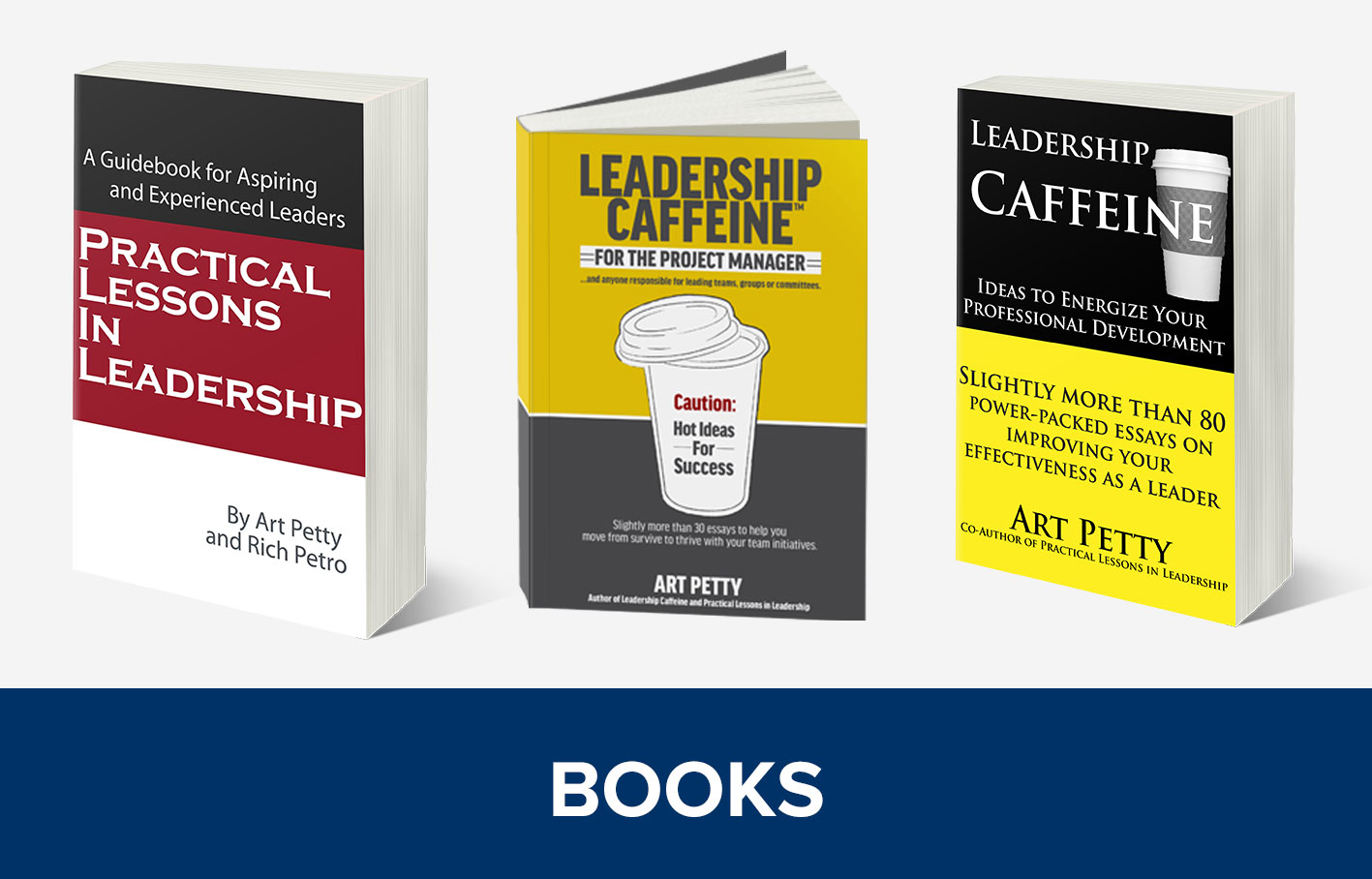
More Professional Development Reads from Art Petty:book cover: shows title Leadership Caffeine-Ideas to Energize Your Professional Development by Art Petty. Includes image of a coffee cup.

Don’t miss the next Leadership Caffeine-Newsletter! Register here

For more ideas on professional development-one sound bite at a time, check out Art’s latest book: Leadership Caffeine-Ideas to Energize Your Professional Development.

New to leading or responsible for first time leader’s on your team? Subscribe to Art’s New Leader’s e-News.

An ideal book for anyone starting out in leadership: Practical Lessons in Leadership by Art Petty and Rich Petro.


5 Ideas to Keep Your Culture from Having Your Strategy for Lunch

Every leader who has grappled with a shift in strategy for their firm understands the powerful gravitational pull of organizational culture.

A firm’s culture keeps management teams from flying off in completely disconnected directions. It also inhibits much needed exploration and it serves as a powerful force of resistance for what Geoffrey Moore describes as asymmetrical bets—those investments outside of today’s business that define tomorrow’s growth opportunities.

There’s an oft quoted statement: culture eats strategy for lunch. Very true if the change is mismanaged and the culture disrespected. Just ask Carly Fiorina how well that worked when she thumbed her nose at the HP Way.

While strategy might be on the lunch menu, competition and the forces of disruption and creative destruction guarantee that a failure to identify, invest in and nurture Moore’s asymmetrical bets might find your firm as the entrée on the dinner menu at that popular restaurant, Irrelevance.

Good strategic leaders respect and leverage a firm’s culture, but they don’t let it unduly inhibit change.

5 Ways to Leverage Your Firm’s Culture While Building the Future:

1. Respect the past and present. Too often leaders talk about the need for change and the pursuit of new directions in terms that are interpreted as critical or even derogatory towards legacy and current businesses. Test your messaging about change with key thought and network leaders in your existing businesses and adjust as needed.

2. Watch the dissonance and educate your employees. A client company held a Town Hall Meeting one day to celebrate the latest solid numbers and then kicked off a strategy program the next week with an emphasis on moving into new, high growth markets. The reaction was one of confusion.

The employees weren’t aware that anything was wrong…and in fact, they felt that everything was great. While management was spot on in the need to find new growth areas to nurture for the future, they failed to properly position the current business as a valuable Cash Cow, but not a growth vehicle, in the minds of the employees.

3. Don’t Make it Seem that Only the Cool Kids will Work on the New Stuff.  Steve Jobs famously divided the company into the best and brightest and not the best and brightest in developing the next incarnation of the Mac. It worked for him, but unless you have the credibility and gravitas of Jobs, it’s not a good plan.

4. When exploring new growth opportunities, don’t shirk the need for strategy work in legacy businesses.  The work and team members might be different, but the importance of forming and framing a viable strategy for current and future businesses is identical. Use Rumelt’s Good Strategy approach by requiring teams to work hard on developing a clear and outside-in view for diagnosis and guiding philosophy.

5. Bring the work outside of the conference room and get the entire organization involved. While not everyone can attend every strategy meeting, good process management will ensure that everyone has an opportunity at one point to share ideas and participate in implementation. Your customer facing employees have valuable insights that should be mined. Internal process and functional leaders are stakeholders in driving the changes needed to execute on strategy. Involvement and engagement create buy-in.

The Bottom-Line for Now:

Most of us in most of our firms must face up to the reality that yesterday’s marketplace victories are sources of pride but not sources of tomorrow’s best opportunities. New and different doesn’t mean better…it just means new and different…and essential for survival and future success.

A strong culture is an asset to be treasured, but you have to deliberately put the culture to work in the process of building the future. Fail to address culture and to respect it, and we’ll, we’re back to that issue of strategy for lunch.

Don’t miss the next Leadership Caffeine-Newsletter! Register here

For more ideas on professional development-one sound bite at a time, check our Art’s latest book: Leadership Caffeine-Ideas to Enebook cover: shows title Leadership Caffeine-Ideas to Energize Your Professional Development by Art Petty. Includes image of a coffee cup.rgize Your Professional Development

Download a free excerpt of Leadership Caffeine (the book) at Art’s facebook page.

New to leading or responsible for first time leader’s on your team? Subscribe to Art’ New Leader’s e-News.

An ideal book for anyone starting our in leadership: Practical Lessons in Leadership by Art Petty and Rich Petro.

Need help with Feedback? Art’s new online program: Learning to Master Feedback


Just One Thing: Rewrite the Rules If You Dare

Image of an elevator button with the number 1 and the braile equivalent

Just One Thing

The Just One Thing series at Management Excellence is intended to prompt ideas and provoke debate…one topic at a time.

One of the most difficult but potentially compelling plays in strategy is to redefine the rules of the game. Those who write the new rules…and get them to stick, win.

Apple re-wrote the rules. Then they rewired the profit models of several industries…and well, it’s remarkable to watch.

Southwest wrote their own rules…and they wired in the profits as well. The rest of the industry still hasn’t figured out the right rules to make the game work for their firms. Buffet might have been right. (Warren, not Jimmy.) Investors would have been happier if someone had shot Wilbur down that fateful day at Kitty Hawk.

IBM changed their rules and the game they were in and saved themselves.

Long ago, Microsoft rewrote the rules. However, somewhere along the way, they lost the book that told them how to rewrite the rules. It doesn’t make them bad…just big and mundane.

Star Trek fans have known about the power of rewriting the rules for years. Kirk did this first. Kobayashi Maru, anyone? He took an un-winnable game and reprogrammed it in his favor. (OK, that’s my inner geek doing a shout out.)

Some companies and industries run into the forces of Creative Destruction. The rules are rewritten for them…and they capitulate, seemingly without a fight. Can you say Kodak? What about the entire publishing industry? Best Buy, the new rules are being written right now…not sure if you’ll be in the next game.

We get used to playing on a discrete playing field with familiar boundaries, whether its in our businesses or industries. We plot predictable strategies…with equally predictable tactics.

The same goes for our careers. We work in jobs…do little to strengthen or diversify our skills or experiences and then it happens. Wham. Out of nowhere, we’re out there…and when we look around, signs of the familiar are nowhere to be found.

On a personal level, strive to rewrite your own rules. Pursue a second discipline. Do something way outside of your routine that forces you to rethink everything you ever knew about a subject. Study companies outside your industry that are changing the rules and winning.

For those of you involved in setting the rules for your firms…quit planning the future of your business using the same dusty old playbook. Fight the inertial resistance of the status quo. If you’re not busy rewriting the rules for your business and industry, you can bet that someone else will do it for you. Soon.

Don’t miss the next Leadership Caffeine-Newsletter! Register here

For more ideas on professional development-one sound bite at a time, check our Art’s latest book: Leadership Caffeine-Ideas to Enebook cover: shows title Leadership Caffeine-Ideas to Energize Your Professional Development by Art Petty. Includes image of a coffee cup.rgize Your Professional Development

Download a free excerpt of Leadership Caffeine (the book) at Art’s facebook page.

New to leading or responsible for first time leader’s on your team? Subscribe to Art’ New Leader’s e-News.

An ideal book for anyone starting our in leadership: Practical Lessons in Leadership by Art Petty and Rich Petro.

Need help with Feedback? Art’s new online program: Learning to Master Feedback


Getting Ahead Part 2-Jump Start Your Strategic Curiosity with Key Questions

Chalkboard with the Word Strategy and a GlobeThe “Getting Ahead” series at Management Excellence is focused on sharing ideas on the skills, tools and behaviors we must cultivate to develop and succeed as professionals and as leaders. Part 1 focused on Developing Your Professional Presence.

Senior leaders value employees who are proven operators AND who are capable of looking at the bigger picture and providing help in developing the way forward for the business.  Your ability to cultivate both sets of skills will help you strengthen your professional value proposition and help differentiate you from your peers. This differentiation might just be the meaningful issue for that next promotion.

Strategic thinking is much about knowing the right questions to ask and then seeking answers to these questions.  Jack Welch, the former Chairman and CEO of GE famously offered:

“In real life, strategy is actually very straightforward. You pick a general direction and implement like hell.”

While there’s some comfort in the pure, raw simplicity of that thought, what Welch didn’t share in this quote is that he subjected his managers and business unit leaders to 40 or so incredibly challenging (to answer) questions as part of the process of picking that direction and building the implementation plan. 

The opportunity for all of us, from senior executives to front-line professionals, is to blend some of Welch’s simplicity on this often confusing topic of strategy, with the on-going pursuit of answers to some critical questions.

6 Question Sets to Help Jump Start Your Strategic Curiosity

1. Our business situation. How do we make money today? What do our customers truly pay for? Why do they choose us over our competitors? How are we meaningfully different from our competitors?

2. Our changing world. What’s changing and what’s changed in our world that will impact us? Our customers? Our competitors? Our partners? What are we doing to leverage or exploit those changes?

3. Our customers. What do we know about our customers and their challenges that we can apply or acquire and apply expertise to helping solve? Can we do this to our advantage and to the disadvantage of our competitors?

4. Our ecosystem. How does our business fit within the ecosystem of players that serve our target customers? Are there opportunities for us to do more or less to improve our differentiation and our profitability? Can we partner or acquire to do something that will help us differentiate and add value for our customers?

5. Our opportunities to change the rules. What can we do to change the game with our competitors? What might our competitors do to change the game for us? What’s our counter?

6. What to do and what not to do. How do we choose what to do and importantly, what not to do? What filters are we using for our decision-making? How can we improve or clarify those filters?

The Bottom-Line for Now:

While that’s a fairly hefty set of questions (to answer), I view those as simply the thought-starters. No one function or level in the organization owns those questions, although senior executives are responsible for ensuring that they are answered and acted upon.

Strategy…and strategic thinking and experimentation should not be left just to senior executives and well-heeled consultants. The work of strategy and building the future is everyone’s business. Effective senior managers value strategic thinking (and actions) in their employees, and your willingness to ask and seek answers to these critical issues is an indicator that you may be ready for more responsibility.

Don’t miss the next Leadership Caffeine-Newsletter! Register here.

For more ideas on professional development-one sound bite at a time, check our Art’s latest book: Leadership Caffeine-Ideas to Enebook cover: shows title Leadership Caffeine-Ideas to Energize Your Professional Development by Art Petty. Includes image of a coffee cup.rgize Your Professional Development

Download a free excerpt of Leadership Caffeine (the book) at Art’s facebook page.

New to leading or responsible for first time leader’s on your team? Subscribe to Art’ New Leader’s e-News.

An ideal book for anyone starting our in leadership: Practical Lessons in Leadership by Art Petty and Rich Petro.

Need help with Feedback? Art’s new online program: Learning to Master Feedback

Just One Thing: Always Add Clarity to Challenge

Just One Thing

The “Just One Thing” series is predicated on the assumption that change takes place one step at a time. Like throwing a pebble into a pond, your one small action can have a far-reaching ripple effect at work for you, your firm and of course, in your personal life.

Too many strategies and corporate plans (and even our personal improvement plans) outline lofty challenges in heady words, but they fail to provide the clarity necessary for us and for our teams to move forward in an integrated fashion.

These statements …a mission, a vision, a strategy sound beautiful on the surface, but like a beautifully wrapped empty box, once the surface layer is peeled back and we peer inside, there’s nothing there for us to seize. And then we add our own interpretation.

Why are we doing this project?

What is this committee here for?

Why does this team exist?

What does adopting this strategy mean for me, my work and for the work of my team members?

We all process and interpret statements, words and ideas in a different manner…and to different conclusions about what they mean for us.

Without striving for clarity, the leader leaves her intentions open to interpretation and at risk of promoting disjointed actions.  This is the opposite of her intent.

Challenge without clarity breeds confusion. Effective leaders always add clarity to challenge.

Don’t miss the next Leadership Caffeine-Newsletter! Register here.

For more ideas on professional development-one sound bite at a time, check our Art’s latest book: Leadership Caffeine-Ideas to Energize Your Professional Development

Download a free excerpt of Leadership Caffeine (the book) at Art’s facebook page.

New to leading or responsible for first time leader’s on your team? Subscribe to Art’ New Leader’s e-News.

An ideal book for anyone starting our in leadership: Practical Lessons in Leadership by Art Petty and Rich Petro.

To talk about a workshop or speaking need, contact Art at via e-mail at art.petty@artpetty.com