
“You’ll go as far as you are able to communicate.”
The quote in the title was from Maury, a senior executive and mentor in my first job out of college. While it stuck in my mind, I’m not sure I understood the power behind it until more than a decade later, when Maury was in the audience as a distributor-owner for the systems unit of a global technology firm where I led product, marketing, and support. His ear-to-ear smile as I engaged the audience, shared ideas, and fielded questions felt to me like a proud father watching a son or daughter come into their own. I’ve lost track of Maury, but I remember his guidance and that warm moment clearly.
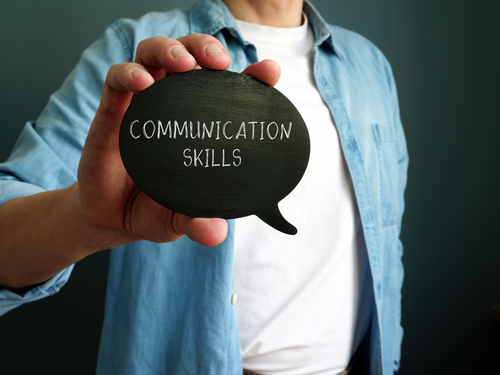
Making the case for investing in your communication skills
- Learning to lead is important. The basis of leadership is how you communicate. Everything you do as a leader depends on your communication skills.
- How you affect others is critical to your success. Your communication skills are the critical elements here.
- Learning to garner support and persuade others is important. Yep, your communication skills are the basis here.
- Displaying courage in the workplace for ideas you believe in or advocating to fix something that is wrong. Communication skills again.
- Advocating for change. Your communication skills are a key determinant of success.
- Need to speak truth to those in power? You’d better have strong communication skills.
- Negotiating your compensation. Advocating for a larger role? Striving to scale your impact?
You get the point.
Your communication effectiveness reflects your command of yourself.
Developing as a great communicator is a whole-body, whole-mind experience. The best communicators understand the power of their tools — their bodies, facial expressions, eye contact, their listening powers, and, importantly, their vocal capabilities.
They know that “the body never lies” and that “the body always speaks first.”
They understand that their vocal impact draws on resonance, pacing, and punctuation. The songwriting phrase “God lives between the notes” is pure wisdom when it comes to creating interest and commanding attention.
Your communication effectiveness reflects your understanding of your audience.
Too often, business communicators fail to understand their audience deeply. Beyond the tactical interests of audience members, their priorities, concerns, and their roles and power in the decision-making process, there’s a deeper need to understand how these people communicate. Are they visual, auditory, auditory digital, or kinesthetic consumers of words? Mismatch your approach and message to how they function, and you’ll be easily discounted. Learn to assess and understand their styles, and doors will open, and roads will be clear for you and your ideas.
Your communication effectiveness reflects your command of the situation via messaging.
Even if you do a good job on all the above. You know your audience, their hot buttons, their communication preferences, and you have command of your body language; you still must nail the message. Easy words.
Great message design for high-stakes moments draws on principles of psychology and persuasion, and even taps into neuroscience. Every word has weight. Your laser-focused opener, matched with the right body language and vocal management, is critical. And if you must use slides (goodness, give it up and learn to communicate and have a conversation with your audience wherever possible!), the slides must support, not distract, the audience from your message.
I teach clients a tool I’ve labeled Strategic Message Mapping. The hardest part of creating your map is the core — that laser-focused opening that captures attention.
My colleague, Tanya Anne Chavez, has brilliantly translated her experience as a U.S. Air Force Intelligence Analyst into an approach that emphasizes developing the Bottom-Line-Up-Front (B.L.U.F.) and the supporting story.
Whatever design template you use, it’s essential to craft messaging tailored to your audience and the situation. Again, if you have to incorporate slides, use fewer words, include supporting images, and be careful not to overload the signal-to-noise ratio you are after.
Many communication sessions are won or lost by how you handle the questions.
A well-designed message and its delivery elicit questions. While some view questions as a sign they didn’t do a good job communicating, I beg to differ. Rather, engagement and the subsequent conversation reflect audience member curiosity. Even tough questions show that they’re listening and even considering.
Questions are that golden opportunity to show your command of the situation and reinforce your authentic passion. Smile. Embrace the questions. And build the dialog.
The Bottom Line for Now
You have an amazing array of tools at your disposal to succeed as a communicator. Your technical command of a topic is important, but not enough. Your ability to articulate in terms they value and to do so with authentic passion, ensuring your body meets your message, and your message meets their needs, are all critical. There’s no single class or book you can draw on to master developing into a great business communicator. However, there is ample science to draw upon, and of course, you get to explore and experiment and gain feedback in your living laboratory, your workplace. Get this right, and someday your boss will marvel at the effective communicator you’ve become.

—
Strengthening as a communicator is an integral element of Art’s professional development programs. Also, there’s an entire section on this important topic in Art’s latest book (Spring/2026), Wake-Up Calls for Managers—Insights to Sharpen Focus and Elevate Results.