Are You Running in Place When it Comes to Your Professional Development?
Unlike the resolutions that so many of us make in January and discard just as quickly by February, our own professional development requires a deliberate and consistent effort to improve.
While most people in our organizations run in place when it comes to their own skills and knowledge development, a few committed souls manage to fight the gravitational pull of doing-nothing and break-away from the pack.
Is this your year to break-away?
Professional Development Success Stories to Motivate & Inspire:
Here are just a few of the examples I encountered in my work last year. They are to be commended for their efforts and results. Names changed for privacy purposes.
- Julie set her sights on moving into a front-line leadership role last year and was just promoted. Along the way, she took on every possible assignment she could glom on to that taught her what it took to lead. Not only did she prove to herself she was cut out for the role, she proved it to the people she worked with and importantly, she proved it to the person who had to select her for success…her boss.
- Mark had long struggled mightily with self-esteem issues in spite of his stellar performance. With guidance, coaching and a lot of effort on his part, he’s become more comfortable with himself, and his excellent performance is now matched with an appropriate level of self-confidence.
- Susan was given a battlefield promotion into what seemed like a no-win situation with the project from you-know-where. She inherited a demoralized and burned-out team and cost-overruns that would choke a good-sized horse. Six months later, after working unceasingly to lead and support this team and project back to health, the organization is looking to Susan and this groupas the model for how a high-performance team should function.
- Juan, consistently displayed great passion for his work, but was limited by his confidence…in part due to his struggles to master English. He did it…and his boss described to me that he could see Juan’s confidence and contributions grow overnight.
- A little over one year ago, Adam was told that he needed to develop more “executive presence” to break through to the next level. Armed with the world’s most ambiguous advice (“You need more executive presence”) he researched and worked to strengthen his presence, authenticity and yes, confidence. He got the promotion.
I love these stories…because their examples inspire us all. Will you write your own success story in the next year?
7 Quick Ideas to Help You Take That First Step Forward:
1. Call a personal time-out. Stare in the mirror for a few minutes and think about where you are going professionally and if you are comfortable with your vector, pace and progress. You know if you are running in place. You also know in your heart of hearts when it doesn’t suit you.
2. Ask Questions About You. While uncomfortable, you will be well served to find someone or some small group in the workplace and ask them what they think of your professional performance and areas for development and your visible strengths. Fair warning…not all feedback is created equal, so you need a few perspectives before you decide where to focus.
3. Mine the Performance Feedback on Your Reviews. While there’s not enough space here for me to pick apart most review processes, I’m a fan of mining them for nuggets of truth or at least clues to the truth.
4. Start Small and Build. You’ll be tempted to tackle the Ironman of professional development and “fix” yourself all at once. Resist this temptation…it’s a formula for failure. You’re better off running a 5K. Identify one thing to get better at…and develop a strategy for doing just that. Remember, if you improve 1% per day… , well, you do the math. The outcome will be impressive. Expand your areas of emphasis once you score some victories and build confidence.
5. Read Widely and Read Mostly from Outside the Business Genre. Regardless of my role as a management and leadership author, you’re much better suited reading about people who have overcome adversity and accomplished great things in the process. Histories and biographies are great! (Although, my Leadership Caffeine book, makes a nice mid-day energy boost!)
6. Get Away from the Naysayers. You are better off reorienting your workplace relationships to those who like you are striving and moving forward. Don’t let the “Run in Place” crowd hold you back.
7. Celebrate the Victories, No Matter How Small. Give yourself a psychological break or reward. When you’ve scored a point, moved the bar a bit, overcome a historic weakness or fear, celebrate for a few moments. And then get back to it.
The Bottom-Line for Now:
Remember, if you are running in place, you’re falling behind. Here’s to moving forward!
–
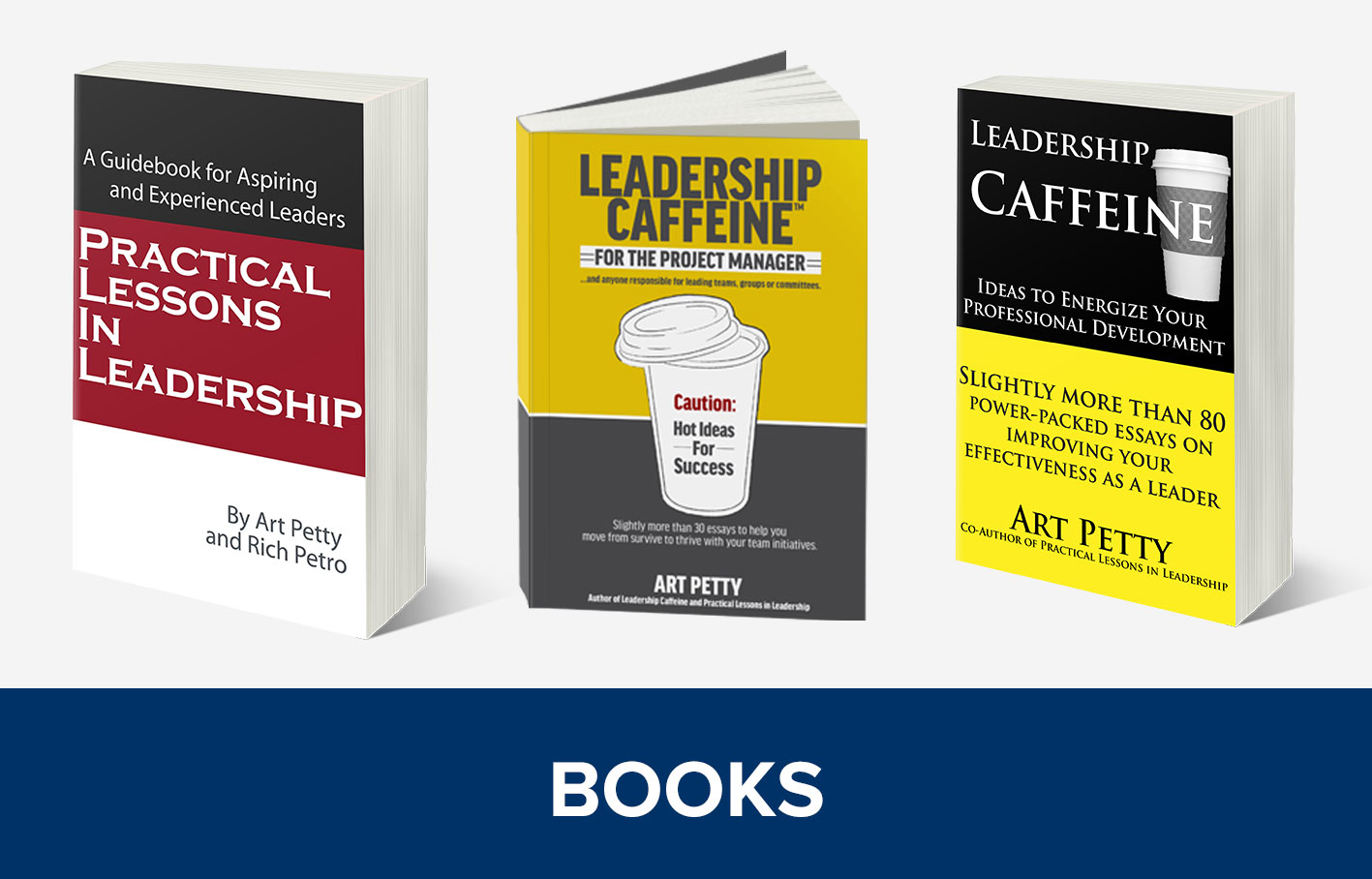
Art Petty is a developer of leaders and a strategy consultant. Art frequently speaks on leadership and management, and his work is reflected in two books (Practical Lessons in Leadership and Leadership Caffeine-Ideas to Energize Your Professional Development) and over 1-million words published at The Management Excellence blog. You can reach Art via e-mail to learn more about his leadership development, speaking and management consulting services.
Leadership Caffeine: Six Low-Cost Ideas to Stimulate Global Awareness
I spend some a fair amount of my post 6:00 p.m. leading programs and classes on various management and leadership topics, including international business. I love the I-Biz classes in part, because for many participants, the classes are like opening the window shades to a big, fascinating, complex, sometimes frightening and always exciting global picture.
I continue my own I-Biz studies outside of the classroom as I pursue my avocation as a Management and Leadership Anthropologist. In this case, my focus is on understanding how well prepared firms and managers are to enter and compete successfully on a global stage. My quick-take: for a good number, it’s important to focus on the basics. (Translation: there’s a lot of learning required to reach a reasonable level of knowledge.)
While most of us have mastered the art and science of consuming products from around the globe, many firms and managers are well served to work on some fundamentals.
Is it Time for You to Cozy Up with Hofstede, the WTO and Your Elected Representatives?
Here’s a quick quiz (self-graded) for you to conduct a quick-check on your current global business knowledge.
- What determines the value of a currency? Why does one currency fluctuate in value versus another? What risks do we face from currency fluctuations? How do I protect myself from currency risks?
- What are the emerging Regional Trade Pacts and how might they impact your firm?
- What is the sovereign debt crisis in Europe and how might it impact the U.S.?
- What is the Doha Round (WTO), why is it important and why has it been underway for a decade
- In exploring new markets, how well do you understand key dimensions (versus your home market) of: short/long term orientation, power distance, uncertainty avoidance, aggression versus nurturing and group versus individual orientation? (these are Hofstede’s cultural dimensions).
- How might you apply your understanding of Hofstede’s dimensions in your target markets?
- How can a simple but thorough P.E.S.T.E.L analysis help you and your team members better understand your target market?
- What options do you have for going global and what are the pros and cons for each?
- What potential ethical dilemmas will we be exposed to as we seek to diversify our manufacturing around the globe?
- How do we choose the right partners?
As citizens:
- Why are protectionist policies potentially lethal to firms and industries in the long-term?
- How do my elected officials support/inhibit global trade expansion through their voting and sponsorship activities?
- Should the government invest in infant industries or support emerging strategic industries with subsidies or other protectionist policies?
- Why is the government pushing China to allow the Yuan to float freely and reduce in value versus the dollar?
If you can confidently answer the above questions, great! Please remember to share the knowledge and help educate those less globally proficient than you.
If you can use a refresher or some good foundational knowledge, consider the ideas below.
Six Low-Cost Ideas to Jump-Start Better Global Awareness on Your Team:
1. Read more! If you and your team members don’t have good insight into and a current view on the above topics, it’s time to hit the books…or the magazines…or the websites. It’s remarkable what even regular, casual reading of the Financial Times, the Wall Street Journal, BusinessWeek and the Economist (and others) can do to boost your understanding of current events and help you better understand the complexities, risks and opportunities in today’s emerging world.
2. Talk about what you are reading. Create a reading club on global issues and meet regularly to discuss interesting articles “In the News.” This promotes not only reading, but the exchange of information and ideas. Ensure a diversity of topics are covered, from current W.T.O. events to specific examples of companies expanding and succeeding or failing outside of the U.S.
3. Apply the tools and then analyze the outcomes. Pick a market that is of interest to your firm and conduct a P.E.S.T.E.L. (Political, Economic, Social, Technological, Environmental and Legal) analysis of the target country. After gathering and sharing insights on this country, focus on analyzing what the information means to your potential business endeavor.
4. Leverage in-house expertise. If your firm has some cultural diversity, invite individuals from various cultures to talk to groups about life, customs and business in their home countries.
5. Invite others to share. Engage knowledgeable guest speakers and other business professionals to share their own experiences in global business. Encourage the speakers to share more than stories of dramatic growth. You want to hear about missteps, and lessons-learned to help accelerate your own learning curve.
6. Explore government’s role in your industry. Explore, summarize and share information on the political issues underlying global trade with your firm’s offerings. Are there protectionist policies here or abroad that directly impact your class of products? How tuned in are your elected officials to your industry and what are they doing to help? Are their regional trade pacts that might impact your firm’s competitiveness?
The Bottom-Line for Now:
As consumers, citizens and as business professionals, living in this modern world requires cultivating and maintaining an understanding of global business and cultural issues. What happens in Bangalore, Beijing , Rio, the Middle East or Zurich now impacts what happens here on Main Street.
As citizens, we have to elect officials with global vision. As business professionals, we have to understand both the risks and opportunities of this hyper-frenetic, interconnected and volatile environment. As managers and leaders in firms, we have to choose strategies, build relationships with global partners and accelerate our learning as a means to continue minimizing risk and seizing opportunities.
It’s truly a best of times/worst of times situation in the world economy. There are unparalleled new market opportunities and heretofore unimaginable sources of risk and competition. You need every edge you can get to succeed. Start with educating yourself and your team members on the rules and flow of this fast-changing game.
Leadership Caffeine-The Artful and Effective Workplace Apology
Filed under: "To Do" List, Career, Leadership, Leadership Caffeine
“The secret to my success as a leader in my business has been my ability to offer well-timed and heartfelt apologies after mucking things up.”
The gentleman who offered up this “secret to success” certainly used this tool wisely, judging by the growth of his business over the years and the loyalty and respect I hear in the words of his employees
The apology is an often over-looked and widely misunderstood tool for keeping smoldering bridges from burning out of control and for repairing relationships that were dented somewhere in the chaos of daily battle. It’s also a tool easily misused by people uncomfortable in their roles and seeking to buy compliance by apologizing their way forward.
For Too Many Leaders, It’s Hard to Form the Words:
Some leaders find it difficult to apologize for their genuine transgressions, in part due to the fear of being perceived as weak, when just the opposite is true. It’s difficult to own up to our mistakes and awkward to get in front of those who were adversely impacted and say, “I was wrong and I apologize.”
Others find it difficult to apologize due to a mistaken belief that their title buys them the equivalent of a human relations “Get Out of Jail Free” card. Newsflash: your title doesn’t entitle you to be a jerk.
Ample Ammunition for Apologies:
Stuff happens in the course of daily business. Crises erupt, emotions fly and it’s all too easy for people to misstep and misspeak in the heat of the moment. A poorly stated piece of feedback, an off-handed comment, failure to provide your full attention when someone truly needed it, or a broken or forgotten commitment are all apology-worthy transgressions.
The Power of a Well-Placed and Heartfelt Apology:
-You display your authenticity as a human being. People respond better to authentic leaders than those who work too hard to mask their frailties and flaws.
-You exercise your social intelligence skills. Ultimately, your ability to read and engage effectively with people will determine your success. It’s important to learn how to recognize when you’ve sent someone down the wrong path with your poor behavior.
-You gain some street credibility for making the effort. While you don’t automatically reset credibility lost through your apology-worthy behavior, you can buy another chance to build trust.
-Your honesty sets a healthy tone in the workplace. People make mistakes and instead of sweeping them under the carpet, you are modeling good behavior for everyone to follow
5 Tips for Constructing an Appropriate, Effective Apology:
A Well-Constructed Apology Is:
1. Timely-As close to the transgression as possible, please.
2. Specific-By describing what you did wrong and why it was wrong, you are showing your command of yourself and your awareness of the impact you have on people and on the workplace.
3. Behavioral-Try: Here’s what I intended and why…here’s what I did…and I understand that my approach failed to communicate what I intended.
4. Genuine-Say what you mean and mean what you say.
5. Brief-No one wants you to draw it out. Don’t excuse it, don’t make excuses for your behavior and don’t try and describe the twenty things that happened that day that added up to your bad moment.
Common Apology Mistakes to Avoid:
1. Apologizing as a tactic to assert your agenda. “Hey, I’m sorry to ask you to this, but… .” Don’t be sorry for asking, and no “buts” please.
2. Saying: “I’ll make it up to you.” You cannot buy your way out of a mistake. The apology is enough please.
3. Not apologizing when you’ve mucked up. Get over yourself and get on with it.
4. Waiting too long. If something you did merits an apology, chances are you irked or upset someone in the process. The longer this festers, the greater the adverse impact on your relationship with the individual or team.
5. Bringing it up repeatedly. Once is enough if you do it right. No need to carry around endless guilt and no need to open old wounds. Let go and move forward.
The Bottom-Line for Now:
Unless your membership card to the human race was repealed, you will make mistakes that merit apologies. Effective leaders manage themselves and their mistakes with grace and professionalism, and as uncomfortable as it may be, apologizing is occasionally on the menu. Please make it digestible for all parties involved.
4 Key Skills Leaders Must Develop to Succeed in Today’s Workplace
Filed under: "To Do" List, Career, Leadership, Marketing Yourself, Professional Growth
With the clear disclaimer that there are no magic formulas, silver bullets or guaranteed fast-track approaches to success in the workplace, there are a number of critical steps you can take to accelerate progress and improve your odds.
4 Key Skills You Must Develop to Succeed in Today’s Workplace:
1. Learn to See Yourself as Others See You.
Short of having a genuine out-of-body experience, learning to see yourself as others see you is a challenging task. Our own view to our strengths and weaknesses is often pretty inaccurate, based in large part on the fact that we’re human and open to a huge number of cognitive biases.
Overcoming our own self-perception biases requires good outside help. I encourage emerging leaders to cultivate a feedback group comprised of other motivated professionals interested in gaining and giving input on performance and perception. While the recruitment of your 3-5 person group is not easy, a good (dare I say it) support group is a priceless source of frank feedback and idea exchange.
Define a group charter, ensure everyone is comfortable speaking openly about perceptions, and hold people accountable for input…as well as for actions. Politically motivated members and social loafers should be quickly benched in favor of others genuinely interested in giving and gaining.
2. Cultivate Your Social Intelligence and Skills
Learning to assess and respond appropriately to the situation at hand is a core component of projecting your professional presence and building your brand. While this sounds a lot like playing politics…and it may be, it is at least being smart about how you participate. No one’s asking you to nod your head blindly…or, to compromise your morals. I am indicating that you should be smart enough and self-aware enough to adapt your style and approach to the situation. Make your point, but make it with grace and courtesy.
The inability to assess and respond appropriately in varying situations is a derailment factor for too many. We all know the person who never passes up an opportunity to stand-up and standout, often in an obnoxious and off-putting approach. You can be zealous in pursuit of your agenda, with out being a martyr.
3. Become a Network Connector
Think in terms of organizational and industry ecosystems, not departments and functions. The better you are at building connections across the broader ecosystem, the more likely you are to gain access to unique information and insight to top talent. A well-developed network where you constantly strive to connect parties (in contrast to just linking yourself into disparate groups), the better the opportunity to help others create value and for you to gain opportunities in the process.
4. Learn to Lead both Vertically and Horizontally
The most successful leaders understand that theirs isn’t just a downward facing challenge. Effective leaders apply the tools in 1-3 above and cultivate their power and influence across organizations. They learn to involve others in pursuit of vexing organizational problems and improvements, and importantly, they learn how to make heroes out of others.
Managing upwards is one of the more important and in my experience, one of the most under-pursued critical professional activities of all. And sucking up to the boss, brown-nosing and generally serving as a brainless follower are not the same as properly managing upwards.
Proper boss management requires you to invest in understanding the boss’s priorities, communication and decision-making styles and preferences. Once you’ve gained some insights in these areas, you are accountable for both providing support for the boss’s agenda, and for adapting your behaviors to better align with his/her approaches. Remember, someone chooses you to be successful, and the boss usually gets a big vote.
The Bottom-Line for Now:
Self-development….it’s hard work. It’s also a full contact sport. Engage or expect to be left behind.
–
Art Petty coaches and trains emerging leaders and consults with B2B firms on strategy and marketing. You can reach Art via e-mail to discuss your needs for coaching, speaking or consulting,
Lessons On Managing Oneself
In his classic article, “Managing Oneself,” (HBR, 1999), the late, great management thinker, Peter Drucker, offered the following:
“We live in an age of unprecedented opportunity: if you’ve got ambition, drive and smarts, you can rise to the top of your profession-regardless of where you started out. But with opportunity comes responsibility. Companies today aren’t managing their knowledge workers’ careers. Rather, we must each be our own chief executive officer.”
The futurist, Alvin Toffler offered:
“The illiterate of the 21st century will not be those who cannot read and write, but those who cannot learn, unlearn and relearn.”
Questions to Ask and Answer:
What are you doing to foster your ability to learn, unlearn and relearn?
Have you declared yourself CEO of your own career? What’s your strategy for success?