Strategy-Towards Hypotheses, Experiments, Involvement & Learning
Filed under: Leadership, Leading Change, Project Management, Strategy
Few would argue that a nimble, quick-to-learn and quick-to-adapt organization is a bad thing. Given the rate of change in our world, those characteristics are increasingly table-stakes for survival and success.
Why then has the approach to strategy and the notion of “strategic planning” in so many organizations remained mired in a 1960’s kind of static, top-down event-focused model?
Many firms practice a style of strategic planning that might have worked in a different time and place, but today, fast-to-try, fast-to- fail and fast-to-learn are essential for survival and success.
Give Me an Epiphany, Darn-It!
Rarely does just the act of thinking through circumstances, opportunities and strategies yield the epiphany that allows a firm to carve out a competitive advantage.
In my experience, the management teams who have pursued the “strategy as event’ approach with the annual or semi-annual meeting(s) serving as the time to talk strategy and decide, are often frustrated with the time investment and disappointing outcomes. Few epiphanies…a lot of time…a lot of bickering and ambiguous outcomes with no clear next steps. Sounds like fun, doesn’t it?
Hypotheses and Informed Experiments, Please!
The best outcome of the front end of any strategy process is one or more (a limited number, please) of ideas…hypotheses, that can quickly be turned into and managed as experiments.
True value in the form of learning accrues to the organization from working through the strategic experiment, assessing outcomes and refining the ideas. Because these workplace and marketplace experiments require people to implement, manage, and assess them, the act of engaging the employee population creates understanding, involvement, excitement and importantly idea sharing.
It Feels So Good When We Stop!
I’ve worked with teams who were accustomed to and frustrated by the “event” orientation of planning. When refocused on assessment, analysis and importantly, hypothesis generation, the unreasonable expectation of finding the magical answer was replaced by high quality dialogue around generating ideas for better serving customers and beating competitors. After a series of these discussions over time, and with some focused facilitation, the teams were able to zero in on one or two strategic hypotheses to invest in and learn from.
The Project Management Art of Building out Strategic Experiments:
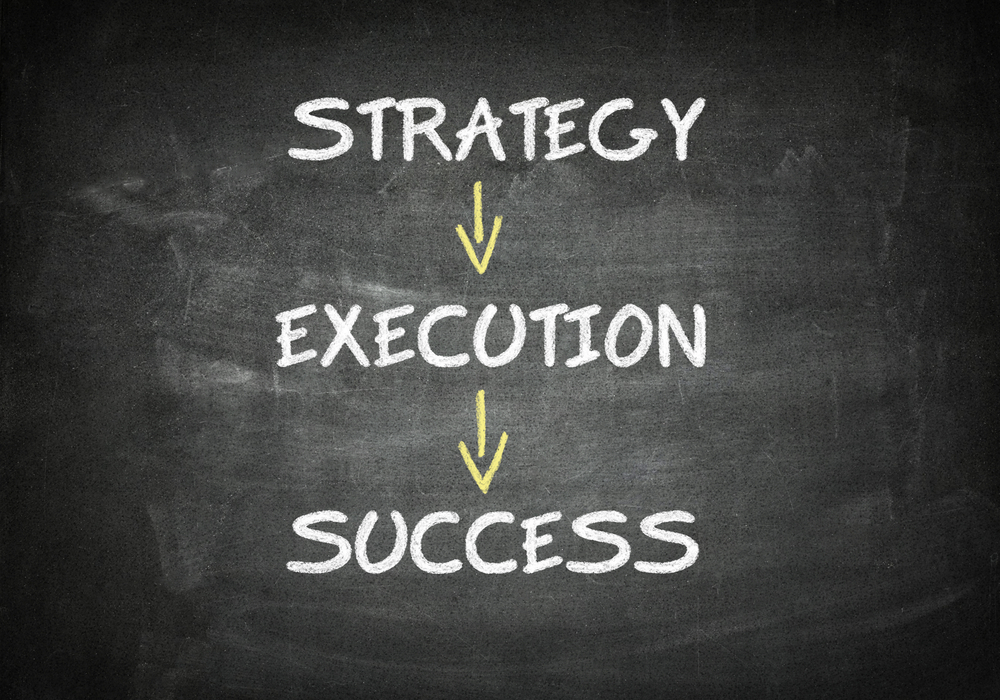
While I frequently reference this phase as the Execution phase, I prefer Experiment…both because it doesn’t sound so fatal…and it implies Doing, Measuring, Learning and Refining (DMLR). In my estimation, its in the DMLR cycle where the real work…and the real “Ah Ha” moments of strategy occur.
Six Ideas for Implementing an Effective Doing, Learning, Measuring, Refining Program:
1. Treat each strategic experiment like a project. Assign a Project Manager and use Best Practices PM to charter, scope, engage stakeholders, define the work, assess the risks, plan and estimate the work, implement the work, monitor and communicate. Yeah, that’s a mouthful. Your Project Manager in this case is priceless.
2. Ensure that there’s a strong sponsor in place for every experiment. Yes, best practices project management again. If this is important enough to be betting your strategic future on, it’s important enough to provide a Supportive Sponsor with heft and teeth.
3. Explain, Engage and Listen! People work in compliance under orders, they work with their hearts and minds when they are part of something big. Getting them involved is good. Arming them with context on why, and what and importance is critical. Listening to their feedback is priceless. Since many strategic initiatives involve doing new things or doing things differently, this holistic approach to engagement is essential.
4. Create Learning and Sharing Forums with Teeth. It’s good to pre and post-mortems…it’s better to create ample opportunities for idea sharing, lessons learned and adjustments to experiments on the move. Hey, I’m probably violating several tenets of The Scientific Method with the adjustment statement, but timeliness is critical and your Project Manager will help you manage changes in the plan.
By the way, by this time, you may want to give your PM a big fat raise!
5. The Truth is Always in the Field…Sometimes You Just Have to Look Carefully. The best strategic experiments involve customers and partners. Invite them in…make them part of the process and of course observe and listen carefully. And then act.
6. Do Something with the Outcomes-Plan to Change or Move Forward. After a period of time and armed with the insights and feedback of employees, customers and partners, there’s a vetting and decision-making process that those in charge have to prosecute. From kill to change to go to what’s next, you and your team are on the hook for returning to the process and assessing and deciding.
The Bottom-Line for Now:
There are at least two “dirty little secrets” in what I’ve described above. It’s a nefarious plan for involving the broader organization in strategy and execution, and it not so secretly “operationalizes” the work of strategy. While there’s no magic and I would be misleading if I didn’t highlight that the process is filled with bumps, hiccups and debates it’s darned powerful if and when managed properly.
Frontline Leaders Help Our Firms Go and Grow
Fred Hassan’s article, The Frontline Advantage, in the May 2011 Harvard Business Review (subscription required), turns the spotlight on the too-easily ignored and truly critical frontline leaders who make our organizations go and grow. Frontline leaders are of course the managers and supervisors directly responsible for those doing the work.
“Typically, they make up 50% to 60% of a company’s management ranks and directly supervise as much as 80% of the workforce.”
Underscoring the importance of this group of leaders, Hassan offers:
“It is the frontline managers who must motivate and bolster the morale of the people who do the work-those who design, make and sell the products or services to the customers. These managers are central to a company’s business strategy because they oversee its execution.”
While there’s much I don’t like about this article, including my interpretation of Hassan’s royal CEO and sometime turn-around miracle worker taking a pampered and well-facilitated walk amongst the common folk tone, his core theme: frontline leaders are really important is spot on. (In Hassan’s defense, he clearly highlights that his advice is for other CEOs.)
Great Front-line Leaders Create “Hustle and Flow”
Regular readers know I’ve got a problem with stores and businesses where customers seem to serve as inconveniences to sourpuss cashiers, unhelpful shelf-stockers and clusters of employees gabbing about something other than improving customer service. While those workers are just plain wrong, the responsibility for their performance falls squarely on the frontline leaders.
Alternatively, the businesses where you are welcomed, greeted with a smile by every employee you encounter and where your problems are politely and promptly solved, and where the energy level seems to say, “let’s help, and let’s be prompt about it,” owe their success to great people selection and day-to-day leadership of good frontline leaders.
Great frontline leaders create great experiences for their employees. This flows immediately and directly to customers. And then it flows to the top and bottom lines.
Wrinkly-Shirted Bridge Lizards Need Not Apply:
During an interview for Practical Lessons in Leadership, one of the managers at a company we visited, indicated that the frontline leaders who did the most damage were the Wrinkly-Shirted managers, who preferred to spy on everyone from behind the one-way glass on the “bridge” above the retail floor, rather than interact with employees and customers.
The visual image of a green, scale-covered manager wearing a wrinkled corporate-issue button down shirt, standing on high with a tongue occasionally flickering out, and glowering at everyone through beady, black eyes, is a powerful and fitting image of the worst-kind of frontline leader.
Five Reasons why Great Front-Line Leaders are Priceless:
1. Frontline leaders are close to the customer. They know how the customers respond to every brilliant and not-so-brilliant idea that rolls out of corporate. They know the tastes and habits and brand preferences and problems of their customers, and they know what’s going on with competition in detail, long before corporate types have analyzed the latest competitive press release. These individuals are treasure-troves of real-time, detailed customer and market information.
2. Hassan is right…frontline leaders are the ones who execute on strategy. Everyone else plans, talks, reports, critiques and thinks about strategy execution…front-line leaders live it. Want to do a better job executing on plans where it counts…educate and support the frontline leaders and let them know how important they are in this process.
3. Frontline leaders directly determine how right or wrong the working environment (atmosphere) is for the employees serving the customers. A healthy, respectful working environment where employees are given quality feedback, supported for development and encouraged to cultivate new schools through training and job rotation, goes a long way to creating that “Hustle and Flow” referenced earlier.
4. Today’s quality frontline leaders are tomorrow’s effective general managers and executives. Learning the business from the front is infinitely more valuable than attempting to absorb it from on high. Give me someone who has worked in the trenches with the troops over the classroom educated chair sitter any day.
5. Great frontline leaders drive results. One of my favorite examples: the most valuable sales person in every organization may very well be the field sales manager who supports, coaches, motivates, and helps his/her salespeople move towards success. The same holds true for great frontline leaders everywhere.
The Bottom-Line for Now:
I’m always glad to see positive coverage of this critical group of organizational leaders. Hassan’s article serves to remind us how important it is to pay attention to and support our frontline leaders. Based on my informal “smile test,” there are a fair number of frontline leaders who need to be doing something else. Soon. And for those who get it…here’s hoping you run your organization some day. Just don’t forget where you came from.
Management Excellence Book Series: Six Disciplines Execution Revolution with Gary Harpst
I started this book series to share the insights and approaches of some truly sharp people on solving vexing business problems. This particular interview with Gary Harpst, author of, Six Disciplines Execution Revolution and the earlier Six Disciplines for Excellence, taps into Gary’s hard won, practical experience and his great ideas on helping small and mid-sized businesses deal with strategy execution.
On a personal note, the discussion, while remaining true to the strategy execution topic, ranged fairly far beyond the borders of the book. Talking with Gary during this interview was like engaging with the wise, thoughtful and helpful business advisor that we all wish we had. Gary offers experienced based, actionable ideas on improving business performance through great execution, that we can all put to use immediately.
Gary’s premise for his “Business Excellence Model” is described in the book as:
- “Excellence is the enduring pursuit of balanced strategy and execution.”
- “Planning and executing, while at the same time dealing with the inevitable surprises, is the biggest challenge in business.
- “Overcoming this challenge is what we mean by “solving the problem that makes all others easier.”
- “Failing to solve the problem destines your organization to a reactive, fire-fighting future.
During the podcast, we talk about the different stages/phases found in the “Business Excellence Model,” and reference the four-box matrix pictured here:
Enjoy the podcast and this unique opportunity to learn from someone that has lived what he is talking about from the business-owner’s side of the table, and now helps clients realize success by guiding them on effective strategy execution. I’m thrilled to feature Gary Harpst and his important thoughts on strategy execution here in the Management Excellence Book Series!
Gary Harpst Six Disciplines Execution Revolution podcast [ 27:57 ] Play Now | Play in Popup | Download–
Note from Art: I purchased the book, Six Disciplines Execution Revolution on my own and have no commercial motive for sharing this podcast and linking to Gary’s website. The Management Excellence Book Series podcasts are intended to share thoughts from leading figures in business and management writing.
Management Excellence Book Series Podcast: Strategic Speed
Filed under: Leadership, Leading Change, Management Innovation, Performance, Strategy
Every year, a number of the large consulting firms publish surveys outlining the issues that keep global corporate leaders awake at night. Inevitably, the topic turns to strategy and more specifically to the headaches and challenges of executing strategy.
For those of us that have labored in the corporate world for a couple of decades, it comes as no surprise that translating ideas into programs and projects and then executing these programs accurately and quickly to seize market opportunities is darned difficult.
It also turns out that we’re not so good at it for a lot of reasons, most of which have to do with people.
It is this critical issue of improving strategy execution (speed and quality) by focusing on the people & leadership issues that bedevil so many programs, that the authors of: Strategic Speed-Mobilize People, Accelerate Execution, take on in this interesting, and research and helpful tool-filled new book. This is a practical, interesting and immediately useful book for anyone engaged in the work of creating and driving strategy and execution.
I had the good fortune to connect recently with Jocelyn Davis, one of the co-authors (along with Henry Frechette, Jr., and Edwin Boswell) of Strategic Speed, for an interview, where we discussed the high failure rate of strategies, the meaning of “strategic speed,” and a number of other issues important to anyone interested in improving strategy execution. Jocelyn’s insights into the book and the world of strategy and leadership were fascinating.
Enjoy the interview.
–
-In case you missed it, check out my recent interview with Bob Sutton on his new book, Good Boss, Bad Boss.
-Note from Art: the authors supplied my review copy of Strategic Speed.
Bicycle Helmets, Texting while Driving and Project Failure
It is well established that wearing a bicycle helmet significantly reduces your chance of head injury should you fall.
It’s also not a big leap to acknowledge that texting while driving is an open invitation to an accident. If you quit texting, put your hands on the wheel and drive defensively, the probability of you successfully getting from point a to point b increases dramatically.
The risks and consequences from riding without a helmet and texting while driving are well known and unarguable, yet many people engage in these activities assuming that they won’t be impacted.
The same human traits that drive people to do dumb things that they know can cause personal injury, appear to manifest themselves in the way many organizations pursue projects.
For those of you ready to click off yet another boring project management post, pause just a second and consider that the success of your firm is likely dependent upon how well your associates execute projects. If your firm is like many/most, you should be worried.
Strategy is executed in projects, and chances are your organization is metaphorically riding without a helmet and texting at the same time.
Every quarter in the opening session of my MBA course on Project Management, the students work in teams to compare notes on successful projects and unsuccessful projects. They consider what made the successful projects work and what went wrong that drove other projects into the ditch.
It should be no surprise that the examples of successful projects are harder to come up with than the seemingly endless supply of failed initiatives. In all cases, and in all classes over time, the reasons for failure are some combination of the same factors that we all know about.
Common Reasons Cited for Project Failure:
- Didn’t know who the customer was.
- I’m not certain that anyone fully understood the objectives for this project.
- Not clear who was in charge of the project.
- Our sponsor was too busy to get involved.
- We kept adding features until what we created didn’t recognize what we set out to create.
- People who fail in our organization are shot. No one estimates realistically…they don’t want to be the one to take the blame.
- It wasn’t clear who was responsible for what.
- We never heard from the project manager.
- There was no project charter.
- People were not accountable to the project team.
- We would meet every week and talk about excuses.
- The executives kept interfering.
- We outsourced this and our partner failed.
And so on ad nauseam.
This is a real list developed over a number of classes by students who work at marquee companies. If you are reading this and rolling your eyes and thinking, “not here,” you’re probably riding your bicycle down a slippery road with one hand texting and your eyes blindfolded. Watch-out for the truck behind the bus coming around that blind curve.
Like head injuries from a bicycle fall without a helmet and car accidents due to being distracted, every single one of the issues above and the many more that I did not list, are easily prevented by the application of well-established professional project management practices.
Make a commitment this year to improving your Project Management and Project Execution culture.
- Make it top leadership’s responsibility to support/drive/enable improvement in project execution and project culture. Formalize the role of Project Manager and make a commitment to introducing the new discipline.
- Put teeth and power into the role of Sponsor. Create a culture where sponsors have the political heft to support project teams and put them on the hook for outcomes.
- Sponsors, see the above point. You are responsible. Get to work and start helping.
- Use Chartering documents and practices to communicate a project’s importance, to establish the identity of the sponsor and the role and authority of the Project Manager.
- Measure twice and cut once. Be relentless on the front-end to develop and agree on scope.
- Stuff happens. Going from inept to competent in project execution will take time and there will be missteps. Quit shooting messengers; create a culture that learns from mistakes and from successes.
- Rinse and repeat.
The Bottom-Line for Now:
Project failure generally has its roots in senior management incompetence, ignorance or laziness. (Redundant for emphasis)! Of course, senior management likely views project failure as a function of the project team and the individuals. Chances are, the executives are too busy texting each other about the need to “make some improvements” while they are driving to work. Well, that’s one way of getting some new top management talent. On second thought, keep texting, execs.