Leadership Caffeine-Lessons from the Wilderness

image of a coffee cupOne of my favorite (and I believe relevant) articles of the past year is: “Wilderness Leadership On the Job- Five principles from outdoor exploration that will make you a better manager,” by John Kanengieter and Aparna Rajagopal-Durbin in the April 2012 Harvard Business Review (subscription or $).

The authors describe the need for leaders to cultivate TFAU or Tolerance for Adversity and Uncertainty for survival and success in today’s uncertain world. As a long time student of the polar explorers as examples (successful and unsuccessful) of leadership and management role models, the need to expect and adapt to the unexpected at every twist and turn is indeed a wilderness survival and success technique.

While much about our world has changed, the structures, processes and tools that we draw upon in our work as leaders and managers have their roots in times that were more static, more contained, and more accommodating of our need for a sense of order.

Instead of teaching people to work within a self-contained system where the goal is to impose order, this new world demands much more of a sense and respond style of leading. Opportunities or threats flare up, we organize quickly to prosecute these events, and we process on and incorporate the lessons learned as we move forward towards a somewhat fuzzy and ever-shifting future.

While cultivating TFAU and a sense and respond type culture might suggest that cultivating a future vision and backing it with forward planning might be less valuable, I would argue it’s just the opposite. Like the polar explorers or any other explorer, there’s a destination in mind and a well-developed game plan to get there. However, reality says that the destination may need to change and the method for getting anywhere is often one we define on the fly by sensing, responding, learning and rethinking our approaches.

Eisenhower’s famous quote, “plans are nothing, planning is everything” has never been more relevant than in today’s business world.

 5 Ideas for Cultivating Tolerance for Uncertainty and Ambiguity on Your Team:

1. Monitor, Talk and Learn. Constantly refresh on the competitor, customer and global forces impacting your environment. External monitoring is everyone’s job. Create forums (live and online) to talk about the external environment. Teach people to connect external changes to, “And what I think this means for us (or our customers) is… .”

2. Less Vision, More Value. Anchor your culture and even your vision around value creation for some audience(s). Targets and destinations shift…and “becoming the leading provider of… .” is just so much happy baloney. Instead, focus on cultivating a galvanizing theme of value creation through problem-solving for well defined audiences.

3. Agile Please! Adopt practices in project management and even strategic planning that foster intelligent experimentation. No one can be right all of the time, but everyone can learn from clearly defined experiments.

4. Learn to Assess Your Perils. Not every bump or noise in the night is a problem that merits response. Choosing what not to do may be the most important task of today’s agile leader.

5. Measure Progress Properly. Traditional measures of success are often insufficient to gauge progress in the wilderness. Look for measures that reflect learning, improvement, feedback and acceleration.

 A Serenity Now Prayer for Leaders in the Wilderness:

From the article:

“We tell them to plan for things they can control, let go of things they can’t, expect the unexpected, and maintain composure when it arrives. Problems get solved only with calm deliberation.”

Wise words, indeed.

The Bottom-Line for Now:

This fascinating, fast-moving, hyper-connected world we are working and living in is indeed much like a wilderness expedition filled with unknowns and new challenges over every hill. In the wilderness, a good plan plus the ability to adapt on the fly to emerging challenges is the difference between life and death. It’s increasingly the same in our world of work.

More Professional Development Reads from Art Petty:

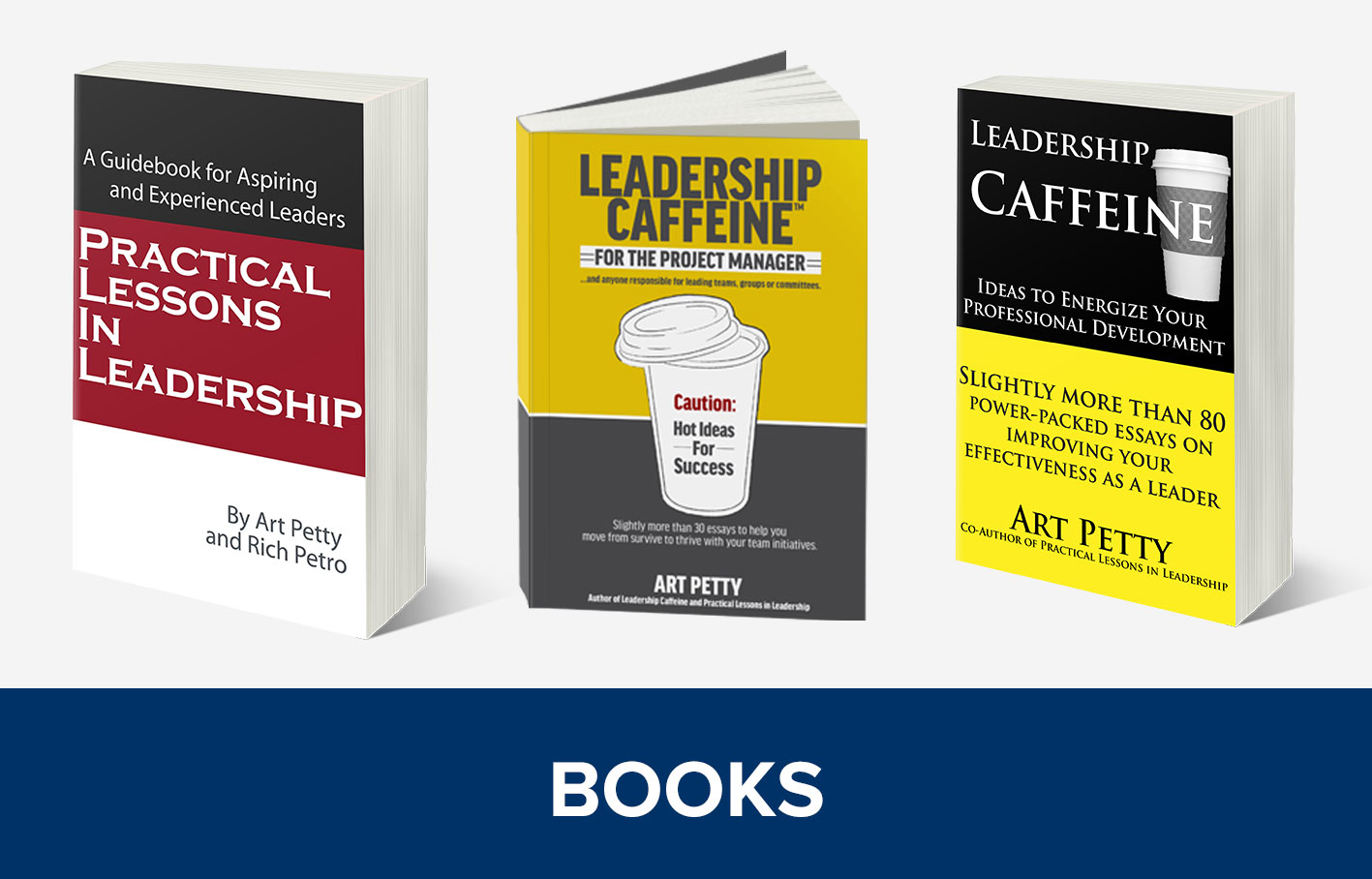
Don’t miss the next Leadership Caffeine-Newsletter! Register herebook cover: shows title Leadership Caffeine-Ideas to Energize Your Professional Development by Art Petty. Includes image of a coffee cup.

For more ideas on professional development-one sound bite at a time, check out Art’s latest book: Leadership Caffeine-Ideas to Energize Your Professional Development

Download a free excerpt of Leadership Caffeine (the book) at Art’s facebook page.

New to leading or responsible for first time leader’s on your team? Subscribe to Art’s New Leader’s e-News.

An ideal book for anyone starting out in leadership: Practical Lessons in Leadership by Art Petty and Rich Petro.

Need help with Feedback? Art’s new online program: Learning to Master Feedback

 Note: for volume orders of one or both books, drop Art a note for pricing information.


Good People or Good Ideas? The Importance of the Working Environment

Ed Catmul, cofounder of Pixar and president of Pixar and Disney Animation Studios offers his perspective on the people versus ideas question in a powerful and practical leadership article entitled: How Pixar Fosters Collective Creativity, in the September, 2008 issue of the Harvard Business Review.

Mr. Catmul is quick to offer his selection of “people” over ideas, a choice that almost might seem counter intuitive for the leader of an organization that clearly wins or loses on big ideas.  While acknowledging that great creativity is essential starting with the “High Concept” (the high-level idea for a new production) and continuing through thousands of steps to completing the project, he submits that it is the working environment that allows this creativity to emerge and evolve rapidly and effectively.  (As an aside, his description of moving from the “high concept” to the finished product as “an archaeological dig where you don’t know what you’re looking for or whether you will even find anything,” wonderfully describes the reality of the creative process in so many functions and industries.  As leaders, we are well served to remember that creativity doesn’t happen on command and rarely on schedule.”

Your Priority as a Leader: Create the Right Working Environment

Catmul’s thesis: getting talented people to work together requires a working environment that nurtures trusting and respectful relationships and unleashes everyone’s creativity, is valid for leaders at all levels and all situations.  The concept of creating the effective working environment is so important to me that it earned a full chapter in my portion of my book with Rich Petro, Practical Lessons in Leadership.  It is also the essence of my description of “The Leader’s Charter” which starts out with the words…”The true role of a leader is to create an environment that… .” 

Mr. Catmull offers that while “most executives at least pay lip service to the notion that they need to get good people and should set their standards high, how many understand the importance of creating an environment that supports great people and encourages them to support one another so the whole is far greater than the sum of the parts.” 

This great article goes on to tie in Pixar’s three key operating principles as powerful components of their effective working environment:

  • Everyone must have the freedom to communicate with anyone (my phrase: an effective feedback culture)
  • It must be safe for everyone to offer ideas (feedback culture again)
  • Stay close to innovations in the academic community (my interpretation: foster a learning organization). 

Pixar’s operating principles emphasizing open communications, mutual respect and the development of trust are bolstered by a refreshing attitude towards risk:

"Management’s job is not to prevent risk but to build the capability to recover when failures occur." 

And on pursuing a compelling vision:

"We as executives have to resist our natural tendency to avoid or minimize risks, which is of course much easier said than done."

The Bottom-Line for Now:

After many years of leading and now several years of working with aspiring and experienced leaders in all manner of industries and cultures, I remain convinced that most individuals lack proper context for their role as leaders.  The great leaders at all levels understand that they have a unique responsibility and unique power to adapt and form their working environment to the unique circumstances at a point in time.  Less effective leaders allow the environment to form around the wrong issues including ego (theirs) and petty politics.  The lessons of Pixar are hard-won and the outcomes visible to all.  You would be well served to listen, learn and apply some of Mr. Catmul’s wisdom to your environment. 

Decision-Making and The Three Rules of Risk Management

Your decision-making style says a lot about you as a leader.  Some people make a lot of decisions with little more than a gut hunch to guide them and others spend a lot of time gathering insights and information to support their decision.  Others struggle to make decisions on anything and might still be considering what to order for breakfast when it’s time for dinner.  And still others avoid making decisions because taking a stand increases the odds that they will be held accountable for results.  

Our decision-making style is driven in large part by our tolerance of risk, something that can change based on many personal and professional circumstances.  An executive guiding a turn-around might operate with a high-degree of risk tolerance, while a project manager leading a construction project might have a much lower risk tolerance.  First-time leaders might not have formed a solid decision-making style and might process risk at a slightly more conservative level than how they perceive their direct manager dealing with it. 

A participant in a recent leadership workshop that I conducted offered up the Three Rules of Risk Management that she learned from her father (an engineer).  I am grateful that she shared and appreciative of the wisdom her father passed along in these simple but powerful rules.

The Three Rules of Risk Management


1. Don’t risk more than you can afford to lose
.

Good advice for corporate leaders, mid-level managers and everyone in their personal lives.  Determining what you can “afford to lose” is of course the key issue here, and sometimes not so easy to calculate.  A patient requiring a heart-transplant to live has one definition and a single parent that needs a paycheck to feed his family has another.  It’s OK to agonize over this one a bit…it is the foundational data point of the Three Rules.

2. Never risk a lot for a little.

Common sense, yes, but I see this one violated everyday. People risk their credibility arguing over who’s right and who’s wrong on small issues.  Boards and executive teams pursue ill-conceived acquisitions based on questionable assumptions.  Marketing and development teams invest heavily in new products without a good understanding of the problem they are trying to solve for their prospective buyers. The operative issue here is defining whether the perceived end game or outcome is worth a lot (usually the assumption) or some fraction of a lot (usually reality).  Align risk with the true definition of the outcome.

3. In general, take the risk if you can affect the outcome.

In my opinion, this is the most profound of the three rules, and another point worth agonizing over as you formulate your decision.  Hoping that the dice roll your way is what helped build all of those grand palaces in Las Vegas.  You cannot control the dice…they have a mind of their own, and in a business environment, hoping for the market to move your way is a guarantee that you will make your better-prepared competitor rich.  You cannot affect the outcome of most situations at 100 percent, so once again, you are left to sort what you can control and what is beyond your control.  This rule guides you to accept risk if you can control a significant portion of the outcome. 

The Bottom-Line for Now:

Learning to think through your risk-environment can help you make the right calls on the tough issues.  The Three Rules are not a silver-bullet, but they do offer a simple framework for mentally processing the implications of a decision. 

In general, I’ve found that most people prefer working for leaders that make a lot of decisions and that make decisions quickly.  Certainly, a leader that is slow to make up her mind or that will never make a decision has an adverse impact on her team and her organization.  Alternatively, a leader that is too fast to decide or that decides more on a hunch than a good understanding of the facts, issues and risks, is prone to making significant mistakes as well.  The trick is finding the right balance, and balance is about understanding and measuring your risks against possible returns.  Use the Three Rules to find the right risk/return balance for your decisions. 

When Projects Go Horribly Wrong: A Great Example

The folks that designed Denver International Airport’s infamous baggage handling system can breathe a bit easier now.  While the much publicized start-up disasters at Denver have faded into the past, apparently the project management lessons learned did not transfer across the pond to the teams responsible for the new Terminal 5 at London’s Heathrow Airport.

[Read more...]

Coping Strategies for the Project Manager Facing an Executive Mandate on Schedule

One of the most common challenges for Project Managers and Engineering teams in new product development organizations is balancing the executive "time to market" mandate with good project estimation and risk analysis techniques.  Many a project has misfired after a CEO or top management group has boldly proclaimed to corporate stakeholders that, "Product X will be to market by (insert your aggressive date here).   

[Read more...]