Leadership Caffeine: 9 Ideas to Help You Jump the Gap Between Failure and Success
Filed under: Career, Leadership, Leadership Caffeine, Life and Business, Performance, Professional Growth, Your Professional Development "To Do" List
We didn’t see a way forward on this project, so we folded our tents and went home.
People and teams fail on their way to success all of the time. That’s great. That’s how it’s supposed to work. The people and groups I struggle with are those who just fail.
Often, the gap between failure and success appears wide, deep and ominous. This perceived gap keeps people frozen in place for a long while and then as time passes, fear turns to regret.
Regrets are soul killers.
Potential Author: I’ve always wanted to write a book, but who would care about what I have to say?
One thing is for certain…no one will care if you don’t start writing.
Newly unemployed individual: I need to go back to school. I’ve not upgraded my skills in 20-years.
There must have been a lot of great television shows on for those two decades.
Student: I didn’t study for the final because I was satisfied with a B.
Why? Really….why?
Potential Entrepreneur: I want to start this business. People have told me they will contract with me. I just don’t know where to start.
Start by putting one foot in front of the other. Ask for help. Talk to those who have already passed this way. Get going!
Flypaper and Failure:
Years ago, people hung flypaper in their homes to catch and kill flies. This sticky, poison-treated paper offers a nice metaphor for what happens to too many otherwise capable people. They view the distance to success as insurmountable, and instead of moving forward, they sit there, stuck, slowly poisoning themselves in their self-defeating thoughts.
Instead of being consumed by the poison of inactivity and regret while staring across a chasm that looks insurmountable, you need to get moving. If you’re leading others, now is the time to show that you know how to lead.
Nine Ideas to Help You Jump the Gap Between Failure and Success:
1. Start moving. Immediately. Don’t get caught on the flypaper. When you’re close to being stuck, remember that action overcomes stickiness. Now get going!
2. Run, don’t walk to download or purchase Steven Pressfield’s book, Do the Work. Based on his thoughts on “Resistance” outlined in The War of Art, this is the best kick-in-the-ass, get-moving book I’ve ever read. Buy one for everyone on your team if necessary. Pressfield will help all of you get unstuck and moving forward.
3. Ask for help. Get a good coach. We stink at coaching ourselves. Even coaches need coaches. And yes, teams can most definitely benefit from external coaching.
4. Flush your mind of the negative thoughts. Remember that no one cares that you think you cannot do something. No one. This is invisible to the world. It’s in your mind. However, people will care when they notice you doing something.
5. Ignore the critics. Critics show up once you start moving forward. Critics are typically people who feed on your actions because they don’t have any actions of their own. Ignore them.
6. Extra effort shrinks the failure gap. For writers, it’s butts in seats and hands on keyboards. For leaders, it’s often about taking the extra time to listen. For athletes, it’s the extra hour of training…beyond what’s expected or scheduled. No one has ever succeeded by doing too little. You know this…now, do something about it.
7. Get the toxicity out. More often than not, team troubles have their root causes in one or two toxic participants. These people are like critics. They have no actions of their own…only criticism of other people’s actions. Vote them off…or push them off.
8. Quit focusing on what you did wrong. Ask, what did I do right? Do more of it!
9. Become an Occasional Anthropologist. Go somewhere…anywhere but the couch or the office and watch people/customers in their native settings. Send your team out to the four corners of the earth. Observe and wonder. And then go back to work or back to your project and draw upon those observations for ideas and energy.
The Bottom-Line for Now:
The gap between failure and success is often much smaller than it appears. The catch is that you have to start moving to shrink the perceived gap and move towards success. Whether it’s your own professional development or that personal dream or aspiration, there’s only one way to jump the gap. Start moving now…and then start running. Happy landings!
–
About Art Petty:
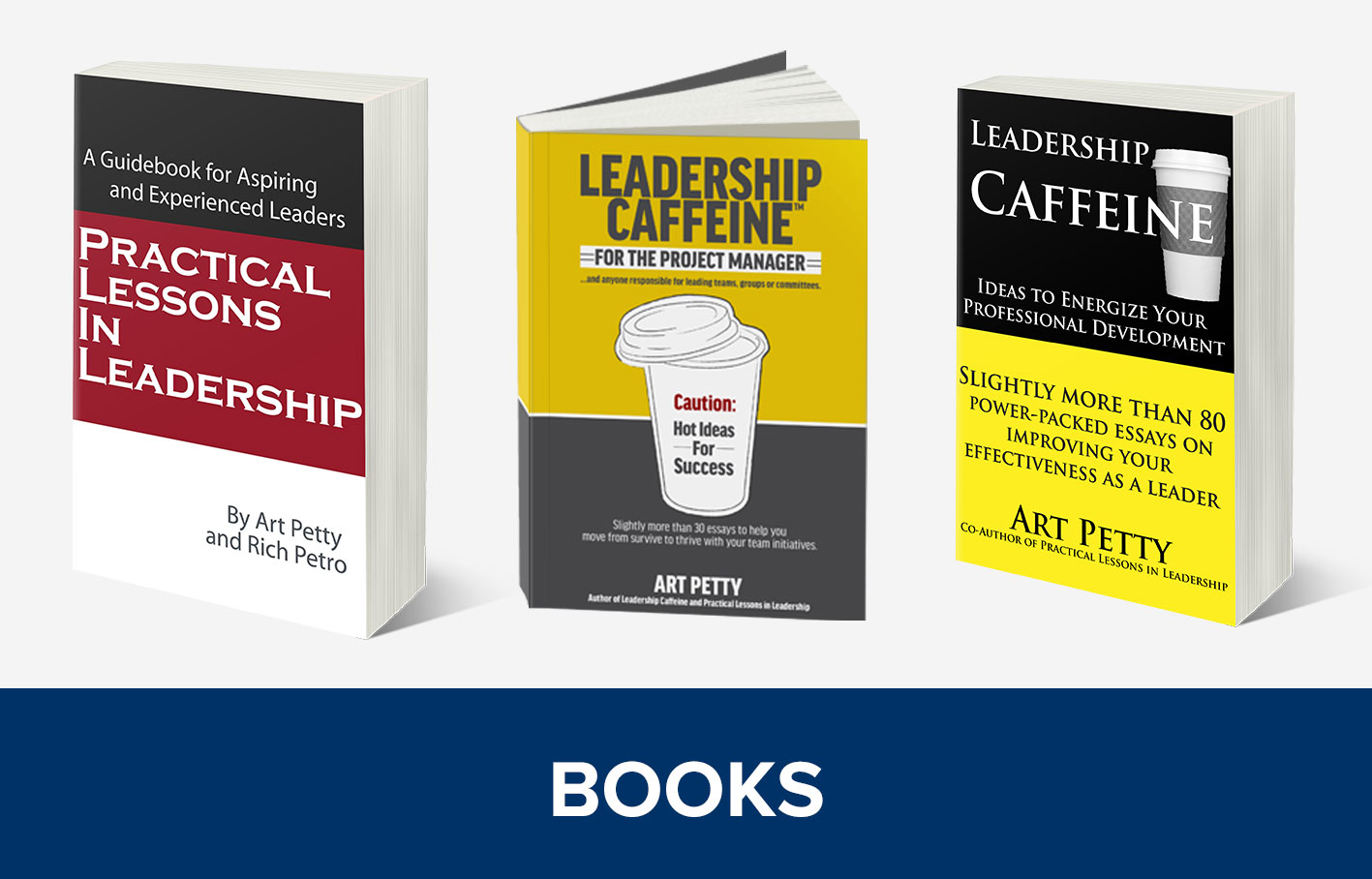
Art Petty is a Leadership & Career Coach helping motivated professionals of all levels achieve their potential. In addition to working with highly motivated professionals, Art frequently works with project teams in pursuit of high performance. Art’s second book, Leadership Caffeine-Ideas to Energize Your Professional Development, will be published in September of 2011.
Contact Art via e-mail to discuss a coaching, workshop or speaking engagement.
It’s Time to Recognize the Project Manager as a Leader
The most challenging leadership positions are the informal roles where an individual leads based on his or her credibility and capability without the backing of a formal reporting structure. These positions are often characterized by a high-level or responsibility for results with little direct authority over the people doing the work. The role of Project Manager matches this description perfectly, with organizations increasingly looking to the individuals charged with project or program management to play key roles in executing on strategic priorities.
Unfortunately, in many organizations, the role of Project Manager is inappropriately disconnected from the strategy process and is often viewed and treated by executives as a mid-level or administrative role. This is wrong. Senior executives would be wise to tap into the unique skills, insights and capabilities of the best Project Managers as they look to build out their leadership teams and to propel their organizations faster.
Want to Change? Manage Strategy in Bursts!
Filed under: Leadership, Organizational Transformation, Project Management, Strategy
Traditional strategic planning approaches often fail to deliver the results that firms require to jump start growth or pull out of a sustained decline. Legacy approaches emphasize a periodic focus on strategy—often an annual refresh against a long-range plan. This “strategy as an event” approach is increasingly obsolete in a world that changes overnight, with markets being born, maturing and dying at hyper-speed. Instead, what is needed is a more dynamic means for professionals to experiment, innovate and to assess results and refine activities in near-real time.
Organizations that learn to work in “Strategy Bursts” are able to learn, adapt and refine their strategic activities faster than more plodding competitors, but this new style requires learning and internalizing a new approach to strategy management and execution. For many leaders and executives, succeeding with this new model requires letting go of old strategy habits and biases.
Sales and Marketing Managers: Use the Lead Refinery Approach to Improve Results
I talk with a lot of marketing and sales managers and have spent most of my life working in these environments. In spite of the dramatic advancements in software tools available, I still find gaping holes in the way many sales and marketing organizations manage and account for the flow of leads into the sales pipeline. Although there are undoubtedly some technology constraints, I suspect that the primary issue is one of process more than anything else. Employed properly, changes in the output of the lead refinery foreshadow expansion or contraction of volume in the sales pipeline.
Here are some thought-starters for employing the Lead Refinery approach to improve your performance:
Would You Work for This Character?
"The only way that you will succeed on my team is if you are married to the job!"
"The reason that I am not in any family vacation pictures is because I’m on the phone. If I’m in the picture, I have a blackberry stuck to my ear."
Yeesh. What a jerk!
The quotes speak volumes about this individual’s leadership style, priorities and character. A "my way or the highway" approach, coupled with an "I will succeed on the backs of your labor and you will help me succeed or else," philosophy. It also speaks volumes about the culture in the organization that tolerates this leader’s style.