Just One Thing: How to Defuse Difficult Workplace Discussions

Just One ThingAlmost all of us get this wrong in the professional environment at some time or another. Myself included.

We find ourselves in a tense situation with someone or some group who is attempting to assert a direction or insert themselves into the area we perceive as our domain, and we react by aggressively defending our position and by challenging or attacking their position.

In this situation, the part of our brain that says “fight” has won, and by dealing with the situation as a turf battle or a battle over “how” we’ve given up the chance to learn, advance and importantly, help our team or our firm.

The opportunity and the challenge is for us to take a step back and focus on uncovering the interests of our colleague (the Why) and to reconcile his or her interests with our own core thinking on the issue.

5 Ideas to Help Derail Arguments by Uncovering Interests:

1. Learn to recognize and tame your “fight” response when approached with a position-based assertion or encroachment from a co-worker. Your natural inclination is to react in kind. The right inclination is to pause and recognize the situation as an opportunity to move towards interest clarity.

2. Use “Why?” questions to uncover interests. One of the tools popularized in the Toyota Production System,  the “5 Whys Method,” is an example of this at work. When someone presents you with an idea or need, a series of “why-focused” questions will help you move from position to the essence or interest behind the idea. While it can be obnoxious to respond to every utterance of your co-worker with “Why?” you can creatively adapt this technique to fit your situation.

3. Lead the conversation by example and share your own interests. Effective resolution requires a dialog and it’s fine to be the first one to open up on the drivers behind the issue at hand. You immediately change the tone and tenor of the conversation by moving off of position and on to the motives and intentions for your approach. Your counterpart will typically respond in kind.

4. Seize and single out convergent interests. Too many people end up arguing points they already agree upon. Capture points of alignment, acknowledge the agreement and move on to identifying and discussing any divergent interests.

5. Add an objective third party to the discussion on remaining divergent interests. The objective 3rd party can listen and probe and help whittle down points of seeming divergence to their base level. Unless you’re faced with a world-domination versus let’s all live peacefully set of opposed interests, most workplace topics share a common set of interests around one or more of: improve, learn, reduce, strengthen, move faster etc, and this third party can help both of you zero in on the points of alignment.

 The Bottom-Line for Now:

Like it or not, our world of work is held hostage to our ability to communicate effectively with each other. Focusing on interests and eliminating the arguments over positions is a great way to improve communication effectiveness and gain better alignment in your organization.

More Professional Development Reads from Art Petty:book cover: shows title Leadership Caffeine-Ideas to Energize Your Professional Development by Art Petty. Includes image of a coffee cup.

Don’t miss the next Leadership Caffeine-Newsletter! Register here

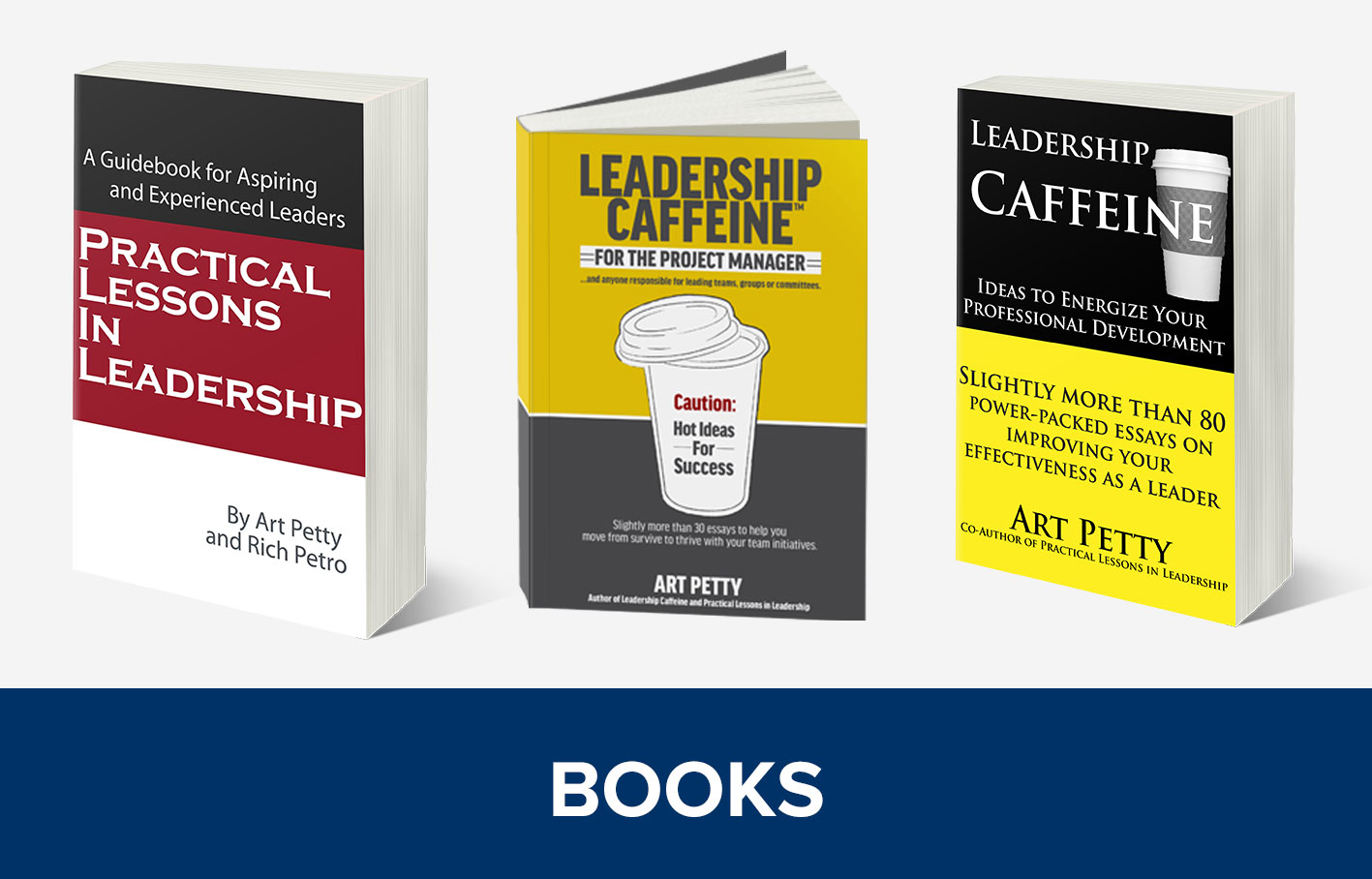
For more ideas on professional development-one sound bite at a time, check out Art’s latest book: Leadership Caffeine-Ideas to Energize Your Professional Development.

New to leading or responsible for first time leader’s on your team? Subscribe to Art’s New Leader’s e-News.

An ideal book for anyone starting out in leadership: Practical Lessons in Leadership by Art Petty and Rich Petro.


Just One Thing: Leading is Lonely Work

Image of an elevator button with the number 1 and the braile equivalent

Water, water, every where,
And all the boards did shrink;
Water, water, every where,
Nor any drop to drink.

-Coleridge: The Rime of the Ancient Mariner

Leading is lonely work. The higher you climb on the ladder, the tougher and lonelier the decisions become. Get used to it.

No one ever signed on as a senior leader because of the potential for camaraderie.

At the end of the day, you own the hard calls on people and direction. While your “kitchen cabinet” of advisers will offer opinions aplenty, there’s no avoiding that moment in time when your stomach is churning and the face you are staring at in the mirror matches the turmoil in your gut.

Your leadership character is forged in these moments of intense self-doubt. Accountability and responsibility are on your shoulders, but fear and uncertainty rent space in your mind. The best leaders fight through the fear. They understand that a non-decision is typically the worst outcome.  And they make a decision. Alone.

“Okay, We’ll Go.” –General Eisenhower on the decision to launch the invasion of Normandy in spite of less than optimal weather and the conflicting opinions from his advisers.  While estimates vary, casualties were as high as 10,000 on this day, yet this decision to go at that moment in time set the stage for the end of World War II.

Contrary to popular belief, senior leaders don’t have a more accurate view to the future than others. They may have a clear view to the risks, but they most certainly don’t have a crystal ball that foretells how major decisions and directional choices will unfold. Yet, they make these tough calls, because they know the cost of not moving forward is high.

The Bottom-Line for Now:

No magical lists of “Ten Things To Do,” here, just a statement of reality. If you aspire to senior leadership, expect to spend a fair amount of time navigating alone. Surround yourself with the smartest people you can find and seek their counsel. Use data to your advantage. Learn from prior mistakes. And importantly, learn to accept that those moments in time when you are staring back at yourself in the mirror and your stomach is churning over the pending decision, are those moments when you are doing your job.

More Professional Development Reads from Art Petty:

Don’t miss the next Leadership Caffeine-Newsletter! Register herebook cover: shows title Leadership Caffeine-Ideas to Energize Your Professional Development by Art Petty. Includes image of a coffee cup.

For more ideas on professional development-one sound bite at a time, check out Art’s latest book: Leadership Caffeine-Ideas to Energize Your Professional Development

Download a free excerpt of Leadership Caffeine (the book) at Art’s facebook page.

New to leading or responsible for first time leader’s on your team? Subscribe to Art’s New Leader’s e-News.

An ideal book for anyone starting out in leadership: Practical Lessons in Leadership by Art Petty and Rich Petro.

Need help with Feedback? Art’s new online program: Learning to Master Feedback

 Note: for volume orders of one or both books, drop Art a note for pricing information.

Just One Thing: Will This Make the Boat Go Faster?

Image of an elevator button with the number 1 and the braile equivalent

Just One Thing

“Will this make the boat go faster?” is my new favorite question. I may quickly wear it out with my colleagues, but I suspect I’ll get my point across.

The original context according to Mark De Rond, writing in his excellent book, “There is an I in Team,” is from Rowing Club Manager, Roger Stephens, who when presented with an idea concerning his team would respond, “Will this make the boat go faster?”

Think of the myriad of situations you experience on a daily basis in the name of business performance where this question might serve as a valuable filter. Here are a few from me…please add your own.

At Least 5 Situations Where The Boat is Not Moving Any Faster:

1. The 8:00 a.m. around the table death march of updates from every functional manager. Nope, not making the boat move any faster.

2. The 437th status update on the IT project from hell.  Definitely not faster.

3. The brainstorming meeting where the boss critiques every idea. The boat is slowing down!

4. The corporate proctology exam that passes for a sales forecast review with bean counters on another continent all trying to ask vexing questions that make the small amount of hair left on the sales manager’s head truly hurt. No faster boat here.

5. The corporate offsite where someone straps you into a canoe with a half-wit from another department and expects you to come out the other end of the river with a new sense of teamwork and camaraderie. The boat may hit the rocks on this one!

The Bottom-Line for Now:

The world of work may well become a better place if we would simply filter a few more activities with this very succinct and clear question: “Will this make our boat go faster?”  If not, just say “no.”

Related Reading-Your Message and the Chicken Salad Sandwich Test

More Professional Development Reads from Art Petty:

Don’t miss the next Leadership Caffeine-Newsletter! Register herebook cover: shows title Leadership Caffeine-Ideas to Energize Your Professional Development by Art Petty. Includes image of a coffee cup.

For more ideas on professional development-one sound bite at a time, check out Art’s latest book: Leadership Caffeine-Ideas to Energize Your Professional Development

Download a free excerpt of Leadership Caffeine (the book) at Art’s facebook page.

New to leading or responsible for first time leader’s on your team? Subscribe to Art’s New Leader’s e-News.

An ideal book for anyone starting out in leadership: Practical Lessons in Leadership by Art Petty and Rich Petro.

Need help with Feedback? Art’s new online program: Learning to Master Feedback

 Note: for volume orders of one or both books, drop Art a note for pricing information.

Just One Thing-Seize That Opportunity

Image of an elevator button with the number 1 and the braile equivalent

Just One Thing

When opportunity knocks, all too often our gut reaction is to hesitate. In more than a few situations, we might be better off telling our gut to shut-up and let our feet answer by moving forward. 

Over my six years of solo practice (and during my corporate career), I’ve encountered many who have agonized over what turned out to be well-qualified opportunities to change. These aren’t the let’s sell everything and open a hot dog stand variety, but rather, they are the promotions that mean new responsibilities, the lateral moves to different groups and the job offers in new industries.

Yes, new opportunities mean breaking your routine, pushing yourself beyond the familiar and exposing yourself to unknown risks. Of course, the flip-side of stepping across the Chasm of Change is that you open yourself up to new discoveries, new people and new opportunities for success.

In my ad hoc but extensive polling of people who have faced opportunities for change, the feedback is telling.

  • Almost everyone who seized what had seemed like a daunting opportunity described their decision to make the move as a pivotal point in their career.  
  • Of those few who indicated that the new opportunity didn’t work out, almost all described it as an important steppingstone to something better.
  • The only people who expressed regrets are those who said “no” to change and remained in place.  

The Bottom-Line for Now:

Don’t step blindly into something new for the sake of change, but don’t let the fear of change keep you from stepping into the new opportunity.  The noise from your gut might just be indigestion.

Just One Thing: Learn to Fight Your Negativity Bias

chalkboard with printing and check boxes: half full half emptyFrom Dr. Amit Sood, Chair, Mayo Mind Body Initiative in: Train Your Brain, Engage Your Heart, Transform Your Life:

“Research suggests that the human mind has a propensity to pay greater attention to and process the bad compared to the good, a phenomenon often called the negativity bias. Bad feedback has greater impact; bad impressions are quicker to form; bad information is processed more thoroughly…and negative stereotypes are easier to form.”

We all know people who seem to thrive on the negatives in life. They can look at what is perceived by others as a beautiful picture and spot the flaws, almost taking pride in their role as watchdogs against perfection.

“Your little Italian lights aren’t twinkling, Clark.”  “I know, and thanks for pointing that out, Arthur.” Paraphrased from the movie, National Lampoon’s Christmas Vacation.

While some verbalize their negative views on everything, many of us struggle to control this demon internally. We get down and stay down after some negative feedback. We focus on the impending catastrophe in our lives and in our jobs. It’s usually just out of reach, but surely getting closer by the moment. We forget to celebrate the victories and life’s special moments because we’re preoccupied on all that’s wrong in our lives, workplaces and careers. 

A Really Short Course in How the Brain Works:

While the neuroscience of it is beyond my training,  as Dr. Sood describes, we have two primary centers of the brain that control our thoughts: the higher cortical and the lower limbic centers. “Increased activity of the lower limbic center makes you anxious, unhappy, depressed and stressed. Activation of the brain’s higher cortical center helps you be calm, happy joyous and resilient.”

And while the choice is our in terms of which center of the brain to activate, for many of us, our natural propensity is to focus on the lower limbic center.  Our evolutionary wiring seems to support our ease for accessing the negative versus the positive. Dr. Sood uses the analogy of a short, fast broadband connection to the lower limbic center and a long slow, narrow band connection to the higher cortical center, to describe our human wiring. In other words, we’re predisposed to spend our time playing in the mental gym of negativity and stress than we are that very different place of mindfulness, peace and positivity. 

4 Ideas to Add Bandwidth to Your Positive Brain Center

1. Read and Apply: Dr. Sood’s book is a program in his words to: “enhance attention, decrease stress; cultivate peace, joy and resilience; and practice presence with love.” I love his research-backed perspective and Mayo Clinic legitimacy…rare assets in the self-help community. Another source focused on teams and the workplace is Shirzad Chamine’s recent book, “Positive Intelligence.”

2. Get Help: A professional I admire a great deal recently indicated that she sought help from a personal coach to combat “negative self-talk.” Objective feedback and direct support for retraining our brains are two of the dividends of engaging a qualified coach. If you recognize your propensity to go negative, and if the books don’t cut it, get some qualified help.

3. Ignore Unsolicited Negative Feedback: Not all feedback is created equal. The negative review of your book on Amazon or the consistently negative comments from your boss or a co-worker are gasoline for our negativity engine hanging out there in the lower limbic center. While easy to say, train yourself to solicit and focus on feedback (both constructive and positive) from trusted, quality sources. Ignore everything else.

4. Work on Your Positive Communication. In my feedback courses and coaching, I find that one of the most difficult issues for people to grasp is the need to deliver ample quantities of positive (behavioral and business-focused feedback). I teach a technique for this and I encourage people to spend a few weeks and keep a tally of their positive to constructive feedback ratio. Most start out at a negative ratio…and the target is to get to a 3:1 positive to constructive. Those who have succeeded at this, report the greatest improvement in their own work performance and working environments.

(Shameless plug: my new online course-Learning to Master Feedback, will help any professional with this positive feedback issue!)

The Bottom-Line for Now:

We do have a choice to take our comments and our thoughts negative. I’ve found that governing the negative output (comments) is somewhat easier than managing our internal negative self-talk. Nonetheless, one supports the other. Seek help, get help and work hard at fighting off your negativity demons and you’ll be a much happier, healthier and more effective leader and person.

Don’t miss the next Leadership Caffeine-Newsletter! Register here.

For more ideas on professional development-one sound bite at a time, check our Art’s latest book: Leadership Caffeine-Ideas to Enebook cover: shows title Leadership Caffeine-Ideas to Energize Your Professional Development by Art Petty. Includes image of a coffee cup.rgize Your Professional Development

Download a free excerpt of Leadership Caffeine (the book) at Art’s facebook page.

New to leading or responsible for first time leader’s on your team? Subscribe to Art’ New Leader’s e-News.

An ideal book for anyone starting our in leadership: Practical Lessons in Leadership by Art Petty and Rich Petro.

Need help with Feedback? Art’s new online program: Learning to Master Feedback