Great Ideas: Management & Leadership Week in Review

October 14, 2011 by · 1 Comment
Filed under: Professional Growth 

Note from Art: My blogging patterns tend to change with the seasons, and now that summer has faded nicely into fall and I’m no longer migrating Up North every Friday, it’s time to bring back the Week in Review posts. Every week (ok, that’s not a promise, but an aspiration), I’ll offer a few articles/posts and an occasional book suggestion, that I believe are worth sharing and worth thinking about and even acting on in our lives. The topics will be eclectic with a slight emphasis on management and leadership. Enjoy!

-Speaking of eclectic, here’s an outstanding essay entitled: “My Years in the Wilderness” from author, Steven Pressfield, that stopped me in my tracks. Pressfield’s historical fiction is remarkable, and I truly love his content on “The War of Art,” applicable to anyone who is striving to achieve something and laboring to fend of what Pressfield describes as, “resistance.” This is another extremely personal essay on “The War of Art,” and while the emphasis is on the struggle to write, the message is broadly applicable to all of our endeavors to create and achieve.

-Jesse Lyn Stoner writing at Harvard Blogs offers us, “Diagnose and Cure Team Drift.” We’ve all been participants in teams or committees that started with a bang and ended with a whimper. Jesse offers us some tools to recognize and deal with the drift. As an aside, if you’ve not checked out Jesse’s work with Ken Blanchard, “Full Steam Ahead, 2nd edition,” you’ve missed the best book I’ve yet encountered on this often abstract topic. Jesse and Ken make it real and practical. (Also, check out my podcast with Jesse!)

-A Book Selection: Beyond Performance, by Scott Keller and Colin Price. This is a research-based book offering some fresh thinking on what it takes to create and sustain high performance over time. While this topic is the equivalent of the search for a unified theory of everything to business researchers and consultants, for the first time in a few decades, I’m optimistic that there’s a work-product here that moves us closer. The concept of Organizational Health, backed by a decade’s worth of research, offers some compelling and actionable ideas and a lot of evidence. As much as I love Jim Collins, I’ve been looking for something to fill that empty gap on my bookshelf,  left by my disposal of Good to Great.

-From Tanveer Naseer, a thoughtful and thought-provoking piece on, “What Does the World Really Need from Today’s Leaders?” Tanveer raises some important issues in a world that is seemingly begging for effective leaders and leadership. This merits consideration and discussion, and Tanveer’s mini-manifesto here is a great place to start. Visit for the essay and stay for his consistently great content.

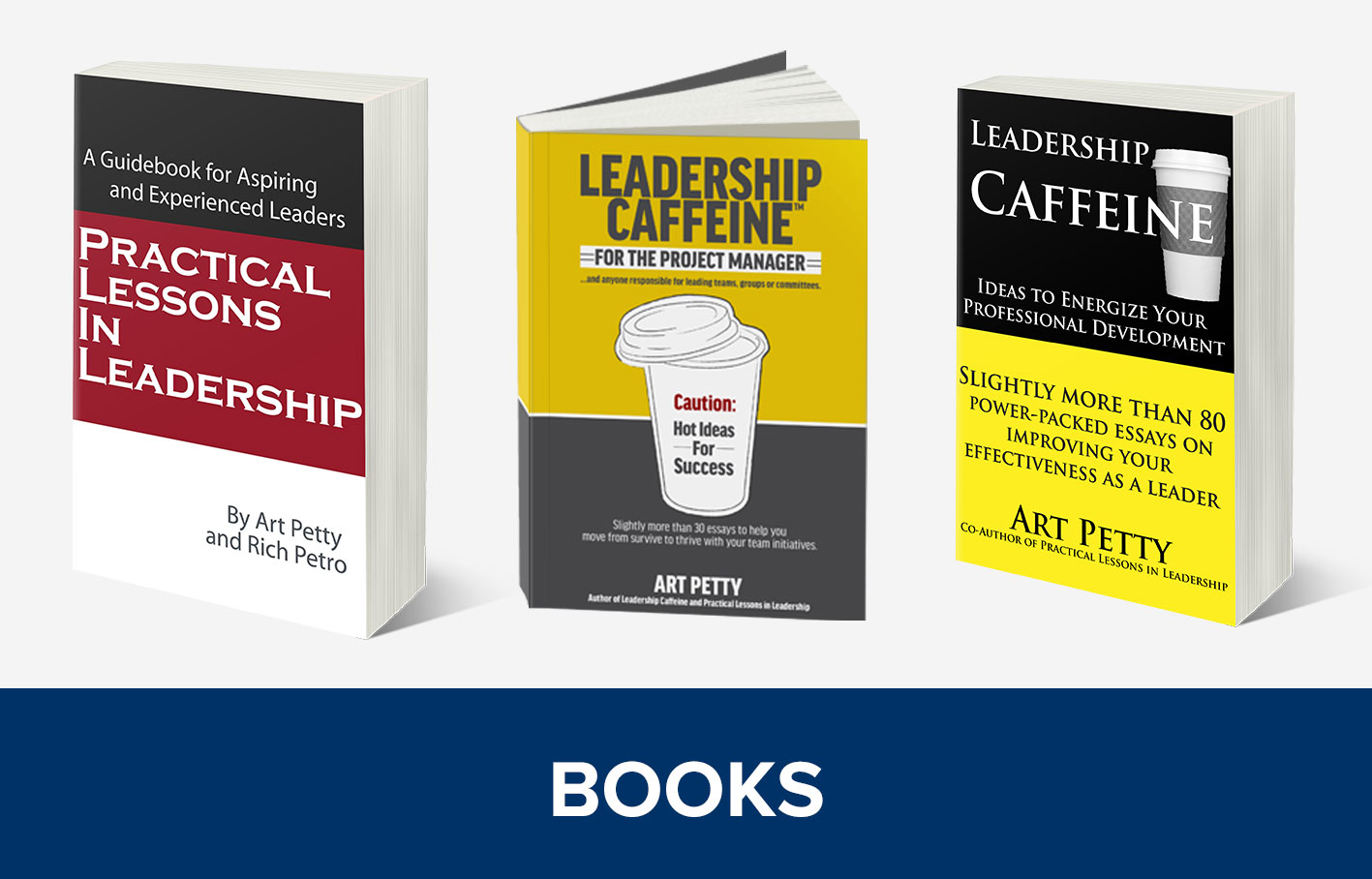
JUST RELEASED! Check Out Art’s New Book: Leadership Caffeine-Ideas to Energize Your Professional Development

More than 80 quick reads filled with ideas to lead teams, manage yourself, survive the tough days and generally improve your performance and success as a professional. This book is ideal for motivated professionals and it is particularly powerful for teams and leadership and performance discussion groups. Take advantage of my group book promotion while it lasts!

Want More: Sign up for the new, Leadership Caffeine e-Newsletter. (publishing in October)  I’ll guard your e-mail address with ferocity, while sharing ideas to energize and inspire.

About Art Petty:

Art Petty is a Leadership & Career Coach and Strategy Consultant, helping motivated professionals of all levels achieve their potential. In addition to working with highly motivated professionals, Art frequently works with project teams in pursuit of high performance. Art’s second book (an edited, annotated collection of the most popular leadership essays), Leadership Caffeine-Ideas to Energize Your Professional Development, was released at the end of September in 2011.

Contact Art via e-mail to discuss a coaching, workshop or speaking engagement.

January Leadership Development Carnival!

January 2, 2011 by · Leave a Comment
Filed under: Leadership 

One of my favorite moments every month is strolling through the latest Leadership Development Carnival, hosted by the generous, popular and might I add, remarkably intelligent , Dan McCarthy, proprietor of the aptly named, Great Leadership blog.

Dan was kind enough to include my post on, “How to Appropriately Respond to Positive Praise,” and we’ll see how he handles my flowery (but heartfelt) words above!

Regardless of whether you’re snowed-in, tucked in your new Christmas Snuggee (or whatever that thing is that I keep seeing on television) or, just simply interesting in finding some great inspiration to kick off the new year, spend some time at the Carnival and remember to stay for Dan’s consistently great blogging content!

Leadership Development Carnival #4: A One-Stop Shop for Great Ideas

October 4, 2008 by · Leave a Comment
Filed under: Leadership 

I am pleased to be included in some great company again this month at the latest Leadership Development Carnival hosted at Great Leadership.  Dan McCarthy brings together  the perspectives of some exciting Carnival newcomers and some industry stalwarts.  Dan's monthly Carnivals may be the best leadership deal going…great content, ideas that you can use immediately and the price is definitely right. Grab a cup of coffee or favorite beverage and take a stroll through the Carnival.  You will be glad that you did. 

Good People or Good Ideas? The Importance of the Working Environment

September 10, 2008 by · 1 Comment
Filed under: Leadership, Leading Change 

Ed Catmul, cofounder of Pixar and president of Pixar and Disney Animation Studios offers his perspective on the people versus ideas question in a powerful and practical leadership article entitled: How Pixar Fosters Collective Creativity, in the September, 2008 issue of the Harvard Business Review.

Mr. Catmul is quick to offer his selection of “people” over ideas, a choice that almost might seem counter intuitive for the leader of an organization that clearly wins or loses on big ideas.  While acknowledging that great creativity is essential starting with the “High Concept” (the high-level idea for a new production) and continuing through thousands of steps to completing the project, he submits that it is the working environment that allows this creativity to emerge and evolve rapidly and effectively.  (As an aside, his description of moving from the “high concept” to the finished product as “an archaeological dig where you don’t know what you’re looking for or whether you will even find anything,” wonderfully describes the reality of the creative process in so many functions and industries.  As leaders, we are well served to remember that creativity doesn’t happen on command and rarely on schedule.”

Your Priority as a Leader: Create the Right Working Environment

Catmul’s thesis: getting talented people to work together requires a working environment that nurtures trusting and respectful relationships and unleashes everyone’s creativity, is valid for leaders at all levels and all situations.  The concept of creating the effective working environment is so important to me that it earned a full chapter in my portion of my book with Rich Petro, Practical Lessons in Leadership.  It is also the essence of my description of “The Leader’s Charter” which starts out with the words…”The true role of a leader is to create an environment that… .” 

Mr. Catmull offers that while “most executives at least pay lip service to the notion that they need to get good people and should set their standards high, how many understand the importance of creating an environment that supports great people and encourages them to support one another so the whole is far greater than the sum of the parts.” 

This great article goes on to tie in Pixar’s three key operating principles as powerful components of their effective working environment:

  • Everyone must have the freedom to communicate with anyone (my phrase: an effective feedback culture)
  • It must be safe for everyone to offer ideas (feedback culture again)
  • Stay close to innovations in the academic community (my interpretation: foster a learning organization). 

Pixar’s operating principles emphasizing open communications, mutual respect and the development of trust are bolstered by a refreshing attitude towards risk:

"Management’s job is not to prevent risk but to build the capability to recover when failures occur." 

And on pursuing a compelling vision:

"We as executives have to resist our natural tendency to avoid or minimize risks, which is of course much easier said than done."

The Bottom-Line for Now:

After many years of leading and now several years of working with aspiring and experienced leaders in all manner of industries and cultures, I remain convinced that most individuals lack proper context for their role as leaders.  The great leaders at all levels understand that they have a unique responsibility and unique power to adapt and form their working environment to the unique circumstances at a point in time.  Less effective leaders allow the environment to form around the wrong issues including ego (theirs) and petty politics.  The lessons of Pixar are hard-won and the outcomes visible to all.  You would be well served to listen, learn and apply some of Mr. Catmul’s wisdom to your environment. 

Ironically, Mid-Level Managers May Save Your Business

Ever since terms like reengineering, right sizing and downsizing became part of the corporate lexicon; midlevel managers have been taking it on the chin.  This once populous class has been synergized and right-sized almost to extinction.  Those that remain often struggle with spans of control as wide as the Golden Gate Bridge and limited authority that is constantly challenged from above and below.  I find it just a bit ironic (and appropriate) that this much-abused class of leader may just hold the key to surviving and prospering in tough times.

In a great article in the July 7. 2008 Wall Street Journal, entitled: In Search of Growth Leaders, authors Carr, Liedtka, Rosen and Wiltbank offer the results of their multi-year study of the role that midlevel managers play in fueling organic growth.  Their conclusion: “most companies have managers who can turbo charge results.  The trick is finding—and nurturing—them.  Read the article for some great insights on finding and developing these critical midlevel leaders. (And read my post: Management By Jane: Leading Effectively from the Middle for some additional thoughts.)

The Power of Great Managers in the Middle:

  • Appropriately trained and armed, midlevel managers are directly focusing on strategy execution—they lead the teams that do the work that drives performance. If your organization is failing to execute on strategic objectives, look to the middle, not to place blame, but to identify what you can do better to help your managers succeed.
  • As the article authors highlight, a tremendous amount of innovation comes from the middle.  In my own experience, the managers that fuel innovation are the ones that are relentless about creating the right conditions for their associates to succeed.   Breaking down barriers and taking the heat for bending the rules are common and comfortable tasks of the innovative midlevel manager.
  • The most important talent scouts and developers are often found in the middle of organizations.  The savvy manager recognizes the import of identifying and developing emerging leaders, competent role players and potentially brilliant individual contributors. While top management might want the organization to become good at this talent scouting and development, like strategy execution, the majority of the heavy lifting takes place in the middle.

Five Ideas to Strengthen Your Support and Success In the Middle:

1. Change your perspective on the midlevel management layer.  Instead of looking
at the organization chart and seeing cost to be minimized or taken out, look at this group as resources to enable strategy execution, fuel innovation and scout and develop talent.  Quit broadening spans of control to the point of ridiculousness, and begin setting goals around strategy, innovation and development, and suddenly the cost perspective starts melting away.

2. Involve midlevel managers in strategy formulation...not just in rubber-stamping the strategy formulated by executives.  Remember, the people in the middle likely understand your customers and your organization’s capabilities at a much more detailed level than those of you with V’s or C’s in your title.

3. Create systems to help midlevel managers experiment with and implement new ideas.  Provide key managers and manager groups with executive sponsors charged with cutting through corporate clutter to help get things done.

4. Reward successes, provide visibility and learn from misfires.  Easy words to write and speak, but realizing this environment takes discipline. 

5. Recognize the fact that new classes of virtual leaders…Project Managers and Product Managers have emerged over the past two decades to replace the former middle level.  These critical positions often carry tremendous responsibility burdens with little real authority across functional boundaries.  If these positions exist in your organizations, strive to create the sponsors, systems and infrastructure to allow them to perform.

6. As an executive, get over yourself.  No one said that you are required to have all of the answers.  It’s a sign of strength, not weakness if you are emotionally secure and intelligent enough to recognize that your strength comes from your ability to get the best from willing contributors. Take the time to invest in reinventing your leadership style.

The Bottom-Line for Now:

The article referenced above is must reading for every executive looking to solve the challenges of how to fuel organic growth.  Innovation doesn’t occur on command, and while good accidents happen (e.g. think 3M and Post-Its), hope as we all know is a lousy strategy. 

I teach, train and support midlevel managers in all forms of organizations and by and large, I find them generally miserable about their tasks and their ability to positively impact their organization.  The majority of their frustration stems from working for leaders that succeed in stifling the conditions required for innovation and execution to flourish.  The opportunity is in the middle…not the problem.  For the source of the problem, take a long, hard look in the mirror. 

Next Page »

  • Art Petty

    picture of Art Petty

  • e-Newsletter Sign-Up


  • Lead Change Member

Blog Subscriptions

Email:

RSS Feed Subscribe to Management Excellence

Connect With Me On

View Art Petty's profile on LinkedIn
Art Petty on Twitter