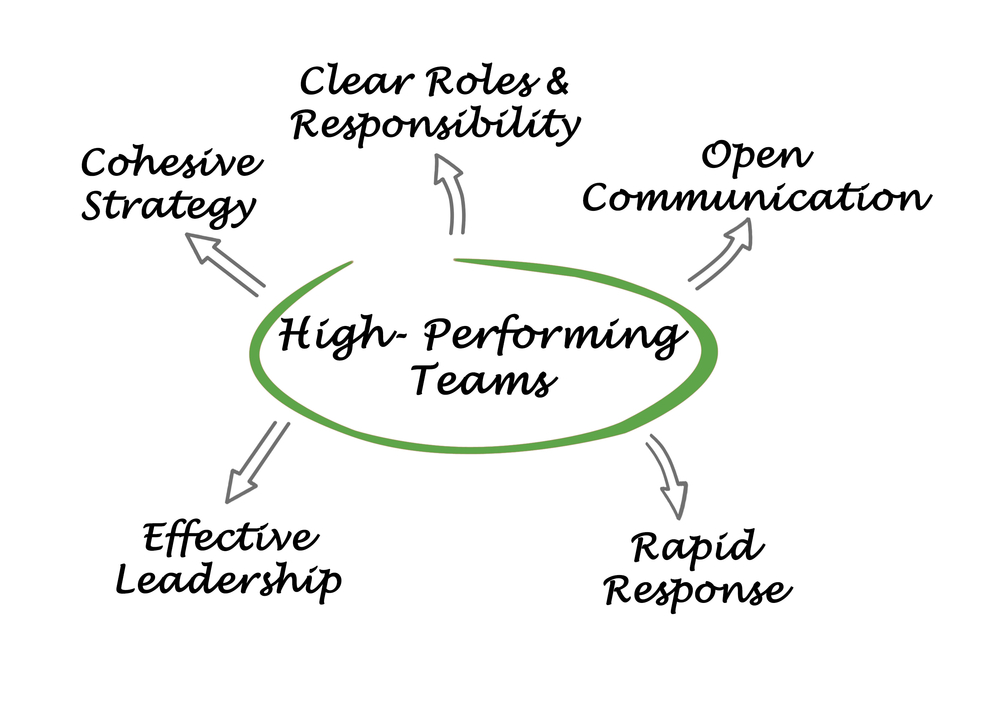
Leaders, Principles and the Pursuit of High Performance Teams

In high-performance teams, the leaders managed the principles and the principles managed the teams.” –Carl Larson and Frank LaFasto via Jim Highsmith in Agile Project Management-Creating Innovative Products.

Larson and LaFasto in their assessment of high performance teams offer us a profoundly powerful and simple to comprehend answer to the question of how to support the emergence of effective teams: clear, strong, actionable, livable principles beget an environment for effective collaboration and innovation.

Every high performance team I’ve experienced as a participant, a sponsor or an outside advisor, was governed by an overarching set of principles or values that formed and framed the culture. And while good words alone don’t create success, the combination of the leaders and participants living and acting according to those words everyday made things work.

On successful teams, the team leaders…and ultimately the participants eat and drink the principles for breakfast, communicate them constantly and most importantly, they live them in how they collaborate, problem-solve and challenge themselves and their team members forward in pursuit of success.

And since as we all know, even the best of teams face dark days when nothing goes right, the guiding principles serve as bedrock for self-reflection and guidance for navigating the way forward.

There’s a cautionary tale here. As Highsmith warns us, “Grand principles that generate no action are mere vapor.”  When engaging with an organization for the first time, I make it a habit to understand a firm’s values, and all too often, what I find are nice words…unarguable in their intent, that serve only to occupy space on a wall in a conference room. It’s a wholesale failure on the part of the leadership of an organization, when the guiding principles aren’t a visible part of everyday life.

Teams are a fact of life. We execute strategy via projects. We innovate on teams. We develop new products, improve processes and search for ways to better serve our customers via projects and teams. We darned well better figure out how to succeed at this more often than not. Right now, in too many organizations, “not” is winning.

The Bottom-Line for Now:

This intangible, sticky, squishy topic of operationalizing guiding principles or values doesn’t lend itself well to a prescriptive list of steps-to-success. The onus is on you as a team leader, project leader, functional leader, informal leader or organizational leader to ensure that your best efforts are supported by meaningful, actionable guiding principles. If you can’t articulate what those principles are and what they mean for behavior, accountability and performance, then it’s time to take a step back and tackle this issue. The effort will pay dividends going forward. Larson and LaFasto are right…leaders should manage the principles and the principles will manage the team.

Don’t miss the next Leadership Caffeine-Newsletter! Register here.

Art Petty is a Chicago-based management consultant focusing on strategy and leadership development. Art regularly speaks on innovation in management and leadership, and his work is reflected in two books, including the recent, Leadership Caffeine-Ideas to Energize Your Professional Development.  Art publishes regularly at The Management Excellence blog at http://artpetty.com

Prior to his solo career, Art spent 20+ years leading marketing sales and business units in systems and software organizations around the globe. You can follow Art on twitter: @artpetty and he can be reached via e-mail at art.petty@artpetty.com


Energy, Engagment and Some Science to Support High Performance Team Development

As a lifelong team participant and now devotee of leveraging the power of teams, I was fascinated and excited to see the article, “The New Science of Building Great Teams,” in the April, 2012 issue  of Harvard Business Review. (Subscription required for the full article…or check out the related HBR Blog Content for free.)

I suspect we are all for adding some science to the sticky, squishy and often problematic issue of how to get people to not only play nice together in the sandbox, but how to do so at a sustained high-level of performance.

While not to trivialize the findings of this extensive, sensor based, sociometric study, the authors engage in what seems to be a a great deal of razzle dazzle to conclude that levels of energy, engagement and exploration are the keys to assessing whether a team will perform at a high level or not. Raise your hand if you didn’t know that…and then excuse yourself from class.

Perhaps their most telling statement is: “A skeptic would argue that the points about energy, engagement and exploration are blindingly obvious.”  OK, I admit to feeling like I needed sunglasses at that less than startling conclusion.

In fairness, the authors continue beyond blindingly obvious with: “But the data from our research improve on conventional wisdom. They add an unprecedented level of precision to our observations, quantify the key dynamics and make them measurable to an extraordinary degree.”

OK. Again, I suspect we all can use some science and more precision in our work herding cats in pursuit of high performance.

A few additional points to ponder from the article:

  • 35% of the variation in a team’s performance can be accounted for by the number of face-to-face exchanges among team members.
  • In a typical high performance team, members are listening or speaking to the whole group only about half the time…the other half being one-on-one conversations.
  • Social time is critical to team performance… “often accounting for more than 50% of positive changes in communication patterns.”

In an important statement (which admittedly gives me cause to pause), the authors offer: “Without the data there’s simply no way to understand which dynamics drive successful teams.”

Excitement but Healthy Cynicism:

Who among us doesn’t want some help in building high performance teams? This study is fascinating for its potential, yet a bit frustrating in the “blindingly obvious” outcomes. The key it seems (and as the authors suggest) is to look deeper into the study outcomes for the insights that will lead to new approaches to building and managing. I’m interested and I suspect every student and practitioner of management is interested as well.

A quarter century of living on and with teams tells me that the dynamics change for every situation. I’m a bit uncomfortable imposing data and potentially inferring causation from correlation on something as complex as human interaction in varied situations. It might be easier to predict the weather accurately and consistently. Nonetheless, I’m hopeful we’ll gain some insights that can be applied in the workplace from projects like this one.

The Bottom-Line for Now:

I’m cheering for the authors of this type of research so don’t misconstrue my intent in the post. You’re getting my blink reaction. I need to read this article a few times to gain more insight beyond the “blindingly obvious” indication that the level (and quality) of energy, engagement and exploration relate to a team’s success. In particular, we all need to look for ideas and tools we can use from big, data-driven studies like the one behind this article.

For the moment, the best outcome for me is a firm, data-driven reminder that energy, engagement and exploration are critical. Now, how do we do a better job promoting the right kind of all three for that critical new innovation project? And that ERP implementation? And the new product development project? And the web site relaunch? And the sales force restructuring. And the… .


Team Conflict? As Long as It’s Not Personal, Run With It

group fightingI’m leery of happy teams. Don’t get me wrong.  I like positive situations and working with happy people, however, in my experience, the happy teams are the ones that produce mediocre results or, they don’t produce at all.

Give me a group of people that show up to do battle on the issues versus the team that strives for peace and harmony, any day.

Just as “being liked” isn’t required to be effective as a leader, neither is maintaining peace and harmony on the team required for success. What is required is the ability to push the envelope on creativity, talk openly and freely about problems and shortcomings, and to cry foul when someone violates the group’s norms for performance, behavior and accountability.

For many people, conflict in the team environment feels wrong.  It’s uncomfortable.  Conflict breeds personal stress and group tension, and sometimes creates a hue and cry for “getting along.”  While an aversion to conflict is understandable if it is personal in nature, task and process conflict are important factors in propelling high-performance teams forward.

5 Reasons a Dose of Conflict Might Be Healthy For Your Team:

1. Elephants aren’t allowed to hide in the room.  The big issues and tough topics are uncovered quickly and dispatched without worrying about personal interests and political boundaries.

2. Social loafing is squashed. Hanging out and working at less than full tilt becomes painfully obvious in environments where the group is challenging itself to move together through the jungle.  People pull their weight or they are left behind.

3. Decisions are held to a higher standard. While the potential pitfalls of group decision-making are well known, teams that challenge themselves and each other in pursuit of achievement tend to have higher standards for the quality of their decisions.  Instead of a rush-to-decide or a drive-to-consensus culture found on more collegial teams, task-focused groups search for answers that pass the filters for both quality and speed.  In my experience, they challenge assumptions, seek the right or at least better data and assess risks and implications much more effectively than the “let’s all get along” teams.

4. Leadership skills are challenged and strengthened. High task conflict teams are leadership laboratories.  One of the “elephants in the room” of my argument here is that leading these teams is not for the faint of heart.  Team leaders must learn to manage the flow and energy of the conflict to ensure that it doesn’t move into personal territory.  They also need to be adept at helping maneuver the team from the heat of robust dialogue to a decision and implementation.  These are clearly non-trivial leadership challenges and remarkable learning opportunities for all involved.

5. Standards for performance are enhanced. Participants refuse to settle for anything other than success, and success is often defined as either exceeding or obliterating targets or, innovating in some meaningful fashion.  The task conflict pushes people higher and harder.  Along the way, these high performance teams raise the bar for everyone in the organization.

The Bottom-Line for Now:

I suspect that I’m skating on the thin-ice of a great number of people that find conflict distressing and destructive.  Keep in mind that my context is task or process conflict, and not anything personal in nature.  It takes an emotionally intelligent group to pull this off and not let good and tough discussion over the right issues reduce to squabbling and paralysis. It’s hard work to find and foster this type of a team and environment.  But who said that producing high performance was easy work?  It’s most definitely not.

What’s Your High Performance Team Experience?

I love to talk with people that have led or been part of a high performance team (HPT).  Their enthusiasm is palpable.  These individuals have been to the promised land of corporate collaboration and achievement for a brief period in time and they are interested in going back.

I imagine that the experience of working on a HPT is a lot like winning a major sports championship.  Since I’ve been part of several HPTs, the imagine part is the major sports championship.  I would like to win the Super Bowl, but it’s probably not in the cards. I’ll have to settle with coaching teams and professionals to win the Super Bowl of project and business execution.

I talk with professionals a great deal about the topic of creating and leading HPTs, and invariably a part of the discussion includes defining just what this is.  Instead of offering my own sanitized, politically correct version of a HPT, I facilitate a group definition.  The exercise usually starts slow and builds.  I’ll paraphrase from recent flip chart notes.

A High Performance Team:

  • Meets or exceeds objectives.
  • A group that other people want to be a part of.
  • Focused on the end goal-passionate about the work.
  • Camaraderie
  • “We couldn’t wait to get to work.” and “Hated when the project ended.”
  • Group of people that thrive on meeting and beating challenges.
  • Group on a mission that is bigger than individual jobs.
  • Group that knows how to turn the unknowns into actions. (A learning team)
  • Operates with distinct set of values and a focus on personal accountability.
  • Knows how to fight and play together while focusing on objectives.
  • Celebrates victories and turns setbacks into new challenges

At this point, the discussion took off around the many characteristics behind these statements…mission, culture, context, accomplishment, values, personal identification and behavior and I quit capturing notes.  The gross majority agrees that participating on a HPT that has some or all of the above characteristics is highly desirable.

I inadvertently triggered an interesting flurry of tweets on this topic on Twitter yesterday, when I indicated that my formal and informal poll of professionals at all levels and in all different functions and industries shows that only 30% or so of professionals believe that they have been part of anything that resembles the HPT defined above. 

For those research purists, I’ll doubt you see my results showing up in an HBR article anytime soon, but the combination of “show of hands” and formal survey responses coupled with many hours of group discussions about this topic leaves me comfortable that the percentage is closer to accurate than not.  Of the 30% that do believe that they’ve been on a HPT, the majority indicates that they have not had this experience more than twice. 

The disturbing outcome of this discussion is always around the “why not?” for the other seventy percent.  The answers of course ultimately point back to issues of leadership and the over-riding leadership and performance culture.  Simply stated, the firm’s leaders have not created the environment needed for high performance teams to develop. 

We learn from both our successes and our failures.  For now, I am most interested in hearing about your own professional experience as part of a High Performance Team.  According to my numbers, so are approximately 70% of the rest of your peers. 

If you’ve been part of a HPT, please jump in and add to the flip chart list above.  Help answer some or all of the following:

  • What was your HPT experience like?
  • What conditions were in place in your organization that allowed this team to develop?
  • Have you been able to replicate this experience more than once?
  • What does leadership do right to enable high performance?
  • And any others that you care to mention.

Thanks for diving in and sharing your experiences.  We all would like to win the Super Bowl at least once.  Although twice or three times wouldn’t be bad either.  

Leadership Lessons from the Road

One of the great things about leading workshops with talented professionals is how much I learn about the very real challenges that people face in trying to get work done inside their organizations.  

I had the great privilege of facilitating a workshop called Leader Mastery for Technical Professionals at The Data Warehouse Institute’s World Conference in Las Vegas this past week.  Kudos to the team at TDWI for producing an outstanding educational conference and for their usual flawless arrangements.

A special thanks to the group of great professionals that had the courage at a technically focused conference to attend a day-long session on a topic that would have many heading in the opposite direction. This group was engaged, hungry for knowledge to improve their performance and excited about sharing ideas, challenges and best practices with each other.  The pleasure was all mine!

After spending a day together helping this group develop a better context for what it means to lead and the principles and practices that will support their development as effective leaders, a number of themes about their challenges emerged from the discussions. These include: 

  • Gaining more context for their firm’s strategies as a means of better linking team goals and priorities to the organization’s priorities. 
  • Dealing with the very real challenges of building high performance teams across cultures, geographies and time-zones.  
  • Leading teams that increasingly include external contractors that don’t necessarily have the same level of commitment and share the same level of accountability.
  • Improving mastery of soft skills that promote performance including: coaching and feedback, talent development and decision-making. 
  • Gaining better support from HR to facilitate talent development and team strengthening versus the still all-too-common policing that seems to emanate from this functional area.
  • Breaking the vicious cycle of promoting the best technical contributors into a nightmare as they try and build bench strength.
  • Finding ways to work effectively and collaboratively in matrix environments.

My message in these sessions is always that effective leadership and effective leadership development practices serve as the foundation of organizational performance excellence.  What I hear consistently as I run these programs as well as when I engage with MBA students is an intense desire on the part of the individuals to contribute at a higher level.

I also hear significant frustration at the ridiculous cultural, managerial and procedural impediments that they face when trying to innovate and drive change.  These people want to create and belong to high performance teams and organizations.  Most confess that all too often, this is not the case. 

My bottom-line for this quick post from the road is for senior leadership to focus on breaking down barriers that inhibit performance and seek ways to set your talent free.  

Now more than ever, you and your organization require all hands to be contributing, innovating and seeking ways to create value.  It’s time to get out of your executive meetings, clear your agendas, start asking questions, listen carefully and then do something.  You are wasting remarkable opportunities to improve, and that’s not a winning approach in this market.