Just One Thing-How Hard Are You Working at Connecting?

Image of an elevator button with the number 1 and the braile equivalent

Just One Thing

We live and work in a transactional world where most of us experience a large number of low engagement, sound-byte type interactions in our professional and even our personal lives. It’s the rhythm of our age.

Few and Far Between:

Take a few moments and try and recall the last time you engaged in a high quality, interactive conversation with a peer, boss or direct report that led to a valued outcome, a new insight or a new direction. While perhaps your situation is unique, I hear often from colleagues and clients that the transactional conversations grossly outweigh the quality conversations.

A Typical Day Spent Interacting but Not Engaging:

Consider a typical day spent communicating in the workplace for many of us. When we’re not rushing from status meeting to status meeting (low value add), or, triaging on how to put out a small brush fire, we’re texting our colleagues, sneaking a peek at our facebook walls, and checking to see if someone thought the last tweet we posted was witty enough to share with a few thousand people we don’t know. And then, we’re having hurried and harried conversations in hallways and yes, even restrooms.

And then there’s the ubiquitous cell phone. Thanks to the advent of this technology, we pay a veritable fortune to talk to each other on a device that has reduced the audio quality of most interactions to the equivalent of talking through two tin cans connected by a hollow jump rope. (I’m dating myself, but cellular quality is so poor that it makes one pine for the old days of a wall mounted phone in the kitchen, where the sound was pristine, and if we needed to be mobile, we bought an extension cord for the handset and walked into the next room.)

The Cost of Our Poor Connections:

I see the impact of our fast-paced, sound-byte culture in the halls and conference rooms of clients and on the survey results of organizations all of the time. People are disconnected from organizational strategies and goals. Instead of building teams that perform because the members trust each other, we build teams that are great at identifying excuses for being over budget, under performance and late.

Too many leaders aren’t giving feedback and worse yet, they’re not listening for any. In many organizations, the lack of connectivity and quality communication translates to feelings of low morale and disenfranchisement, leading to higher turnover and poor(er) customer satisfaction. (Seriously, when was the last time you talked with someone who was genuinely happy to be helping you with a problem?)

Speed Kills…It’s Time to Slow Down and Connect:

Sadly, we have no one to blame but ourselves for the miserable level of communication in most workplaces.  Fortunately, there’s something that all of us can do about it. Sloooooow down and remember to invest in quality interactions.

Instead of perpetuating the seemingly never-ending game of move-fast but don’t engage with quality interactions we’re all so good at, just for this day, hit your mental slow-down button and vow to reach out and actually converse with the people around you.

Stop by, ask questions, check up on the kids or the health of a loved one.

Challenge groups to step back from yet another mind numbing status update and actually talk about how things are going and what can be done to improve the performance and experience.

And for those who work with and for you, there’s nothing more respectful you can do than show genuine interest in their work and invest time to see what people are learning…or, explore where they need help.

The Bottom-line for Now:

Paying attention to someone…caring enough to listen deeply and authentically is the highest form of respect you can pay that person. Taking time to learn from someone, understand what is important to them or, just show that they aren’t alone on this journey is more motivating than any poster or pep talk.

Starting today, vow to engage a bit more and then keep improving every day.

More Professional Development Reads from Art Petty:

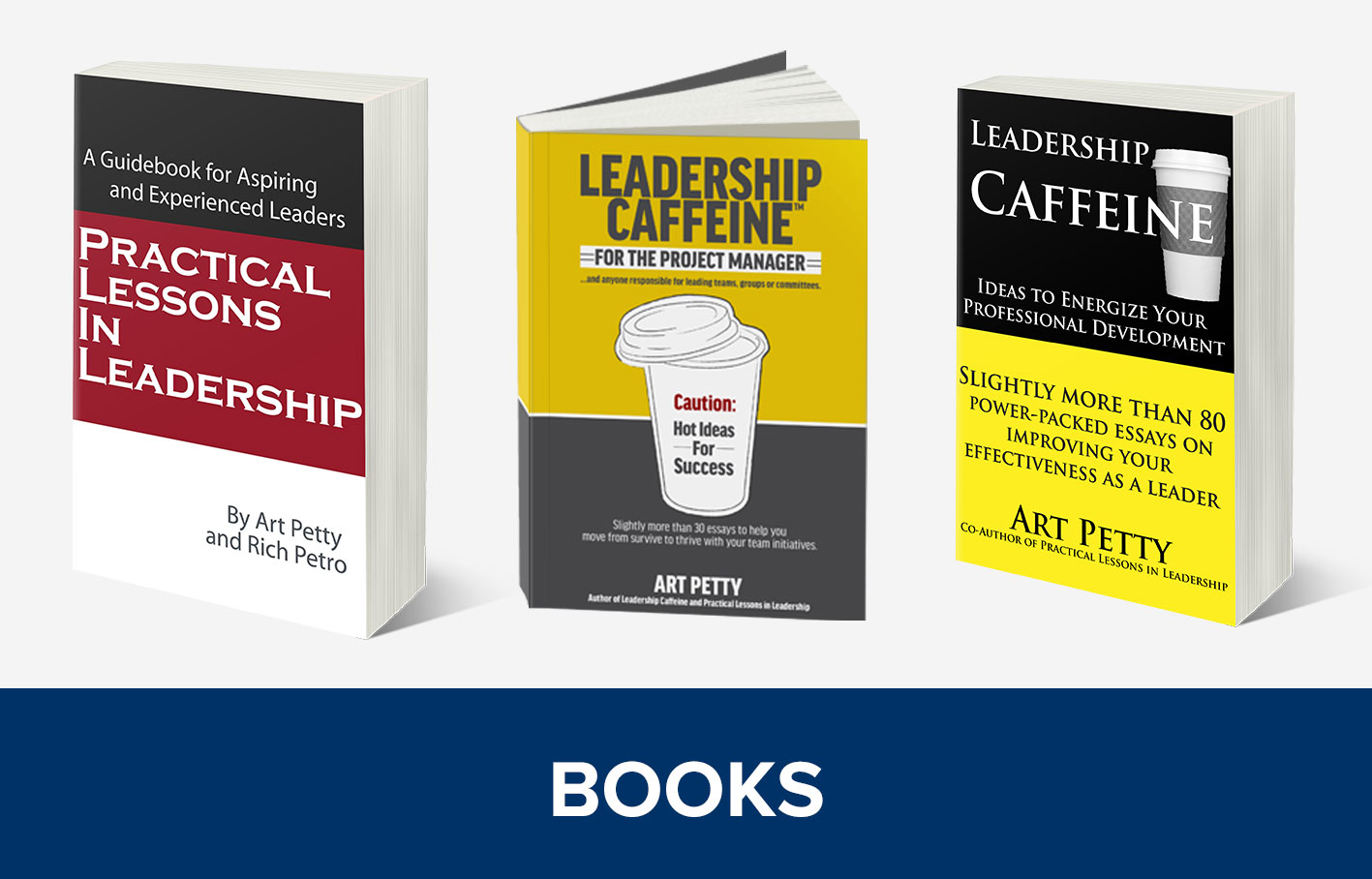
Don’t miss the next Leadership Caffeine-Newsletter! Register herebook cover: shows title Leadership Caffeine-Ideas to Energize Your Professional Development by Art Petty. Includes image of a coffee cup.

For more ideas on professional development-one sound bite at a time, check out Art’s latest book: Leadership Caffeine-Ideas to Energize Your Professional Development

Download a free excerpt of Leadership Caffeine (the book) at Art’s facebook page.

New to leading or responsible for first time leader’s on your team? Subscribe to Art’s New Leader’s e-News.

An ideal book for anyone starting our in leadership: Practical Lessons in Leadership by Art Petty and Rich Petro.

Need help with Feedback? Art’s new online program: Learning to Master Feedback

 Note: for volume orders of one or both books, drop Art a note for pricing information.


Leadership Caffeine-Always Lead with Context

Overheard from various managers:

“I know it doesn’t make any sense, but corporate wants it done this way.”

“You don’t need to worry about the Why…just do your job.”

“Because I said so.”

Chances are you’ve heard one of those statements or some variant of them at some time during your professional life. They are obnoxious, offensive and importantly, they take a perfectly good opportunity to get the best effort out of someone and stomp all over it and then flush it down the toilet.

The empty orders above are utterances without context.

Context in this case is that not-so-secret ingredient that helps people understand the idea or issue and how it connects to something important in the workplace. Context provides the basis for understanding and assessing a situation or a request to do something. It has the equivalent workplace outcome of adding yeast to the process of making bread.  Without it, everything is flat.

People and teams do their best work when they understand how their efforts fit into the bigger picture of the organization. It’s unfortunate that in the hectic pace of business, too many managers fail to leverage the catalytic power of context, and instead, end up issuing empty orders to their compliant but not fully engaged employees.

The Three Levels of Context in the Workplace:

1. Big Picture…What We’re All About Context (Organizational Context). This is “reason for being” context and it provides that sense of belonging to something meaningful and purposeful.

Inherent in this type of foundational context is a directional component as well.  Mission, Vision and Values are powerful context builders here. Unfortunately, these important concepts are often reduced to meaningless jumbles of framed artwork hanging on conference room walls. Instead, Mission, Vision and Values should be used to offer critical foundational understanding of the purpose and general direction of the organization.

Your Actions:

  • Periodically talk to team members about Mission, Vision and Values. Ensure that new employees understand the relevance of these elements to the broader work and functioning of the organization.
  • Use the values to define acceptable and unacceptable behaviors.
  • Teach people and teams to leverage values in decision-making.
  • Engage senior leaders in the discussions and politely challenge them to make Mission, Vision and Values relevant in the context of the firm’s current situation.

2. What We’re Doing to Win with Customers and Beat Competitors (Strategic Context). Whereas foundational context (Mission, Vision and Values) provide a sense of belonging and general purpose and direction, strategic context gives people the high level understanding of the importance of their actions and how and where they fit in support of helping the firm win customers and beat competitors.

I’ve never understood why so many senior leaders fail to provide adequate strategic context to their broader organizations. One leader kept his firm’s strategy securely locked in a drawer, lest anyone leak it to competitors. Another rationalized that the big picture thinking was for senior leaders only. Both grossly misunderstand how important this context is to helping the organization move forward.

Actions:

  • Talk strategy frequently. Don’t kick off projects, discuss results, set goals or talk about improvements, cost cuts or just about anything, without anchoring the discussion in strategy.
  • Invite front-line professionals (sales, customer service) to talk with your team frequently about marketplace realities and issues.
  • Ensure that all goals discussions are in the context of strategy, and always, always, always link scorecard and other discussions about business performance to strategy.
  • Ask for input. The broader topics of strategy and execution should be bi-directional, with employees offering ideas for improvements and feedback on what’s working and what’s not.

3. “Me” Context.  We all want to understand how we as individuals fit into the picture. We also want to understand at least in general where we might be going as the team or organization succeeds.

“Me” Context provides us with purpose and with a sense of belonging. “I count, and my work here contributes to helping move the team forward and ultimately to helping us win with customers and beat competitors.”

The absence of “Me Context” results in a kind of out of body experience at work, where people go through the motions, but don’t truly engage with their full force and power.

Actions:

  • Always frame positions and job descriptions in terms of how the role is expected to contribute to the firm’s/team’s success.
  • Ensure that goals discussions are anchored in Strategic Context.
  • Deliver behaviorally-focused constructive and positive feedback often and always link it to the business.
  • As identified above, ask for input. Your act of asking and listening…and then acting reinforces the connection that people have with their organizations and teams.
  • Don’t ignore professional development and advancement. A surprisingly large number of organizations that I encounter don’t have anything formal in place for developmental activities and discussions. The absence of this system is not an excuse for you.  Help people grow and they will pay you back many times over.

The Bottom-Line for Now:

One of your core tasks as a leader is to foster an environment where people have the tools and resources to do their best work in support of the firm. Context helps create the effective working environment. Consider this as critical context for your own role.