Just One Thing-Vary Your Routine For A Change

The “Just One Thing” Series: Professional Improvement is Best Enjoyed in Small, Digestible Bite-Sized Pieces-One Idea at a Time.

Most of us are creatures of habit. Same route to work…same people on the train and even our work has a familiar cycle…daily lunch with the same crowd, weekly updates, monthly reviews, quarterly briefings and seasonal events. Work long enough in the same role and you can tell the time, month and season just by the event in process

Routines are comfortable..and at the risk of being redundant, habit forming. Eventually, routines become mind numbing.

While breaking the routine is uncomfortable and even frightening for some, deliberate effort to do things differently will stimulate neural activity…wake you up and revive a mind that’s grown lazy and sleepy.

Yes, you’ll be learning. New situations require active assessment and trial and error, and eventually, they lead to learning. Your on-going routine shuts off this mental fitness work and our brains become blobs of gray-matter, growing sluggish and fat.

5 Thought-Starters for Varying Your Routine:

1. Take the path less-traveled. Take a different route to work and pay attention to the new details as you drive. When you get to work, play the equivalent of “this picture isn’t the same,” and jot down as many details as you can recall about this new route.

2. Change up your fitness routines. I know many professionals who are “religious” about their fitness programs. They subscribe to a strong-body, strong-mind philosophy and you can set your watch by the time they’ll show up at the gym. You also know that people are creatures of habit within their workout routines. If that’s you, try mixing up your pre or post-work workouts with different activities. This will minimize boredom, keep you striving and to ensure you exercise different muscle groups in different ways.

3. Change-up your lunch routine. One day a week, find someone in your firm you don’t know well and ask him or her to join you. Don’t talk about yourself…ask questions and listen.

4. Meetings are mind-killers…try mixing things up. Rotate responsibility for facilitating your recurring meetings. Encourage people to put their own twist on the meeting when it’s their turn. Reward people for creative and effective approaches!

5. Read. Read outside of your preferred genre. Read outside of your industry. If you are on the move, change read to listen (podcasts, books, book summaries etc.). Same rules apply. Mix things up.

Bottom-Line:

We all learn in different ways…by listening, by writing, by talking, by reading, by doing and so forth.While you don’t have to vary your preferred method of learning, try something different within that method. Break the routine and enjoy the new rush of energy and ideas. Of course, the next step is doing something with these new ideas and insights, but that is a post for another day.

Don’t miss the next Leadership Caffeine-Newsletter! Register here.

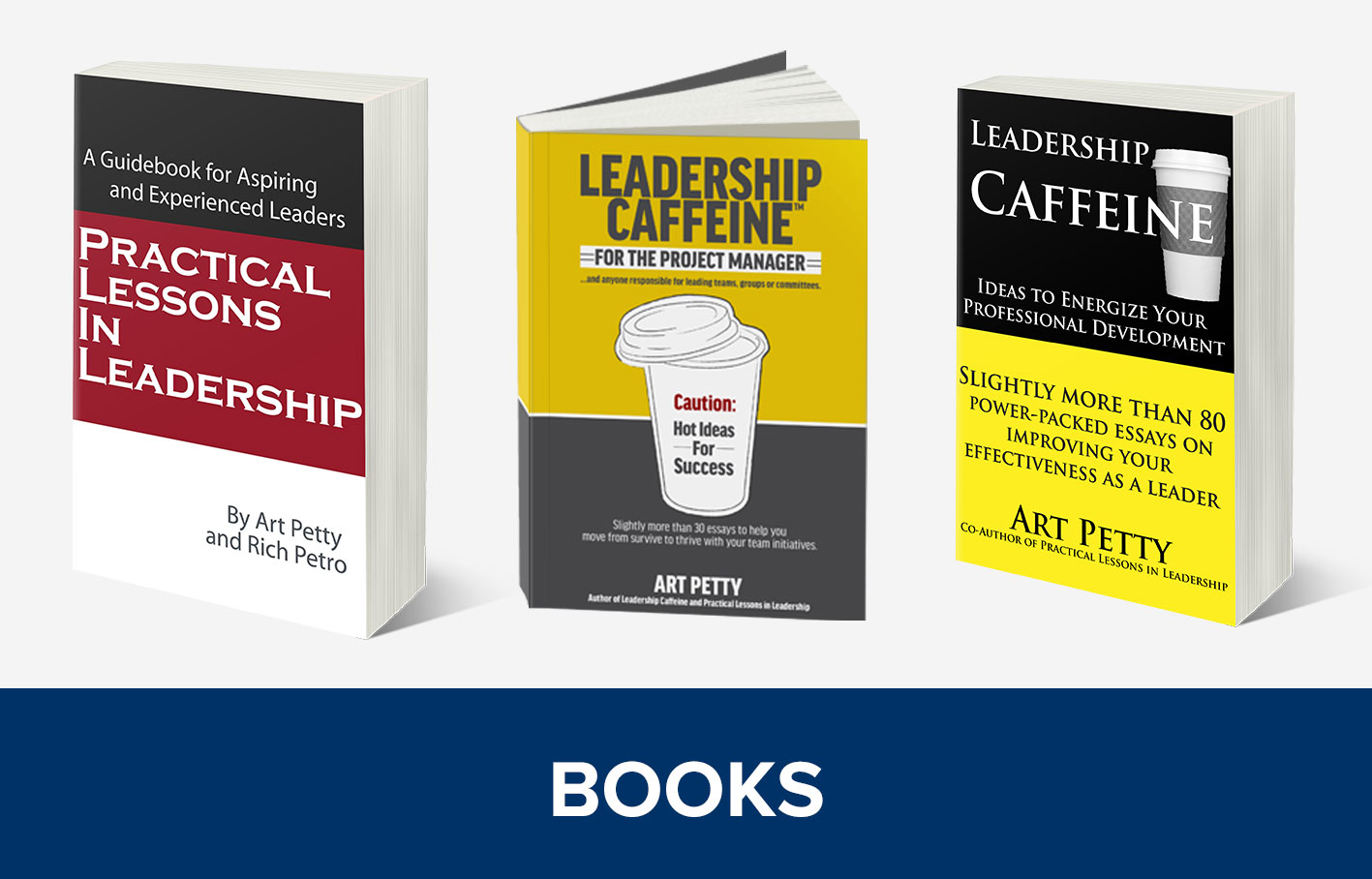
For more ideas on professional development-one sound bite at a time, check our Art’s latest collection: Leadership Caffeine-Ideas to Energize Your Professional Development. (download a free excerpt at Art’s facebook page.)

To talk about a workshop or speaking need, contact Art at via e-mail at art.petty@artpetty.com

Art’s Weekly Leadership Message: Step Up to Cure Effective Dialogue Deficit Disorder

The medical community and drug companies have their ED malady and cure, but too many management and project teams suffer from their own form of ED…with two more D’s…EDDD… Effective Dialogue Deficit Disorder.

It’s not that people aren’t talking. There’s no deficit of hot air swirling around most meeting rooms. The issue is all about the quality of the dialogue.

Consider:

  • All the firms who use last year’s operating plan and budgets as the basis for next year’s plan, without vetting and refreshing on what’s really happening in their markets and with their customers and within their own businesses.  The future is difficult enough to predict in the best of circumstances. It’s laughably impossible to do it by focusing on the images in the rear-view mirror.
  • Strategy meetings where the swirling discussions include opinions, facts, emotions, ideas and yes some political posturing, all without order, direction or purpose.  Kudos for getting people together for the right reasons. Now, focus on managing the discussion flow to ensure purpose and progress.
  • Performance evaluation processes that don’t connect to professional development steps.  Your job is to connect evaluation to forward progress and development. You’re not a movie critic…you’re responsible for helping someone create the next scene in their own professional movie.
  • Project Teams that develop detailed risk assessments at the onset of their initiatives, and fail to constantly refresh and update on the risk plan.  The pesky thing about dealing with risk is that it is annoyingly unpredictable in many circumstances. Vigilance and review beats static advance planning here everyday.
  • Ideation or brainstorming sessions that develop long lists of ideas that are forgotten as soon as the flipcharts come down. Ideas are truly horrible things to waste.

5 Ideas to Help Cure Effective Dialogue Deficit Disorder:

1. Don’t preoccupy on the past. Use past results to assess where YOU failed to anticipate and execute, and then focus on asking the hard questions about what’s changing with markets, customers and competitors. Build your plan around what you should be doing to succeed in the emerging world, not on what you did last year.

2. Change your discussion approach. Learn and apply the process of parallel thinking and discussion to eliminate the swirl and sort facts from emotions, opinions and ideas. De Bono’s Six Thinking Hats is a great place to start.

3. Learn to feedforward. Every opportunity to offer “feedback” on prior performance should be better viewed as an opportunity for what Marshall Goldsmith describes as “feedforward. Again, cut out the rear-view mirror stuff and help people design their way forward.

4. If is was important enough to “assess” and develop a document, it’s very likely important enough to revisit and rethink. Don’t ask people and teams to just comply with a step or process (i.e. create a risk assessment). Instead, encourage frequent return trips to check assumptions and incorporate new learnings.

5. Never waste ideas! Don’t ask people to exercise their creative capabilities and then lose the precious output. Build an idea inventory and reference it frequently.

The Key Point:

Teach your teams to engage with purpose. Plan and manage your discussions to include reflection, assessment, direction and action. Every discussion is an opportunity to design something going forward. Throw in a consistent serving of accountability and you are on your way to building high performance into your working environment.

JUST RELEASED! Check Out Art’s New Book: Leadership Caffeine-Ideas to Energize Your Professional Development

Want More: Sign up for the new, Leadership Caffeine e-Newsletter.  I’ll guard your e-mail address with ferocity, while sharing ideas to energize and inspire.

About Art Petty:

Art Petty is a Leadership & Career Coach and Strategy Consultant, helping motivated professionals of all levels achieve their potential. In addition to working with highly motivated professionals, Art frequently works with project teams in pursuit of high performance. Art’s second book (an edited, annotated collection of the most popular leadership essays), Leadership Caffeine-Ideas to Energize Your Professional Development, was released at the end of September in 2011.

Contact Art via e-mail to discuss a coaching, workshop or speaking engagement.

Don't Spend Too Much Time with the Wrong People

choicesThe major “people mistakes” of my career have occurred as a result of investing too much time and effort in trying to change people.

As leaders, we can enable change.  We can help people that want to change.  But trying to change people on our own is ultimately a fool’s errand.

In one case, a talented, but mercurial individual simply flamed out after several years (yes, years) of coaching, training, disciplining, imploring and anything else that I could think of to strengthen his inter-personal skills.  This was no simple inter-personal issue.  He genuinely pissed people off to the boiling point, although it was always carefully wrapped in supporting business priorities.

In another case, I spent another several years (yes there’s that “Y” word again) helping this individual expand her skill-set through job rotation and preaching.  It was never coaching, because she didn’t want any part of it.

She had a fierce sense of entitlement over being in charge of a group based on her seniority, yet to me, her skill-set was too narrow and her impact on others was typically negative.  She showed no signs of leadership or managerial capabilities.  Nonetheless, I counseled, coached and provided developmental experiences.  When I finally had a promotion to offer, I awarded it to the most deserving candidate.  In response to not gaining the promotion, this delightful individual left the company with no indication.  She just never showed up again.  A few weeks later, I was summoned to the CEO’s office where I was presented with a document indicating her lawsuit.  It was dismissed as frivolous.

While two examples don’t make a career, I learned over time how to invest in those that actively pursued change and development over those that felt entitled or simply were discipline problems.

Give me a person that wants to grow, and I’ll move mountains to help him/her advance.  Show me someone that feels entitled to a promotion or, engages in repeated aberrant behavior in spite of feedback and counseling, and I’ll move mountains to move them out.

Invest like crazy in those that want to grow and develop.  Just don’t spend too much time with the wrong people.

The Seven Critical Conversations of Great Firms and Great Leaders

You learn a great deal about an organization’s current state, near-term prospects and about the health and effectiveness of a firm’s leaders by looking for and listening to the quality of the conversations in the working environment.

Visit and spend time with the people inside an organization that is climbing, growing, reaching and striving for new heights, and you observe that the conversations take on a consistent, high-energy, action focused tone. You also observe and hear constructive and even passionate debate around topics that other organizations and individuals would lack the courage to raise.

Switch sites and visit a struggling organization and you get the impression that the more that people flail, the faster the organization will disappear into the economic quicksand. The conversations, if there are any are stilted, leadership edicts are dictatorial and the person-to-person dialogue is fueled by fear and buffeted by rumor.

I see this constantly in my practice and I’ve observed it consistently over decades of private industry experience. The best firms and the best leaders hone in the right topics and teach their teams and organizations how to talk openly and comfortably about those topics. Easy words, but no small feat when you take into account the common barriers to open dialogue of politics, siloization and the seemingly endless supply of people that have no business being in leadership roles.

The Seven Critical Conversations:

There are at least Seven Critical Conversations that I observe taking place over and over again in organizations that that are either successful or improving. These same conversations are often nowhere to be found except perhaps behind the closed doors of a firm’s leaders in less successful firms or organizations that are struggling and sinking.

1.  Vision. Great firms make this often lofty and meaningless agglomeration of words under glass come alive and permeate the culture of a firm. The “V” word instead of being consultant or MBA-speak is the source of energy for humans. It defines a goal, a championship; a destination that once arrived at will be a great accomplishment. Great visions…those that resonate are visions that inspire and challenge and motivate and help individuals and teams rationalize putting their hearts and souls into an enterprise.

2.  Strategy as an “All Hands on Deck” Action Statement!

While Vision creates context for the goal, strategy defines how we are going to get there. The books written on this topic fill entire shelves and many are brilliant in describing the tools and techniques, but most in my opinion miss the point.

Great, growing and successful firms leverage the tools of strategy to promote the right conversations across and up and down the organization. I’ve observed that the most vibrant of firms find ways to get everyone involved in strategy. At a bare minimum, the firm’s leaders ensure that everyone can connect their goals to the core strategies—the Walk In the Door test.

However, the real gold in creating the organization-wide strategy dialogue is in capturing the ideas that flow from so many parts of the organization that see ways to improve the customer experience and add important context to ideas and certainly how to translate ideas into actions and then provide feedback on the results and ideas for improvement. It’s a beautiful cycle of ideas execution, learning and adaptation.

3.  What Are the Leading Indicators?

The gross majority of firms measure and report on history, with little ability to look forward. The best firms get people involved inconstantly seeking to identify, hone and build processes around early and leading indicators.

A simple example is sales pipeline, yet that measure is often so isolated, convoluted and unreliable as to be nearly meaningless. Alternatively, firms that connect their lead system to their sales pipeline (much like a lead to sales refinery) and work hard to develop an increasingly reliable set of metrics that quantify changes and outputs, are a bit closer to having a reliable leading indicator. This is just one of many leading indicators that can be developed across functions that will tell you a lot sooner how things are going versus waiting for the quarterly financials, which are truly interesting but irrelevant for the future.

4.  What is the Customer Really Saying?

Good firms ensure that customer-facing associates have systems to collect and communicate feedback. Great firms ensure that there are people immersed in their customer’s environments, listening and observing and looking for the real problems.

A customer may complain about a particular product or request a certain feature, because their context for you is your product and your features. However, the right observation might uncover that your product and the feature is relatively insignificant compared to other unresolved problems that new products or services from your firm might well address.

5.  How Am I Doing?

Like a championship sports team where the athletes and coaches are constantly critiqued and critiquing, feedback must flow quickly, honestly and with expectations of accountability.

None of us are great judges of our own performance although we have a gut feeling as to whether we are in the ball game or not. Great cultures create an open feedback culture that requires the tough discussions to take place up and down and across the organization.

Easy words, but when was the last time you gave your boss or your peer in another department robust feedback? And then saw them do something with it?

6.  What’s Next for Me?

All of the above conversations are critical to creating a healthy work environment, but at the end of the day, we make very personal decisions on where and why we work and how hard we work.

The most successful leaders and teams ensure that there is a constant dialogue flowing about next career steps and that this dialogue is backed by actions.

Charan’s “Apprenticeship” model is a perfect metaphor for a vibrant development approach, except that Charan focuses it on finding the next CEO and I want to use it to test, assess and support the development of the people on my team or in my department. As a leader, there is nothing nobler, more appropriate or more valuable that you can do for a person than help them grow and develop. Some people resist that support, but most will be thankful to you for a lifetime.

7.  What did we do that made a difference?

This last conversation is a bit controversial even in my mind, but it strikes me as important to build a strong culture on layers and layers of achievements that give credence to what we can accomplish.

Firms that don’t talk about past successes and individual and team heroics feel to me like soul-less, heartless structures, whereas environments where the stories and heroes of the past are celebrated and used as models for the future seem so much more alive. This topic invites “Mission” into the discussion and shows how the collective and individual efforts lived up to “the reason for being” of the firm. I don’t want to dwell on the past, but our history is a powerful teacher and guiding force for our future.

The Bottom-Line for Now:

Long post and to me a fairly meaty topic. I would love your input, including your suggestions on whether I am on the mark or off the mark (in your opinion) on my set of “7” for the critical conversations. Passionate discourse encouraged!

What Are You Doing to Reinvent Your Professional Self?

A fact of life in our world is that you will inevitably face the prospect of having to reinvent your professional self.  For many this is a daunting task that gets put off along with getting in shape, painting the house and writing a book.  The dream is nice, but the lack of action keeps it firmly out there somewhere in a hoped-for future.

By now, we all know people that have been adversely impacted by the current economic circumstances and are in the midst of looking for their next job and even their next career.  We also know others that are hunkered down behind walls hoping to survive. 

In both cases, it is critical for the individuals to think clearly about and act on the need to reinvent themselves as professionals.

Some thoughts for the audiences that I engage with regularly:

  • Marketers, most everything has changed.  If you cut your teeth on marketing in the 90’s or earlier, and have not stayed on the painful and bleeding edge of what is going on, you are in deep trouble.  While core notions of identifying vexing problems and solving them in great ways will never go out of fashion, the way people buy, how they communicate, what they respond to, where they look for information and how they respond and react to marketing tactics is no longer recognizable.
  • Mid-level managers, you are in danger of extinction.  You had best find a way to standout and develop as a senior contributor or you will go the way of the Dodo bird. 
  • Product Managers, your role is critical, but you face an uphill battle in gaining a “seat at the table” of senior leadership, in spite of your very customer and market focused existence and your strategic perspectives. 
  • Technical Professionals, the skills and knowledge that helped reach this point are insufficient to take you forward.  Grow your technical skills or recognize the need to grow your professional skills as leaders and businesspeople, but do something!
  • Project Managers, what are you doing to improve your ability to lead laterally, integrate strategy with projects and improve your batting average in developing high-performance project teams?  Your process expertise is not enough to earn you a future seat at the table. 

As for those of you in other roles inside or outside of corporations, if moving into an entrepreneurial role is a dream, are you planning and acting on the steps that will move your dream closer to reality?

And finally, for those of you that have hit the panic button after realizing that the job you’ve trained for and worked is no longer out there, well, since you didn’t have a plan, it’s time to get going.

Suggestions:

  • Recognize that only you own your career, not your company.  Do not wait for your company to retrain you and help you develop skills for the new world.  Invest wisely in yourself for the type of training and development that will help you move forward or that will at least keep you employable.
  • Take time now to begin investing in developing the knowledge, skills and credentials that you will need for the next step.  If you want to be a teacher someday, start taking classes now.
  • Develop great habits.  Read something related to your professional development for 30 minutes a day.  Use the DVR to tape your show and watch it later, but read.
  • Start building your brand now, not after you are out in the street following a round of lay-offs.  Speak, publish and lead somewhere in your industry or your community.
  • If you have entrepreneurial dreams in the future, start researching, planning and saving now.  Can you find a job that will get you one step closer to your entrepreneurial self?
  • Work through your ideas with your significant other.  They are a critical part of whatever you do, and particularly if your vision involves risk, I cannot over-emphasize the need to balance your dreams with your partner’s ability to tolerate ambiguity and risk.

The Bottom-Line for Now:

There’s no doubt that many of us identify closely with our jobs and titles, and the loss of job or title can stimulate a real personal crisis.  Strive to view yourself as something other than your job and recognize that you can succeed and be happy in many different environments.  Then take action.  Just do something to move forward and your activity will beget energy and more activity. It’s a great day to take control.