Leadership Caffeine: Change or Learn to Say, “Would You Like Fries with That?”

image of a coffee cupNote from Art: Consider this tough love intended to motivate leaders everywhere to rethink and refine their approaches.

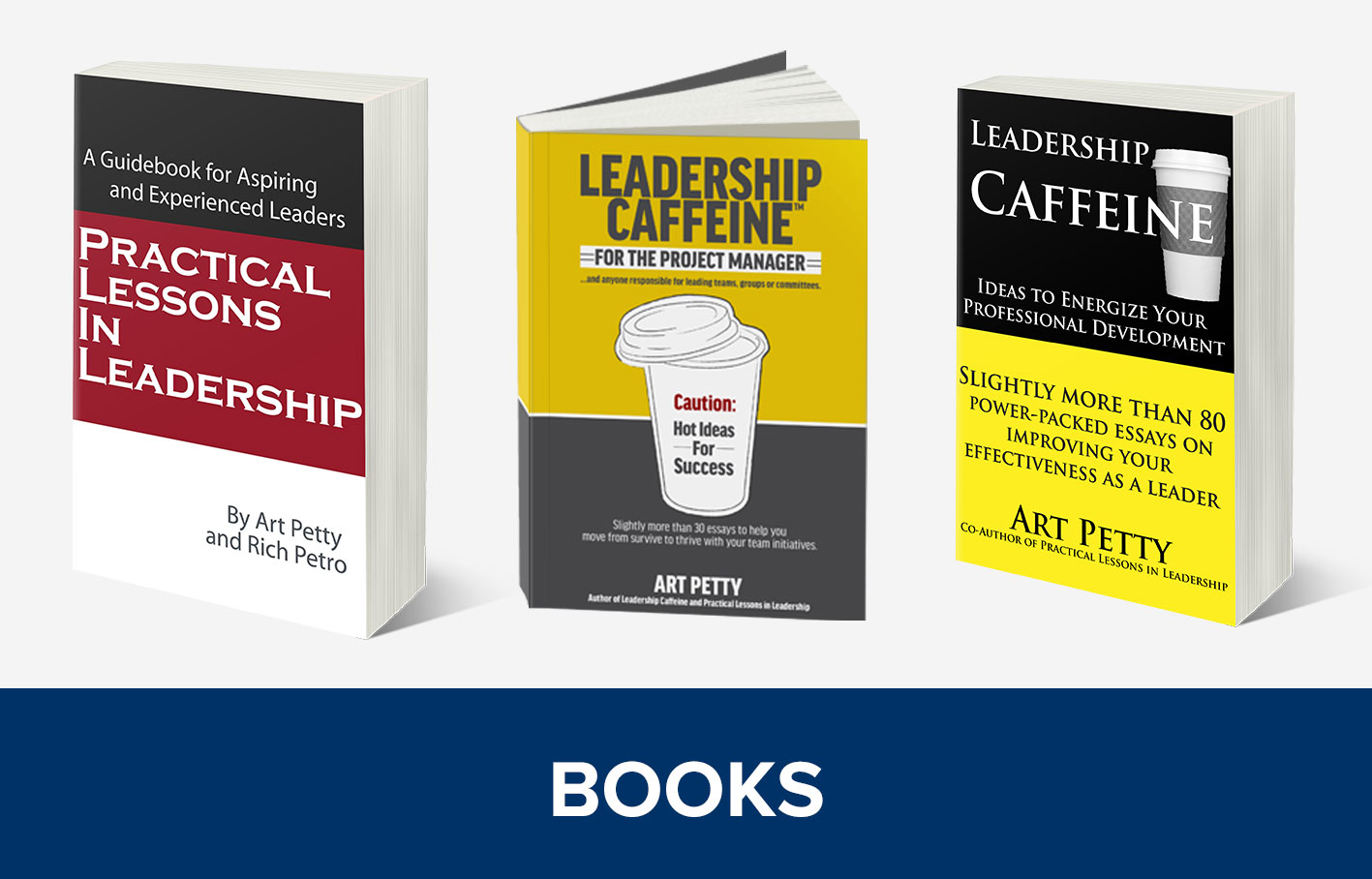
In the prologue to my recently published collection: Leadership Caffeine-Ideas to Energize Your Professional Development, I write:

For experienced and developing leaders, the emerging environment is likely to offer a Dickensian world filled with Best of Times opportunities and Worst of Times challenges.  Now might be a good time to revise your thinking on your role as a leader and to begin cultivating the skills and experiences required for success during the exciting and perilous journey ahead.

What I Wanted to Say:

I stand behind the words…and in fact, my only regret is that I didn’t say something a little stronger, such as:

Wake up! Change now or become leadership road kill! Either start cultivating the new leadership skills or stand in front of a mirror and practice saying, “Would you like fries with that?” because this may be your money phrase in the not so distant future.

“Hey, Who Moved My…”

Much of the pablum that is passed off for guidance on leading others ignores the reality that the context in which we lead has changed from just a few years ago, and it continues to change faster than any of us can truly understand.

Now before your fingers burn a path to your keyboards to remind me of the timeless nature of and attributes of leading, I get the point in spades. Character always counts, no one ever screwed up by showing respect, your job is to develop people, you better be able to inspire people to act…paint a vision and all that great stuff. It’s good…its timeless and UNLESS it’s blended with the new skills of leading, it may prove to be USELESS.

Context is King. Meet King Context-7 Ways the World of Leading and Managing Has Changed

While it’s a bit disheartening to realize that those of us with some experience and a bit of gray are vestiges of a bygone business era, we truly are. That doesn’t mean we can’t be relevant, but first, we have to understand and accept some of the important contextual changes in our world of business:

1. Our management structures and approaches are products of late 19th century and early 20th century thinking. As Gary Hamel offers, they were designed for another goal…to get people out of the fields and into the factories and to optimize their ability to do the same thing over and over.  They weren’t designed to cope with the need for rapid innovation, constant change and frequent disruption. Gary is right…the practice of management must change to cope with a world where exponential change is the norm.

2. Oversight as a core task of those in power is no longer the point, yet it is still widely practiced. I still find managers uncomfortable with the idea that work might actually take place somewhere and sometime when employees are out of sight. Oh, and yes, imagine that it might take place at some point in time when the “normal” work day has ended. My guidance: “get over it.” Control is no longer the point. 

3. Technology tools aren’t necessary evils, they are tools essential for survival, connectivity, speed and idea sharing. Too many leaders struggle to know which end of a tablet is up (answer: neither)…much less, how to turn the power on and use it. By the way, if you’ve not purchased an e-book, grabbed your news from Flipboard, tweeted about something interesting to a group of industry peers and used Evernote to capture a few great web sites for future reference in the past few hours, please grab your hairnet and watch out, the grease is hot by those fries. You’ve got to participate in the activities of the day to understand their implications for the world of work.

4. Ambiguity is the order of the day. Get over it. By the time things become clear in most markets, the opportunity is missed.   You need to build capabilities in your organization to go from idea to execution to learning to refinement, and to do that, you need great people who are comfortable that you’ve got their backs.

5. The Silos in our organizations are still there and they are still rusting in place. Teams that cross boundaries are now the principal means of getting work done and silo control is a game no longer relevant. Your goal as leader is to help teams form fast, support their efforts to execute and then ensure that they are able to disband and reform on the next opportunity.

 6. Your Cultural Intelligence may just be the most important asset that you aren’t doing anything about. It’s a global world…we’re all working across cultures, and chances are your workplace is (or should be), filled with diversity. Learning to tap the different world-views of your colleagues is a critical mission for leaders today…and it takes deliberate effort to learn and understand how to competently navigate across cultures.

7. The most important tool of management you  probably don’t know enough about is Project Management.  Too many treat it like an administrative process instead of a critical tool to enable value creation, learning and strategy execution. Heck, I struggle to find leaders who even get that project management is so much more than an endless stream of Gantt charts and status meetings. It’s time to dig in on this important new way of getting work done.

The Bottom-Line for Now:

Welcome to the leadership blender, where speed and adaptability are essential for survival.  Control is something from a 1960’s era sitcom (Get Smart), where ironically and fittingly, Chaos was the primary adversary. Sorry, Chief, but Chaos won. Adapt, or repeat after me, “Would you like fries with that?”


Strategy-Towards Hypotheses, Experiments, Involvement & Learning

Few would argue that a nimble, quick-to-learn and quick-to-adapt organization is a bad thing. Given the rate of change in our world, those characteristics are increasingly table-stakes for survival and success.

Why then has the approach to strategy and the notion of “strategic planning” in so many organizations remained mired in a 1960’s kind of static, top-down event-focused model?

Many firms practice a style of strategic planning that might have worked in a different time and place, but today, fast-to-try, fast-to- fail and fast-to-learn are essential for survival and success.

Give Me an Epiphany, Darn-It!

Rarely does just the act of thinking through circumstances, opportunities and strategies yield the epiphany that allows a firm to carve out a competitive advantage.

In my experience, the management teams who have pursued the “strategy as event’ approach with the annual or semi-annual meeting(s) serving as the time to talk strategy and decide, are often frustrated with the time investment and disappointing outcomes. Few epiphanies…a lot of time…a lot of bickering and ambiguous outcomes with no clear next steps. Sounds like fun, doesn’t it?

Hypotheses and Informed Experiments, Please!

The best outcome of the front end of any strategy process is one or more (a limited number, please) of ideas…hypotheses, that can quickly be turned into and managed as experiments.

True value in the form of learning accrues to the organization from working through the strategic experiment, assessing outcomes and refining the ideas. Because these workplace and marketplace experiments require people to implement, manage, and assess them, the act of engaging the employee population creates understanding, involvement, excitement and importantly idea sharing.  

It Feels So Good When We Stop!

I’ve worked with teams who were accustomed to and frustrated by the “event” orientation of planning. When refocused on assessment, analysis and importantly, hypothesis generation, the unreasonable expectation of finding the magical answer was replaced by high quality dialogue around generating ideas for better serving customers and beating competitors. After a series of these discussions over time, and with some focused facilitation, the teams were able to zero in on one or two strategic hypotheses to invest in and learn from.

The Project Management Art of Building out Strategic Experiments:

While I frequently reference this phase as the Execution phase, I prefer Experiment…both because it doesn’t sound so fatal…and it implies Doing, Measuring, Learning and Refining (DMLR).  In my estimation, its in the DMLR cycle where the real work…and the real “Ah Ha” moments of strategy occur.

Six Ideas for Implementing an Effective Doing, Learning, Measuring, Refining Program:

1. Treat each strategic experiment like a project. Assign a Project Manager and use Best Practices PM to charter, scope, engage stakeholders, define the work, assess the risks, plan and estimate the work, implement the work, monitor and communicate. Yeah, that’s a mouthful. Your Project Manager in this case is priceless.

2. Ensure that there’s a strong sponsor in place for every experiment. Yes, best practices project management again. If this is important enough to be betting your strategic future on, it’s important enough to provide a Supportive Sponsor with heft and teeth.

3. Explain, Engage and Listen! People work in compliance under orders, they work with their hearts and minds when they are part of something big. Getting them involved is good. Arming them with context on why, and what and importance is critical. Listening to their feedback is priceless. Since many strategic initiatives involve doing new things or doing things differently, this holistic approach to engagement is essential.

4. Create Learning and Sharing Forums with Teeth. It’s good to pre and post-mortems…it’s better to create ample opportunities for idea sharing, lessons learned and adjustments to experiments on the move. Hey, I’m probably violating several tenets of The Scientific Method with the adjustment statement, but timeliness is critical and your Project Manager will help you manage changes in the plan.

By the way, by this time, you may want to give your PM a big fat raise!

5. The Truth is Always in the Field…Sometimes You Just Have to Look Carefully. The best strategic experiments involve customers and partners. Invite them in…make them part of the process and of course observe and listen carefully. And then act.

6. Do Something with the Outcomes-Plan to Change or Move Forward. After a period of time and armed with the insights and feedback of employees, customers and partners, there’s a vetting and decision-making process that those in charge have to prosecute. From kill to change to go to what’s next, you and your team are on the hook for returning to the process and assessing and deciding.

The Bottom-Line for Now:

There are at least two “dirty little secrets” in what I’ve described above. It’s a nefarious plan for involving the broader organization in strategy and execution, and it not so secretly “operationalizes” the work of strategy. While there’s no magic and I would be misleading if I didn’t highlight that the process is filled with bumps, hiccups and debates it’s darned powerful if and when managed properly.

Leadership Caffeine: Warning! Your Words About Change are Falling on Cynical Ears

image of a coffee cupEven the most credible of leaders have to step up their game when it comes to talking about and promoting change on their teams and in their organizations. 

You can trust that a good number of the people doing the heavy lifting inside of your organization have developed a case of cynicism on talk of change emanating from the higher-ups.

They’ve consumed too many “flavor of the month” programs and developed heartburn when the programs died in mid-stream. They’ve watched people in your role come and go, and they no longer hear the siren call or pay much attention to the slogans and signs.

Can you blame them? If they wait a few minutes, this too shall pass, and in spite of their positive view of you, people have been conditioned to wait until the noise dies down and the focus turns back to getting the work done. They also know that you’ll likely move on to something bigger or different before too long.

For some leaders, the institutionalized and individual resistance to change is extremely frustrating and vexing. One leader offered to me, “I’m told that I’m credible, people have responded well to my leadership, I don’t pump sunshine or doom and gloom, yet people are dragging their feet on this new program. I know that it means doing new things and that can be frightening, but why aren’t people more excited and supportive?”

What’s a leader to do?

7 Helpful Steps to Get Started on the Right Foot Talking About Change:

1. Expect Resistance. Start from the assertion that you will run into a naturally occurring level of personal and cultural resistance, regardless of the how much people like and respect you.

2. Construct a Message for Real People. Lead with the facts. Explain the situation. Include your assessment. Avoid corporate and consultant-speak. Openly acknowledge the risks and unknowns.

3. Don’t Pitch the Solution…Share the Problem. Ask for help finding the solution. There’s a profound difference on how people process “here’s the answer,” versus “here’s the problem and we need to find the answer together.”

4. Beware the “Town Hall” Trap. Whether you are leading a company or a team, your inclination is to pull everyone together and to “present” your case for change. Senior leaders in particular fall victim to assuming that because something has been shared far and wide that it is now fact and reality. It’s good to share but there’s no “one-and-done” big group style of communication that cuts through the individual resistance to change. The large meeting is one step of many required for success.

5. Make Your Case One-on-One. The optimal level of dialogue is always one to one. Yes, it’s difficult. It’s also essential. Whether it’s you or those members of your change-coalition, the dialogue (not monologue) must be focused at the individual level.

6. Keep the Monologue Locked in the Closet. The faster people perceive that you are genuinely interested in their ideas and even their challenges to your own ideas, the faster the initiative will build momentum. Listen, acknowledge, adjust based on good input and share the adjustment.  And just keep doing it.

7. Model the Behavior. Do as you say…and do it very visibly and genuinely.  Nothing shoots a change initiative in the rear-end faster than your words and your actions not matching. The do must match the tell.

The Bottom-Line for Now:

Change is inevitable in our world and intuitively, we all know and accept this reality. However, don’t discount the challenges you will face in gaining support for your message on the need to change.You’ve had ample time to process on it, but when your team members hear it for the first time, it’s either noise…or interesting but not tangible.

The only way through the resistance is straight ahead. Your honesty and authenticity are truly important. Your willingness to engage in a dialogue and your humility in asking for input and help are priceless.

The Heavy Lifting of Career (Re) Invention-5 Keys to Moving Forward

Whether you are a few years removed from college or a few years removed from that time when prior generations began thinking about retiring, chances are, you or someone you know is involved in defining or redefining their career.

It’s a daunting task in a world where the old rules no longer apply. For those just starting on their career journeys, many have sprinted out of college only to run face-first into the brick wall that is the job market in so many sectors and markets. For this group, career development has turned out to involve a lot more work than just graduating.

For those of us with a few more laps around the block to our credit, the future doesn’t quite look like what we expected. The book on career management has a new chapter that many of our parents never experienced. It’s called, “Reinvention,” and it’s really daunting.

Regardless of where you fit on the chronological scale, there are at least five key issues that I encourage you to wrap your arms and mind around. Like much of the invention or reinvention process, tackling these items is challenging, uncomfortable, and critically important.

At Least Five Keys for Career (Re) Invention:

1. Aligning Your Values, Purpose and Goals around a Vision.

While your tendency may be to roll your eyes at the fluffy and abstract discussion of personal vision and values, the reality is that you do have a set of operating instructions (your core values) and there is a purpose that drives all of us. Sometimes we ignore that purpose (often for decades), but it is there and aligning values and purpose around some big, exciting and challenging goals is an important part of the process. It’s awkward and difficult and squishy to grasp but when you focus in on a vision for yourself, it’s transformational.

For some help here, check out Ed Batista’s outstanding post, “Developing Your Professional Vision,” and Jesse Lyn Stoner’s (with Ken Blanchard) excellent book,  Full Steam Ahead. 

2. Cultivating Your Confidence and Self-Esteem.

Confidence is critical for fueling invention or transformation. Without it, we just dream. With it, we take actions to build towards our dreams.

I’ve long believed the biggest barrier to individual success is self-confidence. Recognize this issue as human, get over any stigma attached to it, and seek coaching, help and guidance on developing the inner-strength to tackle problems and issues that seem foreboding and practically impossible. A good coach is priceless here. My post, “9 Ideas for Strengthening Your Self-Esteem” is a starting point.

3. Strengthening Your Professional Presence.

A critical part of the confidence issue is the ability to project this confidence and to engage as an articulate, intelligent professional. Those who lack confidence AND who lack the ability present themselves as confident, knowledgeable and interesting human beings are relegated to bit roles in their own careers.

From your posture to your eye-contact to your smile to your eyes to your ability to listen and importantly, your use of your vocabulary and your ability to articulate your thoughts, it’s all on display and it’s all being judged. Solicit feedback from trusted sources, engage a speaking coach and take deliberate action to match the vision. One of my favorite books on this topic: Seeing Yourself as Others Do, offers some great guidance.

4. Planning to Act…Creating a Strategic Plan for Your Career.

Pardon the lofty sounding label, but you cannot operationalize a vision…you can’t put into play unless you’ve created a roadmap complete with those items on the critical path that are essential for success.

Armed with a vision, you need to set clear goals and define those very clear actions and milestones required for success. My favorite definition of strategy: “integrated actions in pursuit of competitive advantage,” reminds me of the need to coordinate my activities, measure my results and adjust accordingly. Put pen to paper. The act of planning forces you to think through what it takes to succeed. And then engage. You can update the plan along the way.

5. Building Your Professional Brand. 

There’s never been a better time to build and form and frame your professional brand…to build yourself as a thought-leader than now. The tools are there, they are mostly free and they are truly powerful. Sadly, just about everyone I know who is struggling with the career issue is failing to leverage these tools in the proper manner to position themselves as thought-leaders, as exciting and relevant professionals and as people worth listening to and investing in.

The person I pay attention to on this topic is Dr. Bret Simmons writing at Positive Organizational Behavior. Bret is a champion of the topic of building your professional brand…particularly when it comes to leveraging the power of social media to do this.

The Bottom-Line for Now:

Whether you are building, rebuilding or transforming your career, the work described above is some of the sticky, dirty, roll-up-your sleeves hard work that builds towards success. There’s no silver bullet, no convenient short-cut and no getting away from the heavy lifting.

It’s Always About Leadership

From BP and the Deepwater Horizon to the response to Hurricane Katrina to the allegations swirling about the captain, officers and crew of the cruise ship, Costa Concordia, leadership or lack thereof, is always THE issue. 

It’s hard to fathom that the Captain, the Officers and Crew of this formerly floating city could allegedly display such callous disregard for the safety and lives of the liner’s passengers. By now, most of us have seen the cell phone video clips and heard the reports of complete chaos during the crisis.

Leaders step up during times of crisis. This is where people in positions of responsibility finally earn the right to the “L” label.  Unfortunately, in this instance, much like just about every other crisis we’ve created or viewed, leadership seems to take a holiday, replaced by “everyone for himself” and “it’s not my fault.”

Those paid to oversee the safety and comfort of their passengers were nowhere to be found at the point in time when they were most needed. The Captain has been charged with a number of crimes, including the odious act of abandoning ship in advance of the passengers. In the not-so-distant past, that act alone might merit keelhauling.

The CEO of the business behind the ship, Pier Luigi Foschi, has already pointed his finger squarely at the Captain. Yes, Pier, the Captain is likely at fault for the incident. However, you and your firm hired him, trained him and his crew and created the culture that allowed this to happen. See also the comment on keelhauling.

The Bottom-Line for Now:

If you’ve been given the responsibility and the title, you better be prepared to act selflessly when the time comes. Anyone can float through their days showboating and blowing their own horn. It takes a real leader to step up when the ship hits the rocks.

Art Petty is a developer of leaders and a strategy consultant. Art frequently speaks on leadership and management, and his work is reflected in two books (Practical Lessons in Leadership and Leadership Caffeine-Ideas to Energize Your Professional Development) and over 1-million words published at The Management Excellence blog. You can reach Art via e-mail to learn more about his leadership development, speaking and management consulting services.