The Millennial View: Public Speaking Doesn’t Suck

Eric Rodriguez is the voice of The Millennial View here at Management Excellence. You can follow Eric on Twitter @mvieweric for more on the millennial perspective.

With spring break currently underway my office has been getting an influx of students from other colleges and universities who want to take summer classes at the community college. If you want to know one of the classes students are most likely to enroll in this summer it’s the dreaded speech class.

Last week a Millennial summed up the phenomenon of students taking speech classes in the summer when she said, “A community college’s speech class is short in the summer, most universities accept it, speech sucks, students hate it, and we’ll probably never use it again.”

These were strong words and it’s understandable why a speech class isn’t a student’s most pleasant experience in college. In speech students have to stand in front of their peers, be judged by an instructor, and some stare and clutch their cue cards hanging on for dear life hoping they won’t screw up.

Before I go any further I want to establish that this is not a post on how to prepare for a speech. There are many great articles out there for that, but the purpose of this post is to convince Millennials and others that public speaking serves a great purpose and doesn’t… suck.

One reason why public speaking is great is because it gives an opportunity for a young professional to shine. A speaker has the attention of everyone in the room, they can communicate clearly about a topic without interruption, and great speeches can make a speaker get noticed by people in the workplace who can advance a career.

But, some people will never speak in public because they’re scared of an audience.

This fear is irrational – maybe the phobia is rooted in a bad experience, an annoying classmate, or a rude teacher. If an aspiring speaker is still hung up about this, it’s time to move on and realize that was then and this is now.

The audience wants you to succeed. The audience is there to hear you, listen to your ideas, they’re giving you their time, and that is one of the highest honors anyone can receive.

There’s also something rewarding about sharing a laugh with a crowd, seeing some heads nodding in agreement with an idea, or having people smile in your direction.

Public speaking can be a beautiful thing, but the Millennial generation and others need to give it a chance.

It’s puzzling that Gen Y possesses so many new and valuable skills, but when it comes to public speaking some of them shy away. This is a mistake, public speaking is something that looks hard, but with enough practice it becomes easier and Millennials will gain a skill that’s immensely valuable, if they try it.

A colleague once told me that the most successful people she knew were professionals who were great public speakers because they would get noticed by management for their ability to communicate. It wasn’t a surprise for her when she saw these speakers get promoted or when they were asked to talk to clients for a business deal.

When an individual starts developing a talent for public speaking it becomes less strenuous, the butterflies disappear a little, and soon an aspiring speaker will be able to step in front of a crowd effortlessly and talk about a topic with ease. When this happens people realize that public speaking doesn’t suck, it may even be, dare I say it?

Fun.

Leadership Caffeine: Supporting the Rise of the Informal Leader

Want to know where to find your best and brightest emerging leaders? Here’s a hint, you’ll have to use your peripheral vision to see them, because they are moving sideways at a high rate of speed.

The Rise of the Informal Leader:

While it’s unlikely that hierarchical leadership will disappear anytime soon from our long-standing organizational models, it is my opinion that we’ve entered an era characterized by the rise of the informal leader.

The ever-shrinking middle layer of management has been replaced by a variety of different individuals fulfilling roles as project and product and team leaders. Their titles say, “manager,” but the real meaning is something like, “tons of responsibility and no authority.”

These Informal Leaders are the ones busy getting work done through and with others by marshaling resources, building coalitions and cutting through the organizational crap that slows many functional leaders to a “protect my turf” crawl.

Informal Leaders are often on a mission to change the world and improve their organizations for the better.  They are organizational and initiative focused zealots with the passion and confidence necessary for success.

Existing leaders will be well served to cultivate an Informal Leader culture and class to cope with the prevailing market forces. The need for speed, flexibility and adaptability have never been greater, and the better your people are at traversing functional boundaries to “get stuff done,” the better your odds of success.

And for those seeking to strengthen and grow your careers, instead of looking up the organizational ladder, it’s time to rethink your view of success and start looking sideways as the best way to make a difference.

7 Ideas for Cultivating Informal Leaders in Your Organization:

1. Give your people room to run beyond your boundaries. Hell, encourage them to run. Don’t create artificial silo or turf barriers for your people. You will succeed if your people are encouraged to create value and build coalitions across the organization.

2. Use your functional power to broker alliances with peers that pave the way for people and teams to tackle the big issues of the day. Actively encourage teams to work to solve problems across boundaries and you will be supporting the development of an Informal Leader culture.  Those with passion and skills will take the opportunity to grab these initiatives.

3. If your culture is already project centric, recognize that great project management has two components: the tools of the trade and the socio-cultural (people) issues. You can be mechanically sound and still fail. Invest in strengthening people skills to improve your chances of success.  Don’t assume that people know how to collaborate.  I see far too many cross-functional initiatives reduced to “debating societies” to be comfortable assuming that people truly get how to collaborate for results.  Provide resources and coaching to teach teams and Informal Leaders how to succeed.

4. Change at the top to promote growth across the organization. Current leaders need to learn what it means to effectively sponsor working teams.  Those at the top of the ladder (yeah, there is still hierarchy) need to consistently model the right behaviors for cross-functional and Informal Leader success.

5. Design developmental assignments to push people into informal leadership roles. Ensure that assignments challenge individuals to quickly form relationships and guide groups towards problem resolution.  Ensure an ample flow of feedback from participants and stakeholders, and provide a reasonable blend of skills development in areas such as: communication, negotiation, critical thinking and facilitation.

6. Engage Informal Leaders in the strategy processes of the firm. Too often, the people driving progress are simply “receivers” of direction. This devalues their understanding of talent, organizational capabilities and their tremendous insights and lessons learned along the way.

7. Create diversity in your upcoming Informal Leader ranks.  Far too many organizations create “project managers” out of just their technical professionals. While cautious to generalize, many of these same organizations end up with a project management culture that is mechanically excellent but truly weak on the soft, people side of the equation.  Draw from and build informal leaders in all areas of the organization.

The Bottom-Line for Now:

The issue of building a powerful Informal Leader culture transcends the topic of project management. This is neither a functional nor a vocational issue as much as it is about building an environment that works effectively in this challenging and ever-changing world.

I see successes all of the time, although they tend to emerge due to the tenacity of one or more passionate individuals, rather than through a deliberate development process. The challenge now is to find ways to deliberately develop an Informal Leader class and quit relying on its emergence by accident.

Art’s Latest Workshops and A Peek at a New Book and 2 Upcoming Programs

March 27, 2011 by · 4 Comments
Filed under: "To Do" List, Performance, Project Management 

Note from Art: Thanks as always for your readership, conversation and comments.  And thanks to our remarkable clients who inspire us, push us and challenge us to keep innovating. They also allow me to fund my blogging efforts (a true passion) and for that, I am grateful!

It’s been a busy time for new program development with more to come this spring.

Here’s a snapshot of the latest workshops (decision-making, feedback mastery) and a quick peek at some early summer offerings, including a new book, and new on-line course content and coaching offerings:

Available Now!

New! Effective Decision-Making Program(s):

Improving decision-making quality and speed in this hyper-competitive and incredibly challenging global business environment is a clear priority for project teams and management groups.

This program helps individuals, leaders and teams (management or project) learn how to recognize and fight off critical decision-making traps, and how to improve discussion quality leading up to a decision.

An Association Executive offered after participating recently in the program: “You helped make this one of our most successful spring meetings ever.  I know that everyone not only enjoyed, but got substantial helpful information from your program. I thought it was terrific!”

Visit the detailed page for Effective Decision Making or contact Art to discuss a program.

Updated! Feedback Mastery Program:

A key component of creating great leadership, team and company performance is ensuring that the tough performance topics are effectively addressed. Whether you are an individual leader, a project or program leader or a senior executive, your ability to deliver timely and effective behavioral feedback is critical to your success.

I’ve delivered this program to Fortune 50 clients, management and project groups in smaller firms and I’ve coached individual leaders on improving their mastery of this communications power tool. You will leave this program with improved confidence in your ability to immediately deliver effective, constructive feedback.

Visit the detailed Feedback Mastery page to learn more, or contact Art to discuss a program.

Available Formats for Both Programs:

  • Full-day workshop (can be split over multiple sessions)
  • Half-day accelerated program
  • Association and Keynote formats (45 minutes to 2-hours)
  • Optional Coaching services for individuals and groups.

Coming Later this Spring/Early Summer

New Distance-Learning programs in leadership, project management and creativity.

We’re partnering with a leading provider of on-line programs, and coupling my coaching services with their on-demand distance learning tools to provide you with a rich learning and developmental experience.   Look for an April announcement.

Live On-Line Small Group Leadership Discussion Groups and Live On-Line Workshop programs.

We’re working with a talented technology executive and entrepreneur who is pushing the envelope on how people work, learn and forge productive relationships in an on-line world, and we will be one of his first clients with the new tools.  This is “beyond webinar” type of engagement, and of course the focus is on how to develop, how to grow and how to advance as successful leaders and managers in your careers.

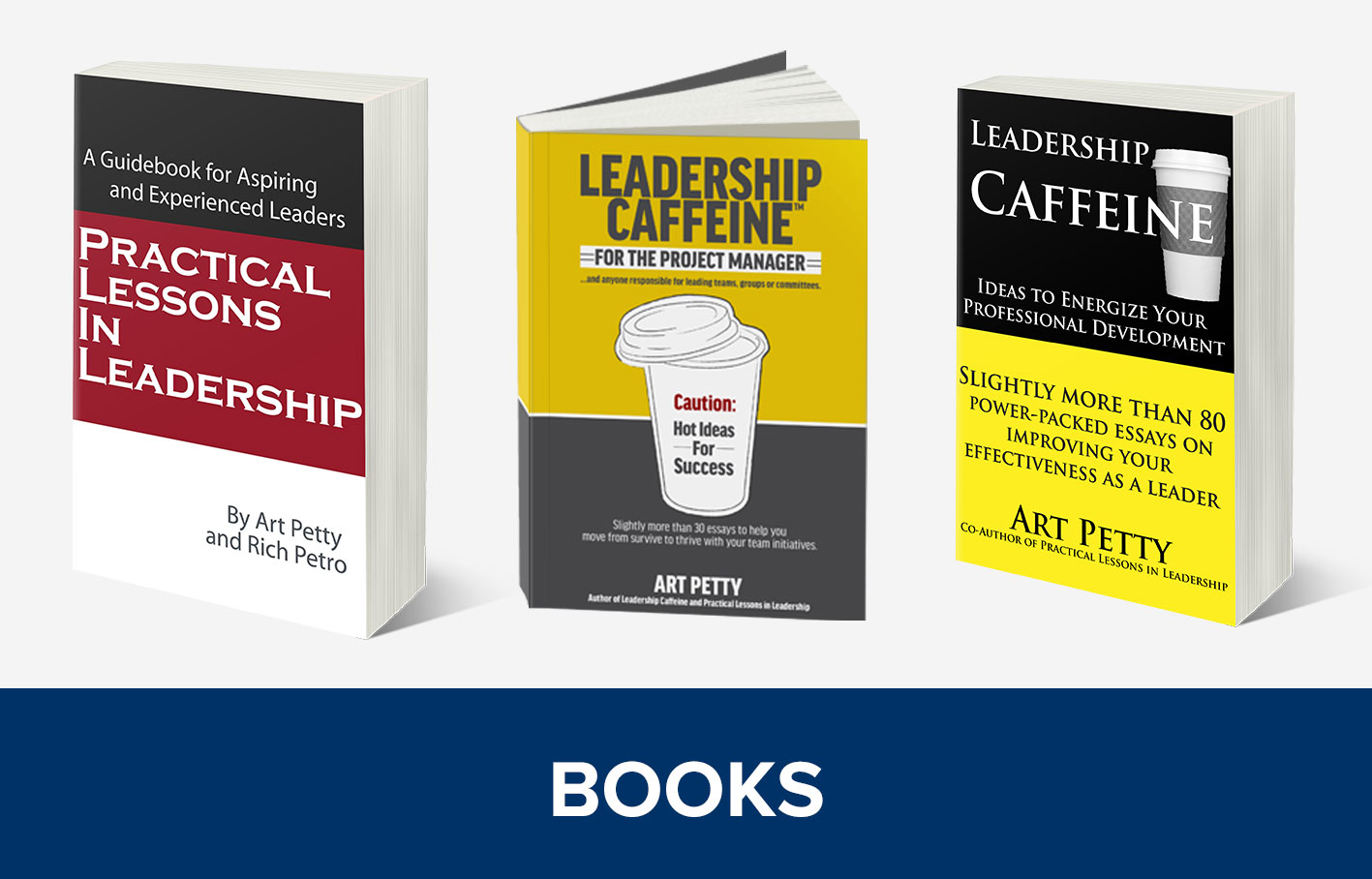
My Forthcoming Book: Leadership Caffeine-Ideas to Energize Your Professional Development

Created very much in the spirit and format of Kawasaki’s Reality Check, Leadership Caffeine draws upon 90 essays here at Management Excellence, but does it with a twist.

The essays are all edited, annotated and importantly, organized in sections ranging from, “Surviving the Tough Days,” to “In Pursuit of Greatness,” to “Building and Leading High Performance Teams”, “Developing Yourself” (and 8 other sections) for your instantaneous, at-a-glance jolt of ideas and energy.

My goal is for this book to become a valued and frequently referenced (and wildly highlighted and dog-eared” part of your practical leadership and career library. Availability: Summer, 2011.


Art Petty coaches, trains and speaks on leadership development, high performance team development, feedback and decision-making. Drop Art a note to talk about a workshop program, speaking need or coaching opportunity.

Management Week in Review for March 26, 2011

March 26, 2011 by · 1 Comment
Filed under: Career, Leadership 

Note from Art: every week, I share three thought-provoking management posts for the week. Fair warning: I take a broad view of management, so my selections will range from leadership to innovation to finance and personal development and beyond.

This week’s selections feature content on hard working CEOs, the importance of stories as tools for persuasion and the difficult choices people are facing in some toxic workplaces.  Enjoy!

From Steve Tobak writing for BNET at The Corner Office, CEOs are Just Like You -Without All the Whining. Tobak offers a rare defense of the many hard-working CEOs who frequently get bashed in our office water-cooler conversations. I’ll echo his advice: “Quit whining!”

From the post: “You’d think CEOs were born with the title, like royalty. Or they just fell right out of the sky into a cushy corner office chair. Nothing could be further from the truth. Many, if not most, CEOs started with nothing. But instead of whining, they took responsibility for their careers, worked their tails off, and made it.”

From John Baldoni writing at HBR Blogs, Using Stories to Persuade. We like to hear stories and we remember them.  John appropriately reminds us of the power of telling stories in our attempts to leave an impression or make a point.

From the post: “Effective storytelling can serve anyone in leadership who seeks to persuade others to his or her point of view. Opinion-based rhetoric is often more polarizing than persuasive, while statistics are often go in one ear and out the other. But a careful blending of rhetoric and facts, woven into the right story, can change minds.”

From Jennifer V. Miller writing at her blog, The People Equation, Flying Without a Net. This is the first time for Jennifer in my Weekly Review, and I look forward to making up for lost time.  Her insightful, positive and people-focused posts are must reading.  In this particular essay, she raises the challenging issue of workplace atmosphere, emotional well-being and the difficult choices some people feel compelled to make to retain physical and mental health.

From the post: “Have workplace conditions gotten so bad that people are willing to leave even when they don’t have the “safety” of a new job?  Just how bad does it have to get for someone to fly without a net? Is there anything human resource professionals can do about it?”

Enjoy your weekend. Back next week with more Leadership Caffeine!

Art Petty coaches, trains and speaks on leadership development, high performance team development, feedback and decision-making. Drop Art a note to talk about a workshop program, speaking need or coaching opportunity.

Guest Post: The Trouble with Leadership By The Numbers

March 23, 2011 by · Leave a Comment
Filed under: Leadership, Performance 

Note from Art: I’m pleased to share the thoughts of Scott Spreier, head of the Leadership and Talent Practice in the Federal Sector at Hay Group, a global management consultancy.  I was a happy customer of Hay Group in a prior lifetime, where they provided my team with valuable input and guidance on a complex and fast-moving sales restructuring.  I am pleased that they reached out to share this thought-provoking post exclusively with readers of Management Excellence. Enjoy!

You can follow Scott and his colleagues on Twitter @ Hay Group.

The Trouble with Leadership by the Numbers by Scott Spreier, Hay Group

Ah, those geeks from Google.

After months of crunching numbers, a team of their top statisticians cracked the code on what it takes to be a good leader.  Their finding, as reported by The New York Times, was that what employees valued most in their managers was not technical expertise but “even-keeled bosses who made time for one-on-one meetings, who helped people puzzle through problems by asking questions, not dictating answers, and who took an interest in employees’ lives and careers.”

Now, is that surprising?

A few paragraphs into the story, the Times’ turned to human resource experts to help put Google’s research into context.

They quoted Todd Safferstone, managing director of the Corporate Leadership Council of the Corporate Executive Board, who noted that Google is at the “leading edge” of trying to apply a data-driven approach to what the Times calls the “unpredictable world of human interactions.”

Project Oxygen, as the research was named, is unusual, Safferstone says, because it is based on Google’s own data, which means that it will feel more valid to those Google employees who like to scoff at conventional wisdom.

Two observations here: (1) We (the HR experts of the world) are a sincere, but dull lot whose lingo about leadership is indeed often limp; and (2) it is this habit of sounding warm and squishy, not hard and businesslike, which drives organizations like Google to try to create leadership by the numbers.

The truth is, for more than 50 years researchers, particularly behavioral scientists, have been studying and linking these so-called softer attributes of leadership to performance. At Hay Group, we’ve done numerous studies that tie the hard stuff of business − gains in productivity, revenue, and profits − to the human stuff of leadership, such as providing vision and context, showing empathy, and engaging, coaching, and developing employees.

In general, our body of research has shown that when managers and executives use a good combination of these behaviors or styles, the performance of their teams − again in terms of measures like sales, productivity, and even revenue − tends to jump 15 to 30 percent.

That Google had to rediscover this, however, is not cause of smugness or ridicule. Like most organizations and the people who run them, it’s human nature to try to succeed by the numbers. All of us, not just Charlie Sheen, want to win. And winning in our society is defined by the specific, not the squishy: scoring more points, putting up better financial numbers, the number of goddesses one lives with, etc.

David Brooks, in a recent column, The New Humanism, blamed this in part on the fact that we view ourselves as “divided creatures” who try to separate reason, which we trust, from emotions, which are suspect.

“We emphasize things that are rational and conscious and are inarticulate about the processes down below,” he wrote. “When we raise our kids, we focus on the traits measured by grades and SAT scores. But when it comes to the most important things like character and how to build relations, we often have nothing to say.”

And, we might add, when those parents and kids go to work, their focus switches from SAT to ROI.

What our research and Google’s show is that organizations need to put more emphasis on the softer behavioral attributes of leadership. They need to move beyond what Brooks calls the “amputated view of human nature,” and embrace the role that motives, values, and behavior have in engaging people to do their best and ultimately driving performance.

Equally important, they have to let go of this nonsense about technical skills and financial results being the perfect equation for running a successful organization. Certainly they are critical elements, but as Google has confirmed, leading solely by the numbers is not only bad science, it’s bad business.

Next Page »

  • Art Petty

    picture of Art Petty

  • e-Newsletter Sign-Up


  • Lead Change Member

Blog Subscriptions

Email:

RSS Feed Subscribe to Management Excellence

Connect With Me On

View Art Petty's profile on LinkedIn
Art Petty on Twitter