Art Guest Posts at Lead Change, My Next Book & Other Updates

My Guest Post at Lead Change:

I confess to focusing a great deal recently on the future of leadership. This was evident in my guest post, “The Great and Perilous Leadership Journey Ahead,”at Tanveer Naseer’s site, and in today’s essay, “Leadership Guidance for Our Children.” at the Lead Change site.

The momentary pre-occupation with a future view on leaders and leadership development is driven in part by watching my sons grow up into responsible young men in front of my eyes, as well as from the insights and lessons shared of a number of early career leaders via workshops and classroom settings.

If you’re responsible for the development of others, you’ve got a big job in front of you. Let’s all get it right and we can contribute in our own way to improving the odds for those coming up behind us.

Speaking of Leading Change:

There’s a fascinating new group that is gaining critical mass, called Lead Change. I’m proud to be a participant in the process and to be allied with some of the sharpest and most dedicated leadership professionals (coaches, consultants, writers and those just passionate about the topic).

Lead Change brings together professionals from all walks of life dedicated to the proposition of extending, teaching and reinforcing Character Based Leadership. Without being preachy, this is a group of professionals that stand for The Right Stuff in leading and in developing talent.

The initiative, facilitated by Mike Henry Sr. (@mikehenrysr on twitter)  is spreading and growing. Check out the site, subscribe to the blogs and consider and check out the ways that Mike and team have created for you to get involved and start the networking on character-based leadership.

Happiness, Kind of, Is a Completed First Draft of My Next Book!

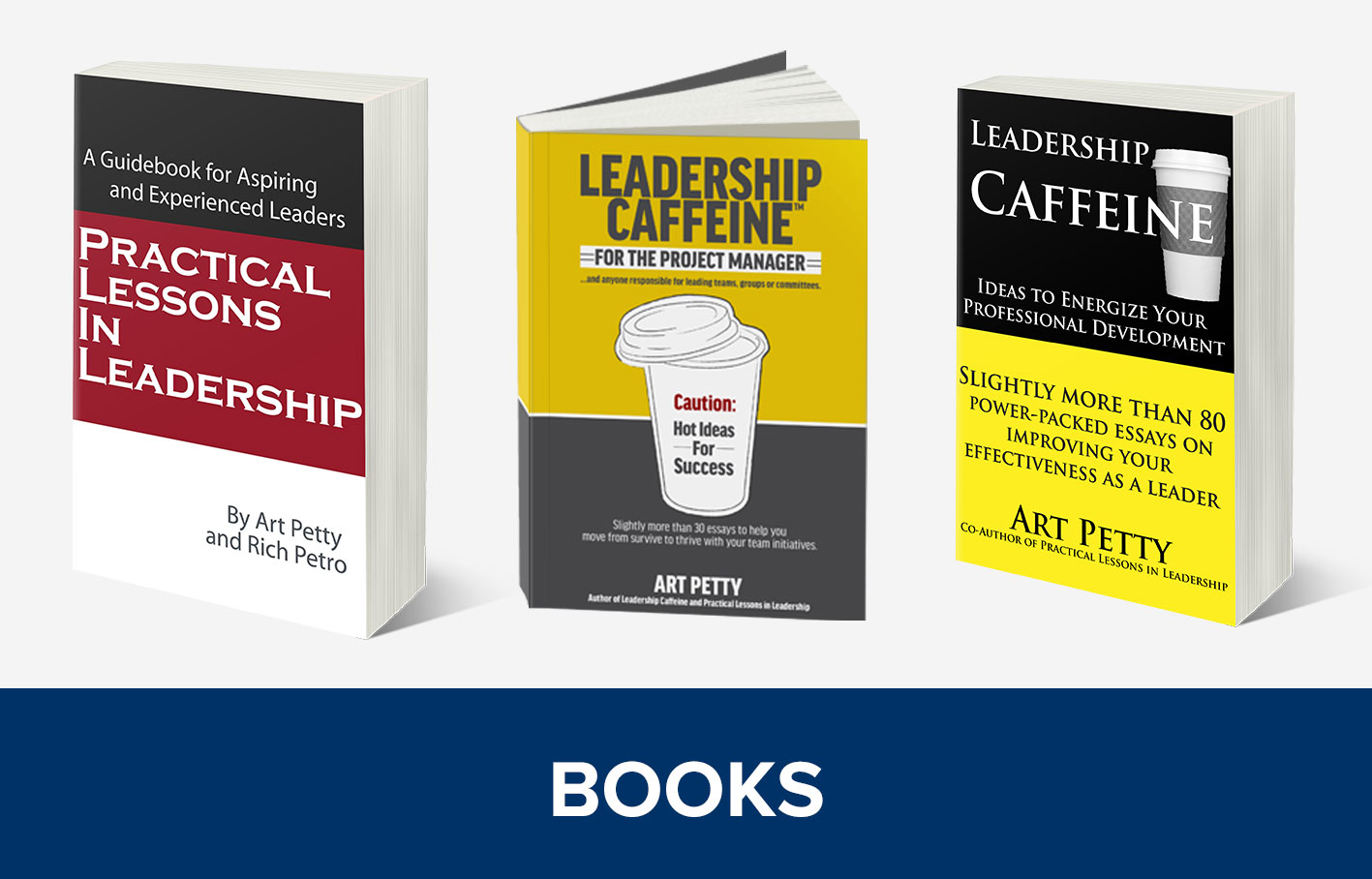
The “kind of” part is an acknowledgement that there are some painful, soul-searching hours of tough editing ahead on my latest book, Leadership Caffeine: Ideas to Stimulate Success and Help You Kick A** in Your Career. (OK, the Kick A** part may not make the final cut, but it reflects the passion I have for helping people get an edge.)

Stay tuned for tasteful updates, snippets of the content, and what I expect to be a fun and exciting build-up to the targeted March or April publication.

Oh, and since I’m future oriented, for my next effort, I plan on extending my e-book, Leadership and the Project Manager into a full book, complete with a lot of new content and case studies. The e-book form has been downloaded many thousands of times, and this issue of managing without formal authority, while owning the results for major projects is one that merits a lot more attention. However, one thing at a time. Sort of.

Many, Many New and Great Resource Links on the Sidebar..More New Content Coming:

One of my favorite ways of discovering great thought leaders and inspirational writers is to mine the links/blogroll sections of writers that I enjoy.

It’s funny how sharp and interesting people tend to find other sharp and interesting people to recommend. While stopping short of describing myself as either sharp or interesting, I can assure you that my Links list includes people you absolutely want to know.  I’ve refreshed the listing considerably and will be attacking my book recommendations and many others over the holidays.

If you know someone that you believe others would benefit from in the areas of management, leadership, marketing, drop me a note or leave a comment with your suggestion!

OK, it’s time to quit writing. I’ve got a son to retrieve from college for winter break. Back soon! -Art

Leadership Caffeine: How to Appropriately Respond to Positive Praise

It’s easy to start believing the praise you hear in the hallways about your leadership approach. Easy and dangerous.

I’ve always been leery of the unfounded and saccharine-sweet praise that is bestowed upon leaders. While you may call me cynical, I prefer to think of myself as pragmatic.

Praise goeth before the fall:

Your employees may genuinely like and respect you however, the best measure of your performance is not their praise for you, but rather, it’s their performance on your team.

We like to hear nice things about ourselves, and employees are quick to figure out that you respond positively to their praise. If there were an Office Olympics, Boss-Praise would be a major medal category. If there’s even the remotest evidence that you respond favorably to subtle or blatant sucking up, I guarantee that you’ll be buried under an avalanche of false praise. You need to maintain objectivity at all times. A hunger for praise will compromise that objectivity.

You start over and earn your leadership credibility every single day. Start believing your own press clippings and you’re likely to back off of your own performance accelerator. Take the praise too seriously, and you’re likely to back off the accelerator, pop the performance gear into neutral and start coasting. Downhill.

As for the boss offering up praise for your work, we really love to hear it. However, knowing that most managers struggle to deliver the constructive kind of feedback, the positive praise may very well be a misguided attempt to manage you by feeding your ego. It’s easier to make you feel good than it is to highlight specific instances where YOU need to improve.  And yes, many, many managers will dispense general positive praise only, due to their fear of offering effective constructive criticism.

Five Ideas for Coping with Positive Praise:

Yeah, I know. The words are nice to hear. They help you define your own sense of self-worth. We all want to be appreciated.  There are some good habits in coping with positive praise, including:

1. Always receive praise graciously. In spite of my apparent cynicism on this topic, it is possible that the praise you are receiving is genuine and heartfelt.

2. Look for the nuggets that explain what you did that merited the praise. You want to find the behaviors that are appreciated and reinforce them in your daily activities.

3. Teach people through your response to praise. In an environment where it appears people are seeking favor through praise, politely counter with statements like, “Thank you. Now, what is it that I can do better to help this team succeed?” After a few rounds of those, people will begin to understand that you don’t respond to disingenuous praise, and importantly, they will see that you are truly focused on improving your daily performance. That attitude and habit is infectious.

4. Put a positive-praising boss at ease by seeking out the constructive feedback. Once you clearly communicate that you genuinely like the constructive input, the boss’s fear of feedback may melt.

5. Teach your team how to dispense proper positive praise. Liberally dispense positive praise of your own. Ensure that it is behavioral and tied to the business.  Your team members will quickly catch on to the pattern.

The Bottom-Line for Now:

Always remember that you’re not working for praise, you’re working for results.  Measure your success not in the words of others, but in how well your team members succeed and grow as professionals. Experienced leaders know that the highest form of praise that they can receive is watching those that they’ve supported go on to successful roles and careers. And every once in awhile, someone will look back and say, “Thank you.” Now that’s praise that you can take to heart.

Management Excellence Book Review: Management? It’s Not What You Think

I confess to having a proclivity for essay collections when it comes to reading about management. Essays move along quickly and they offer the reader the opportunity to capture quick sound bites over breakfast, on the train or in other ideal reading rooms.  Also, there’s the reality that many management books struggle to adequately fill the space between the book-covers, offering up their best in the introduction, the first chapter and the wrap-up chapter.

Irreverent, Funny and Pointed with a Point:

I enjoyed the often irreverent, frequently amusing and always thought-provoking collection of essays in: Management? It’s Not What You Think, by Henry Mintzberg, Bruce Ahlstrand and Joseph Lampelis.

Like watching the popular show, The Office, reading many of these essays induces a cringe factor. The situations are a bit too close to reality for our own comfort, and we can see and hear ourselves and others in similar situations.

I laughed out loud while reading, Accenture’s Next Champion of Waffle Words, which unabashedly tackles the issue of our abuse of the language with business-speak…meaningless jargon wrapped in layers of B.S.

Other essays that induced laughter and agreement included: PowerPoint is Evil, Maxims In Need of a Makeover, and A Long Overdue Letter to the Board. Oh to meet a senior executive capable of writing that letter!

Mintzberg is known for his discomfort with contemporary MBA education (a view that I share), and his essay, Managers, not MBAs, strikes a blow for experience and immersion in the business over the stripes that we confer in the classroom.

Some Important Ideas Between the Covers:

And while there’s a decidedly irreverent tone concerning the traditional practice of management and leadership, the editors and authors serve up some important and thought-provoking ideas.

In the essay, Change Management, the author skewers the “dubious consulting industry and profession claiming to provide change management services.” The author offers, “Change can’t be managed. Change can be ignored, resisted, responded to, capitalized upon and created. But it can’t be managed and made to march to some orderly step-by-step process.”

Mintzberg’s essay, “Managing Quietly,” is a fitting capstone, based on the premise, “Quiet management is about thoughtfulness rooted in experience,” and, “…the best managing of all may well be the silent.”

The book is organized in 9 sections (including that ever-valuable, Introduction section) ranging from Misleading Management to Management of Meaning, Myths of Managing, Maxims of Managing, Managing Modestly and several others.

The Bottom-Line for Now:

If this were a movie review, I would be more positive than negative.

This collection of management essays is ideal for anyone on your list that is a thoughtful practitioner and student of the craft of management. The reader will enjoy the lighter moments as well as the irreverent pokes at much of what passes for contemporary management thinking and practice.

I’m not certain that there’s content in Management? It’s Not What you Think!, that will alter anyone’s view or drive new actions and cure old ills, but for those looking for reassurance that we’re all living and working in a universe that parallels “The Office” a bit too closely, this is entertaining and stimulating.

Management Excellence Book Series: Six Disciplines Execution Revolution with Gary Harpst

I started this book series to share the insights and approaches of some truly sharp people on solving vexing business problems. This particular interview with Gary Harpst, author of,  Six Disciplines Execution Revolution and the earlier Six Disciplines for Excellence, taps into Gary’s hard won, practical experience and his great ideas on helping small and mid-sized businesses deal with strategy execution.

On a personal note, the discussion, while remaining true to the strategy execution topic, ranged fairly far beyond the borders of the book. Talking with Gary during this interview was like engaging with the wise, thoughtful and helpful business advisor that we all wish we had. Gary offers experienced based, actionable ideas on improving business performance through great execution, that we can all put to use immediately.

Gary’s premise for his “Business Excellence Model” is described in the book as:

  • “Excellence is the enduring pursuit of balanced strategy and execution.”
  • “Planning and executing, while at the same time dealing with the inevitable surprises, is the biggest challenge in business.
  • “Overcoming this challenge is what we mean by “solving the problem that makes all others easier.”
  • “Failing to solve the problem destines your organization to a reactive, fire-fighting future.

During the podcast, we talk about the different stages/phases found in the “Business Excellence Model,” and reference the four-box matrix pictured here:

Enjoy the podcast and this unique opportunity to learn from someone that has lived what he is talking about from the business-owner’s side of the table, and now helps clients realize success by guiding them on effective strategy execution.  I’m thrilled to feature Gary Harpst and his important thoughts on strategy execution here in the Management Excellence Book Series!

Note from Art: I purchased the book, Six Disciplines Execution Revolution on my own and have no commercial motive for sharing this podcast and linking to Gary’s website. The Management Excellence Book Series podcasts are intended to share thoughts from leading figures in business and management writing.

10 of My Favorite Dumb Ass Management Mistakes

Rear view of a brown horse. Note 1 from Art: this one is rated something or another for strong language and emotional intensity.

Note 2: In the spirit of my post, At Least 20 Things to Stop Doing as a Leader,” which has grown well north of 50 thanks to a deluge of reader comments, I’m back with a list of some insanely stupid and all-too-common management mistakes. These focus more on the decisions, actions or inactions that contribute to creating even bigger problems. While I’ve remained on the positive side of the law here (felons, you’ve had your day!), some of these mistakes are truly criminal. Please feel free to chime in with your additions.

1. Locking the corporate strategy in a drawer. Hey, I’m all for security, but this wasn’t just protecting important documents. This executive didn’t bother to share the strategy with employees either. It was a secret.

2. Not rolling out the sales compensation plan until late March. The sales team was on a calendar year. Hmmm, what did everyone do for Q1?

3. This one is epidemic…sucking the value out of an acquired company by folding, spindling, mutilating, disrespecting, vanquishing and otherwise conquering and plundering the target. We’ve got a mountain of evidence of this, and still, dumb a@@ executives focus on the deal (the easy part) and forget the real work of properly and positively managing the new relative. Welcome to the family! Now bend over and cough.

4. Looking for cause in the effect. This is a daily occurrence in many businesses, where managers run around trying to explain the drivers behind company, competitor and market outcomes. “Hey, our competitor keeps putting up great numbers. They’ve gone to a formal dress code at the office. It must be the clothes.” OK, that’s a little far-fetched, but I double-dog dare you to find a few instances of misguided cause and effect in your workplace today.

5. Losing sight of the core issues in the heat of argument. The decision making process is complex. Add in a group of high powered and big ego managers and you’re certain to be pressured into a dumb a** decision. My favorite evil tactic, “Take of your (insert function) hat and put on your business hat.” You might as well have a lobotomy prior to making that decision, because that’s what your evil counterpart is essentially asking you to do.

6. Letting marketing define its own key performance indicators. Hey, I’m a lifetime marketer, and I still rankle at this one.  If the marketing activities don’t specifically connect to the key levers that move the business forward, they are interesting to some but useless to many.

7. Sliding down the slippery slope of consensus decision-making. Everybody doesn’t get a vote unless we’re talking about ordering pizza. We’ve all seen the cartoon that indicates in a series of panels what various functions wanted in a new product development effort. The Rube Goldberg outcome looks nothing like what the customer wanted. Start looking for the moves away from smart and good in the consensus-based decisions on your teams. It should frighten you.

8. “It’s sunk cost. We can’t worry about what we’ve spent, we need to keep moving forward.” Ha! This rationale has derailed careers and destabilized nations. For the love of all this is good in humanity, quit burning money when all the signs say “Stop!”

9. Daily occurrence in this economy: failing to acquire the right talent because of cost controls. Yeah, let’s fix this one once we’re making money! (For 20 bonus points, identify the insane and inane thought processes that went into that last statement.)

10. Annual occurrence: putting a group of managers in a room one time per year and expecting that out of the collective group grope, market winning strategies will emerge. “Hey, great meeting. See you next year.” We’ll maybe…unless our competitors leave us for global road kill.

The Bottom-Line for Now:

The common denominator in all ten of those very real mistakes is that they are controllable. We can decide to not make these mistakes. The sales comp plan can hit the street with the new year. We don’t have to throw good money after bad, and we don’t have to engage in practices like the annual strategy planning retreat (it’s a process!) that are just stupid. If you can’t go out and get the talent that you need now with what’s walking around on the street, you’re either not trying hard enough or you need to find some other people to work for.

Instead of thinking deep thoughts about making good decisions as part of your New Year’s Resolutions, why not resolve to simply not make the same bad old decisions over and over again. Now that would be progress.