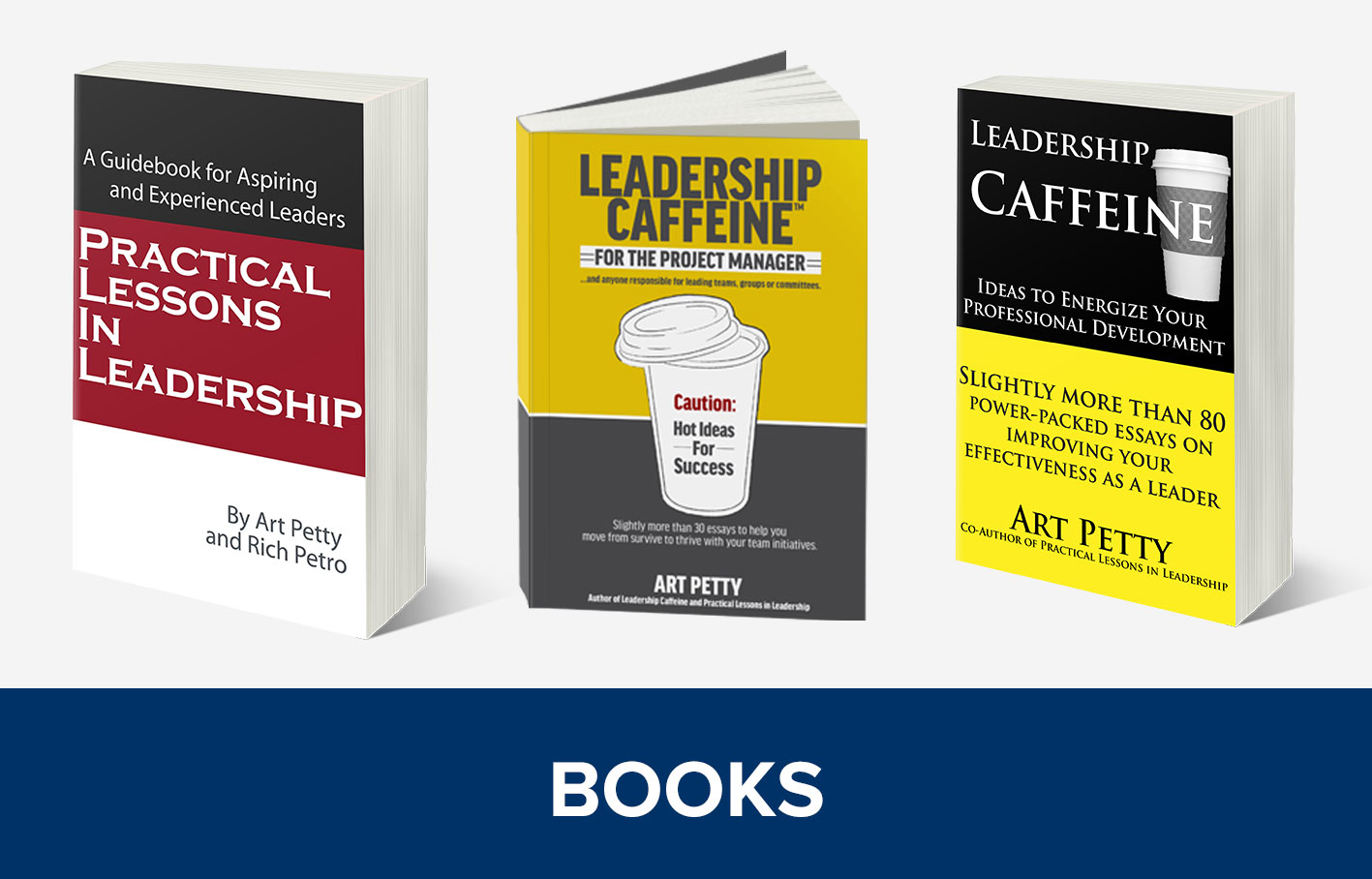
Leadership Caffeine: Strengthen Your Leadership Foundation

The best leaders in my opinion are guided by a strong sense of duty and responsibility. The individuals that succeed in motivating, inspiring and even changing the lives and careers of others operate with an underlying philosophical foundation that they draw upon to remain focused and steadfast in pursuing their daily activities.

Everyone else sort of wanders through the leadership woods, reacting more on instinct than acting as if they are being guided by a stronger sense of purpose and duty.

First-time leaders wander a great deal, often because they are thrust into the very difficult role of a leader without much more than a pat on the back and a disingenuous “let me know if you need any help.” Others get a two-day training class and a binder of materials that sit on the shelf in their offices for the next few years.

Mid-career leaders that survived those awkward first few years often settle into a pattern that includes guiding people on tasks and managing to minimize their own personal risk.

In both cases, the cost to our organizations is huge in real and in psychic terms. Floundering first-time leaders create tremendous disruption and take a significant toll on the unwitting victims around them. Mid-manager malaise sucks the energy and life out of a team and entire organizations, resulting in an employee culture where everyone seems to be walking around with their feet encased in concrete.

Unfortunately, I see far more concrete-encased teams and managers and floundering first-time leaders than those guided by a clear sense of duty and responsibility. I also hear from a lot of people that are caught up in those traps seeking a way out.

The good news is that many express a desire to change. First-time leaders would rather succeed than flail and a great number of people that have had the leadership life sucked out of them would like to renew and re-energize their careers.

One of the activities that I encourage those interested in changing and improving is to craft some form of personal philosophical statement that will guide and serve as a frequent reminder as to their true role. I have my own, and I call it The Leader’s Charter.

I’ve written about this before. It’s one of those topics and one of those important tools that bears repeating. The Charter helps remind me of my True North as a leader and allows me to align my priorities properly when I feel them drifting in the face of the urgent-unimportant. My version reads as follows:

Art’s Personal Leader’s Charter:

My primary role as a leader is to create an environment that:

Facilitates high individual and team performance against company and industry standards

Supports and promotes innovation in processes, programs and approaches

Encourages collaboration where necessary for objective achievement

And…

Promotes the development of my associates in roles that leverage their talents and interests and that challenge them to new and greater accomplishments.

I developed this as a younger leader and refined it over time based on my own experiences…both the successes and the failures. The words are noble and the thoughts lofty, but every word and phrase has a very distinct meaning for me in my leadership life.

I anchor on creating the effective environment as a core priority; never lose track of the fact that my firm is looking for performance and innovation and last and most important of all, I remind myself that my highest and best use is to help others develop.

The Charter has served me well.

Perhaps you know someone that is earnest in their desire to improve and hungry for something that will give context to their activities as a leader. Encourage them or help them create their own Charter. Use mine or parts of mine if it fits, or create something new from the ground up.

And when you or they are finished, put the charter in a place of prominence to both remind you of your role and priorities but also to show others how you view your role and what they can expect from you as a leader.

The words are important but of course, they are the easy part. The real payoff comes in striving to live up to Your Leader’s Charter.

Collaboration and the Leader

Many leaders are lousy collaborators.

It doesn’t seem to matter that they spend a great deal of time encouraging, coaching and facilitating collaboration between their team members and across functional boundaries. When it comes time for Leader A to work with Leader B on something other than getting other people to do things, the dynamics get interesting and the output is often disappointing.

I’ve had somewhere between five and ten great, collaborative experiences with other peers during my two plus decades of leading teams. I’ve had considerably more experiences where the efforts ultimately ground to a halt.

While I have to factor in the very real possibility that I might just suck at collaborating, I look at those that worked as some of the most formative and enjoyable experiences of my career. They also resulted in remarkable value creation for our firms in the form of business and market strategies, talent development, organizational design and development and new venture planning.

My unscientific observations on why leaders often fail to collaborate effectively with other leaders are as follows:

  • We forget how to work or, at least we forget how to do work that results in output other than talking. I observe this a great deal during strategic planning activities, where senior leaders have a seat at the table, but when push comes to shove on tangibly contributing, you can feel the breeze from the speed that they delegate the work. I noticed this myself as I moved out of the corporate and team environment into the life of a soloist. “What do you mean I have to write all my own web copy?”
  • We irrationally view collaboration as weakness. Many leaders are inherently uncomfortable relying on someone else to supply input. While not an admirable trait, it is a common one. Leaders incorrectly believe that they are in their positions because they know the answers. Working with someone and task sharing or accepting the ideas of others as better than their own is a challenge to their overly inflated egos.
  • The CEO does not create a culture that requires and promotes collaboration at all levels. Often, the CEO works with his/her subordinates one on one rather than as a team. The subordinates become conditioned to working directly with the decision maker and are out of their element when asked to do something as unconventional as work with a peer to create and to solve problems.
  • It’s a power thing. Back to the weakness topic, but with a twist. One interaction that I had with a smart individual (peer) failed to materialize in spite of several years of genuine attempts on my part to find common ground. At the end of the day, it was clear that he viewed any joint work that impacted his functional area as a threat to his power. It didn’t help that he had one of his key lieutenants that saw this as well and fed his paranoia.

What’s a Leader to Do?

  • Get over yourself! It’s a lean, mean world right now, and the better you are able to find ways to participate in value-creating activities with the leaders around you, the better off your firm will be.
  • CEO, build in accountability for collaboration. We do what we are paid to do and what we are measured against. Create appropriate shared performance indicators and objectives, and put some teeth in them. While the initial efforts might look like compliance, some successes will breed increasing cooperation.
  • Focus on creating collaborative activities around items that impact customers directly or at least impact a firm’s ability to serve customers in a tangible way. Instead of two leaders charged with fixing what’s broken about their departments, focus on getting the leaders to create something that is all about the customer. The internal fix-it activities will start to occur in support of the broader and more noble and neutral initiative.
  • Re-learn how to work. Pick a solo project that doesn’t immediately require you to delegate and execute on it. Develop and deliver a keynote, write an article, volunteer for a webinar or focus on improving relationships with your counterparts at your customers and partners. Don’t step on your team members toes and don’t making them crazy with your personal initiatives, but definitely do something that requires you to generate output. You’ll be better prepared to do the same when it comes time to collaborate with a peer.

The Bottom-Line for Now:

In my own experience and as an observer in client firms, the situations where the collaborative efforts between leaders worked, produced great results. Problems were solved, the working environment for everyone improved and value was created in the process. CEOs and senior leaders would be well served to look around the table and find a reason to start working together more effectively.

The Seven Critical Conversations of Great Firms and Great Leaders

You learn a great deal about an organization’s current state, near-term prospects and about the health and effectiveness of a firm’s leaders by looking for and listening to the quality of the conversations in the working environment.

Visit and spend time with the people inside an organization that is climbing, growing, reaching and striving for new heights, and you observe that the conversations take on a consistent, high-energy, action focused tone. You also observe and hear constructive and even passionate debate around topics that other organizations and individuals would lack the courage to raise.

Switch sites and visit a struggling organization and you get the impression that the more that people flail, the faster the organization will disappear into the economic quicksand. The conversations, if there are any are stilted, leadership edicts are dictatorial and the person-to-person dialogue is fueled by fear and buffeted by rumor.

I see this constantly in my practice and I’ve observed it consistently over decades of private industry experience. The best firms and the best leaders hone in the right topics and teach their teams and organizations how to talk openly and comfortably about those topics. Easy words, but no small feat when you take into account the common barriers to open dialogue of politics, siloization and the seemingly endless supply of people that have no business being in leadership roles.

The Seven Critical Conversations:

There are at least Seven Critical Conversations that I observe taking place over and over again in organizations that that are either successful or improving. These same conversations are often nowhere to be found except perhaps behind the closed doors of a firm’s leaders in less successful firms or organizations that are struggling and sinking.

1.  Vision. Great firms make this often lofty and meaningless agglomeration of words under glass come alive and permeate the culture of a firm. The “V” word instead of being consultant or MBA-speak is the source of energy for humans. It defines a goal, a championship; a destination that once arrived at will be a great accomplishment. Great visions…those that resonate are visions that inspire and challenge and motivate and help individuals and teams rationalize putting their hearts and souls into an enterprise.

2.  Strategy as an “All Hands on Deck” Action Statement!

While Vision creates context for the goal, strategy defines how we are going to get there. The books written on this topic fill entire shelves and many are brilliant in describing the tools and techniques, but most in my opinion miss the point.

Great, growing and successful firms leverage the tools of strategy to promote the right conversations across and up and down the organization. I’ve observed that the most vibrant of firms find ways to get everyone involved in strategy. At a bare minimum, the firm’s leaders ensure that everyone can connect their goals to the core strategies—the Walk In the Door test.

However, the real gold in creating the organization-wide strategy dialogue is in capturing the ideas that flow from so many parts of the organization that see ways to improve the customer experience and add important context to ideas and certainly how to translate ideas into actions and then provide feedback on the results and ideas for improvement. It’s a beautiful cycle of ideas execution, learning and adaptation.

3.  What Are the Leading Indicators?

The gross majority of firms measure and report on history, with little ability to look forward. The best firms get people involved inconstantly seeking to identify, hone and build processes around early and leading indicators.

A simple example is sales pipeline, yet that measure is often so isolated, convoluted and unreliable as to be nearly meaningless. Alternatively, firms that connect their lead system to their sales pipeline (much like a lead to sales refinery) and work hard to develop an increasingly reliable set of metrics that quantify changes and outputs, are a bit closer to having a reliable leading indicator. This is just one of many leading indicators that can be developed across functions that will tell you a lot sooner how things are going versus waiting for the quarterly financials, which are truly interesting but irrelevant for the future.

4.  What is the Customer Really Saying?

Good firms ensure that customer-facing associates have systems to collect and communicate feedback. Great firms ensure that there are people immersed in their customer’s environments, listening and observing and looking for the real problems.

A customer may complain about a particular product or request a certain feature, because their context for you is your product and your features. However, the right observation might uncover that your product and the feature is relatively insignificant compared to other unresolved problems that new products or services from your firm might well address.

5.  How Am I Doing?

Like a championship sports team where the athletes and coaches are constantly critiqued and critiquing, feedback must flow quickly, honestly and with expectations of accountability.

None of us are great judges of our own performance although we have a gut feeling as to whether we are in the ball game or not. Great cultures create an open feedback culture that requires the tough discussions to take place up and down and across the organization.

Easy words, but when was the last time you gave your boss or your peer in another department robust feedback? And then saw them do something with it?

6.  What’s Next for Me?

All of the above conversations are critical to creating a healthy work environment, but at the end of the day, we make very personal decisions on where and why we work and how hard we work.

The most successful leaders and teams ensure that there is a constant dialogue flowing about next career steps and that this dialogue is backed by actions.

Charan’s “Apprenticeship” model is a perfect metaphor for a vibrant development approach, except that Charan focuses it on finding the next CEO and I want to use it to test, assess and support the development of the people on my team or in my department. As a leader, there is nothing nobler, more appropriate or more valuable that you can do for a person than help them grow and develop. Some people resist that support, but most will be thankful to you for a lifetime.

7.  What did we do that made a difference?

This last conversation is a bit controversial even in my mind, but it strikes me as important to build a strong culture on layers and layers of achievements that give credence to what we can accomplish.

Firms that don’t talk about past successes and individual and team heroics feel to me like soul-less, heartless structures, whereas environments where the stories and heroes of the past are celebrated and used as models for the future seem so much more alive. This topic invites “Mission” into the discussion and shows how the collective and individual efforts lived up to “the reason for being” of the firm. I don’t want to dwell on the past, but our history is a powerful teacher and guiding force for our future.

The Bottom-Line for Now:

Long post and to me a fairly meaty topic. I would love your input, including your suggestions on whether I am on the mark or off the mark (in your opinion) on my set of “7” for the critical conversations. Passionate discourse encouraged!

Leadership Caffeine for the New Week: Power-Washed! Guest Post

Note from Art: I read Mark Raymo’s inspirational e-Newsletter, Light4theWeek, every Monday morning and enjoy it so much that I asked him if I could share it with my blog readers. Mark agreed and what follows below is one of my favorite shorts in his great and motivational weekly anecdotes and stories.

I first read this “Power-Washed” piece after coming off of a weekend of doing just that at my lake house. The annual rite of bleaching and power-washing combats the natural forces of mildew and pollen stains and restores the deck and cedar siding to pristine condition.

One of the challenge that many leaders face in their seemingly endless string of days of teaching, leading, motivating, supporting, challenging and guiding their colleagues is how to refresh and recharge. It’s an important topic and one that is under-represented (in my opinion) in the leadership literature, including my own.

It’s difficult to be “on” all of the time, and for leaders, the stress fractures show through usually in the form of snapping or growling at someone. While never good form, the momentary break from behavior is indicative of the need to take a few deep breaths or to even look towards tomorrow as a chance to start over and get things right.

Sometimes what’s needed is a good Power-Washing for the leader’s attitude and soul.

Power-Washed by Mark Raymo

“Each morning, at the start of the business day, I see the same sight.  Everyday.  One worker outside of a storefront with a power washer, spraying down the sidewalks with a powerful stream of water.  The motor is loud as it generates the water pressure needed to strip the sidewalk of all grime and mud from the day before.  With one powerful spray, all of the dirt is washed away, down the street into the drain.  With one powerful spray, the sidewalk is cleaned…like new.

It may sound silly, but that one routine scene always motivates me to start my day.  In a way, I feel like the sidewalk has a fresh start, a new chance…washed clean.  It reminds me of the newness and fresh start that I have before me…that I have a new day, a blank slate…a day that I can shape and mold in whatever way I wish.  Sure, there will undoubtedly be challenges and things that don’t go according to plan.  But each morning, the power washer comes out, and I get a fresh start to make it right.

This day, this week, was power-washed for you.  It’s a fresh start, to make whatever you want.  You can choose what you want to accomplish, who you want to spend time with, how you will react to each challenge.  And, don’t worry.  If today you get some grime and mud and dirt, the power washer will come out tomorrow.  And you’ll get a fresh start to make it right.  Each day, each week, we get a fresh start.  Make it count.

Keep shining.  And use your fresh start to be the light for your week.”

About Mark Raymo and Light4theWeek

Note from Art: Mark was a student of mine and a survivor of the first class that I taught at DePaul University’s Kellstadt Graduate School of Business. I am eternally grateful for his patience with my initial and mercifully now much more polished approach to graduate school instruction. Mark’s bio and information about his e-newsletter follow below. I’ve politely nudged Mark to turn this into a blog and hope that he will sometime soon.

Mark Raymo launched Light4theWeek in March 2009 as a small project to encourage those in his social network. Noticing many struggling with business and personal transitions, Mark saw opportunity to provide an encouraging quote, story, or learning lesson. What started as a small list of recipients has exploded to include many from all walks of life, industries, and states across the country. The purpose, however, has always remained the same – to encourage others to live their best life. A weekly email designed to be received each Monday morning, Light4theWeek has inspired many to do just that.

Mark has exciting plans for Light4theWeek moving forward. Plans to launch a website and blog feed are in motion, and Mark aims to formerly publish some of the issues. To join the Light4theWeek network and receive the FREE weekly emails, please send your contact information to raymo.mark@gmail.com. Also, please feel free to contact Mark simply to network or connect. Be the Light for your week…

Mark Raymo received an MDiv in Ethics and Non-Profit Leadership from Garrett-Evangelical Theological Seminary, and a MBA from DePaul University. He resides in the Chicago, Illinois area.

Fresh Voices: Two Posts that Can Improve Your Day and Your Life

Still reeling from my losing battle with the apologetic sales rep from Big Telco, I went searching for solace and inspiration from the many great writers that I follow. Two posts from two professionals in very different fields stood out as particularly thought provoking and inspiring.

Grab Control of the Negative Beliefs and Perceptions that Are Holding You Back!

The first, “How to Do (Almost) Anything and Feel Good Doing It,” is from Mary Jaksch of the Goodlife Zen blog. I featured one of Mary’s posts in an earlier Fresh Voices column a few weeks back, and I’ve made it a priority to keep current with her work.

As you might gather from the titles of the post and blog, Mary offers up inspirational and thoughtful content intended to motivate and encourage. In a world filled with an over-abundance of bad news and seemingly unconquerable challenges, we can all use a good dose of what Mary has to offer.

This “How to” post offers up some outstanding and thought-provoking ideas on grabbing control of our negative beliefs and preconceptions to start focusing on thinking and doing the right things. Mary offers a nice roadmap and some great advice for dealing with our demons, establishing goals and moving one step at a time towards those goals.

While you might be rolling  your eyes, thinking, “I’ve heard this all before,” I know more than a few people that are struggling in their personal and professional lives that will benefit from having Mary as a guide.

The Self-Development Power of Blogging:

The second post is entitled “9 Hidden Benefits of Blogging and comes from someone that I hold in high regard, John Jantsch of Duct Tape Marketing fame. John is the author of the great book, Duct Tape Marketing and he runs a successful business, website and coaching network that share that same name.

Note from Art: if you are in business, the book is a must-read and his website is chock full of remarkable resources and suggestions.

While one might think that the topic of blogging is old news, I still find that a good number of friends and family and way too many professionals that I encounter (all non-bloggers) either don’t understand the medium or don’t see the value of participating. Sadly, many of these individuals have some great insights to offer and the world would be well served by hearing from them. Many have lumped blogging into that uncomfortable category of something that people do in pursuit of over-night riches and instant internet fame. Those perceptions are very wrong.

John eloquently and convincingly highlights the professional and personal benefits that have accrued to him from a sustained approach to writing about marketing and business. This has turned out to be a powerful self-development tool for John as it has for me and can be for you.

John’s “9 Benefits” very effectively make the case that there is a great deal to be gained from challenging yourself to think big, write diligently and convincingly and sustain the effort over a period of time, whether you are doing it for an audience of 1 or 1 million.

Thanks to Mary and John for the great, thought-provoking and motivating posts!